

PC shipment growth: When does the pain end?


Updated 3 Nov 2026•4 min read

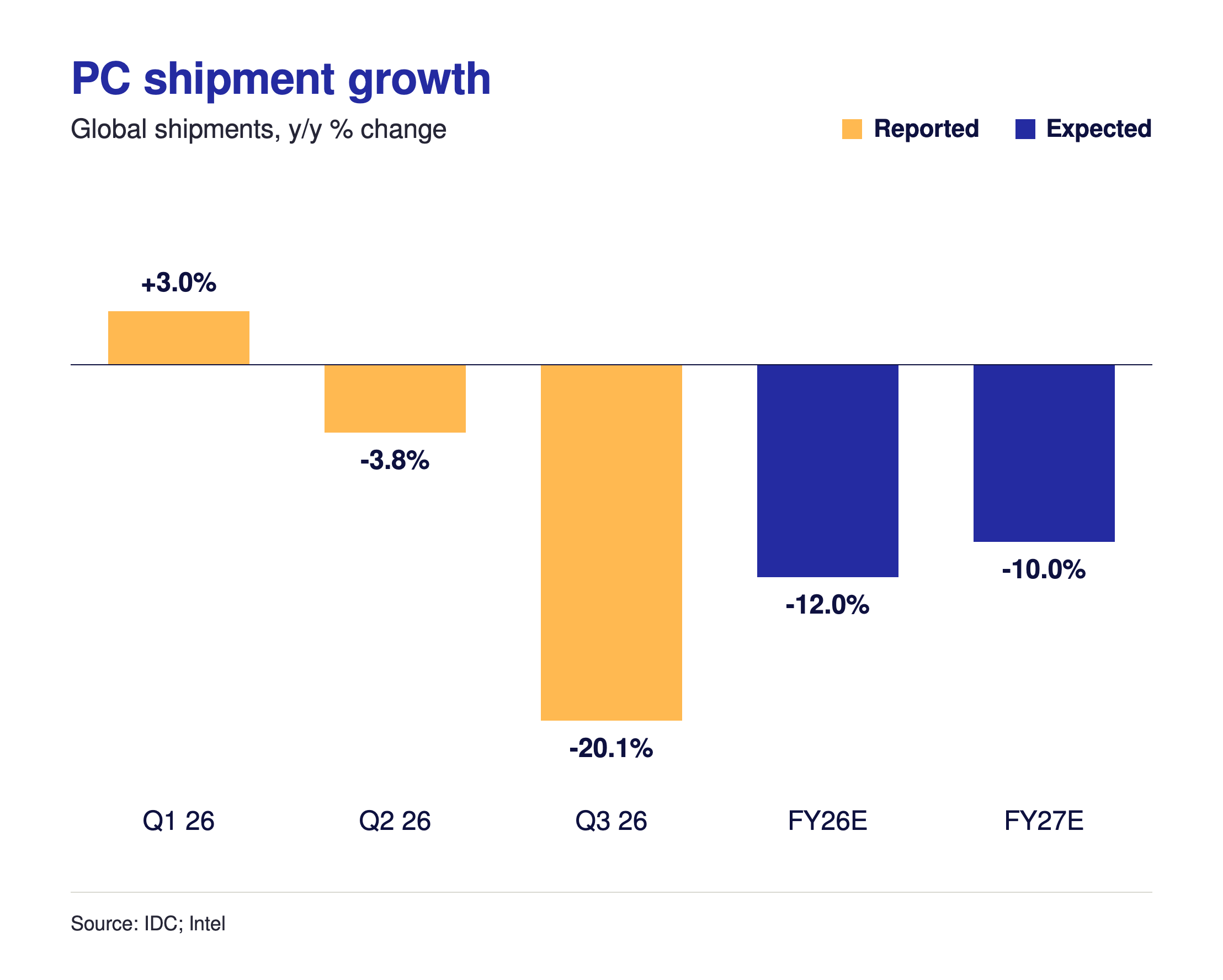
Intel reported its Q3 results last week, and the stock fell c.29% the next day (the stock’s worst single-day drop since 1974). This was in part driven by continued weakness in the global PC market, with IDC citing a 20% decline in PC shipments y/y in Q3 26. Company now expects PC unit market to decline c.12% in FY26 and a further c.10% in FY27, with the first half of 2027 the weakest.
Signals across tech
The warning showed up across earnings. Intel’s Client Computing and Physical AI group revenue fell 9% sequentially, with a further 20%+ sequential drop guided for Q4 as OEMs cut weeks of inventory to match softer sell-through, and the weakness set to persist until memory availability and pricing normalize. Microsoft's Windows OEM revenue fell 27% on inventory drawdowns and weaker PC demand, with a further mid-thirties revenue decline guided for next quarter for its OEM and devices segment. Logitech, which makes PC peripherals, described the same end-market softness. The company had previously raised prices in May to offset memory costs and warned that component shortages have spread beyond memory.
The shipment data
IDC put third-quarter shipments at 62.7mn units, down 20.1% year on year and 9.1% sequentially (the second straight quarter of y/y decline and well below the usual third-quarter build). The Windows majors took the brunt - HP down 30.9%, Dell 25.0% and Lenovo 22.6%, while Apple and Asus fell least at 11.3% and 8.6%, respectively. Apple was the standout on the revenue line: Mac revenue rose 24% to $10.8bn, with demand running ahead of a memory-constrained supply, even as it guided December-quarter margins down to 45-46% on higher memory costs.
What is driving the slowdown?
Constrained memory supply and consequent price hikes.
- As a reminder, the high-speed memory market is extremely concentrated, with 4 global manufacturers accounting for almost all the DRAM (Dynamic Random Access Memory) sold globally (including CXMT, which primarily sells in China).
- HBM (High Bandwidth Memory), the stacked memory that sits beside GPUs, is built from the same DRAM wafers as the DDR5 and LPDDR that go into PCs. As data center investments continue to grow, suppliers are increasingly redirecting a large chunk of the capacity towards data centers as these come with higher contract prices and long-term purchase commitments (Samsung now estimates c.30% of industry’s FY27 wafer capacity to go to HBM, vs 20% today).
- Further, industry leaders continue to advocate for even higher allocation of memory towards data centers, with the most recent call out by Open AI CEO Sam Altman. In a recent interview, he argued that such a scarce component is getting under-utilized in traditional PCs, and that data center allocation of memory should increase as they are used far more efficiently.
SK Hynix’s Q3 results further feed into the narrative
Management said its DRAM and HBM volumes are effectively sold out through 2029, with more than 50% of its 2027 and 2028 production capacity already covered by LTAs. Supply is growing, but demand is still far ahead of it. This continues to drive prices higher with TrendForce now expecting conventional DRAM contract prices to rise 10–15% quarter on quarter in Q4 2026.
Implications on broader tech stocks
With PC unit volumes expected to remain muted well into CY27, we believe growth will remain challenged for names that sell into this end market. The extent of the damage also depends upon the company’s positioning in the supply-chain of data centers, where demand remains strong.
- PC makers. HP is the most exposed, with PCs making up the bulk of its revenue and little AI server business to fall back on (though the softness in unit growth has so far been offset by higher prices). Dell and Lenovo face the same squeeze in PCs, but both are growing AI server sales, which cushions the hit at group level.
- CPU and software suppliers. Intel and AMD both sell PC processors, but AMD has a faster-growing data center GPU and server CPU business to lean on, while client remains a larger share of Intel’s revenue. Qualcomm’s push into Windows laptops also gets harder in a shrinking market. For Microsoft, Windows OEM is a small line next to Azure, so the hit, while visible, is contained.
- Peripherals. Logitech, GN Store Nord (Jabra) and Corsair have no direct data center offsets. While their businesses are not solely dependent on PC shipment volumes alone, certain segments of their businesses (notably enterprise headsets and peripherals at Logitech and Jabra, and DIY PC components at Corsair ) have historically shown positive correlation to PC shipment volumes.
- The other side of the trade. Memory makers Samsung, SK Hynix and Micron are the beneficiaries, as the same scarcity that weighs on PC volumes supports their pricing and margins.