


Game Theory: How Play Became Entertainment’s Biggest Business


Updated 19 Nov 2026•9 min read

What the year’s largest entertainment launch reveals about a $214 billion industry.
A launch as a lens
Grand Theft Auto VI went on sale on 19 November, thirteen years after its predecessor. Grand Theft Auto V has sold 235 million copies, a total surpassed only by Tetris and Minecraft, and its successor is widely estimated to be the most expensive video game ever made. By launch it had logged more than 17 million pre-orders, and Sony and Microsoft have each confirmed it as the most pre-ordered title in the history of their digital stores.
EXHIBIT 1 · THE BEST-SELLING VIDEO GAMES OF ALL TIME
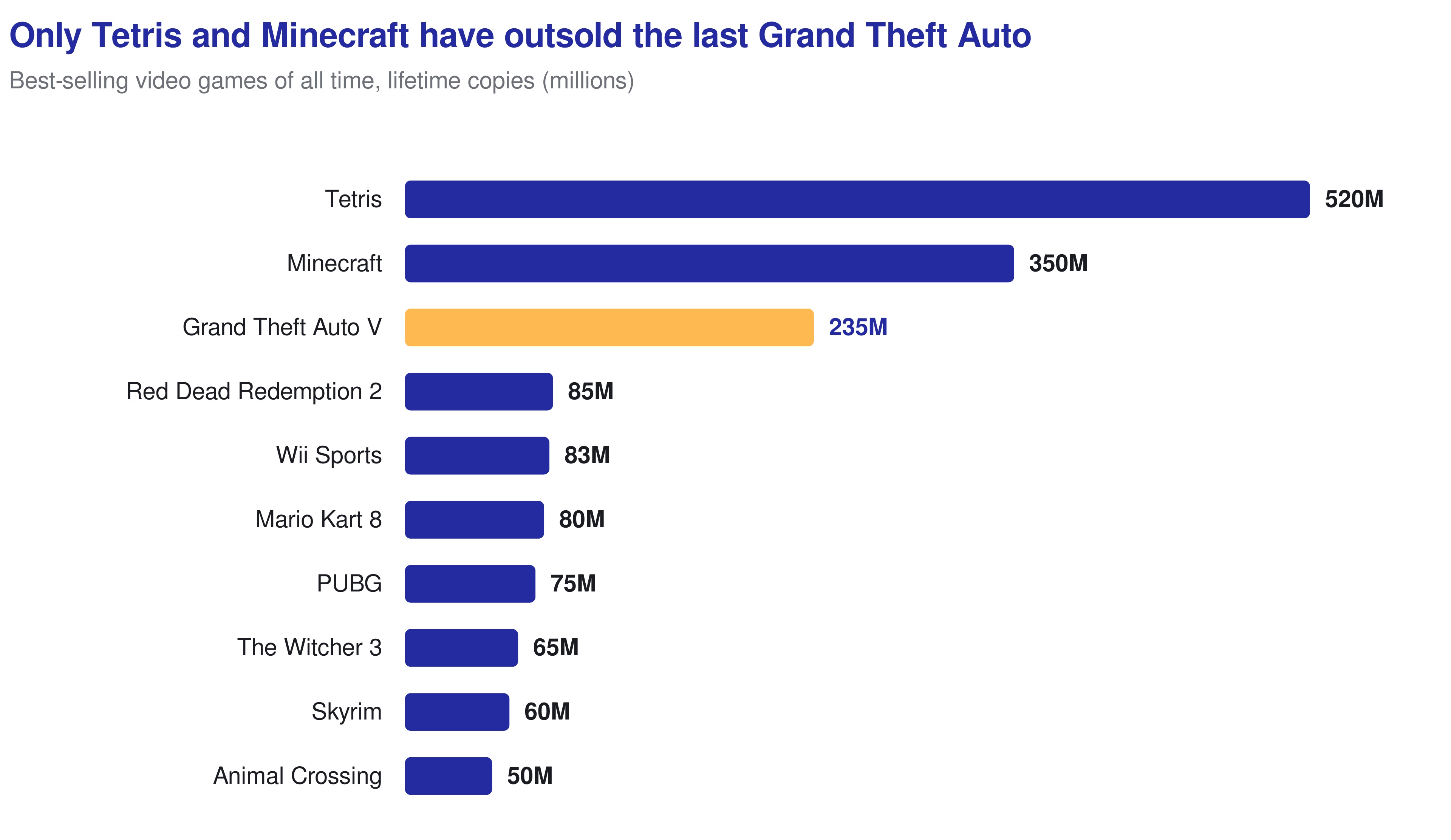
Source: Gamespot, company filings, Bloomberg Intelligence; lifetime unit sales, rounded. Tetris combines all versions.
These are large numbers for a single product. They are more useful as a window onto the business behind it: how gaming came to out-earn the rest of entertainment, how the way it makes money has changed, why its biggest bets have become so large and so few, and what artificial intelligence may change next. This note uses the launch to look at each in turn.
Bigger than it is given credit for
Gaming is still often discussed as a niche within entertainment. On revenue, it has been the largest category for years. Newzoo estimates that consumers spent $201.6 billion on games in 2025 and expects $213.9 billion in 2026, an increase of 6.1%. Global box office was about $33.6 billion in 2025, and recorded music $31.7 billion. Games, in other words, earned roughly three times what film and recorded music earned combined.
EXHIBIT 2 · GLOBAL REVENUE OF GAMES, FILM AND RECORDED MUSIC, 2025
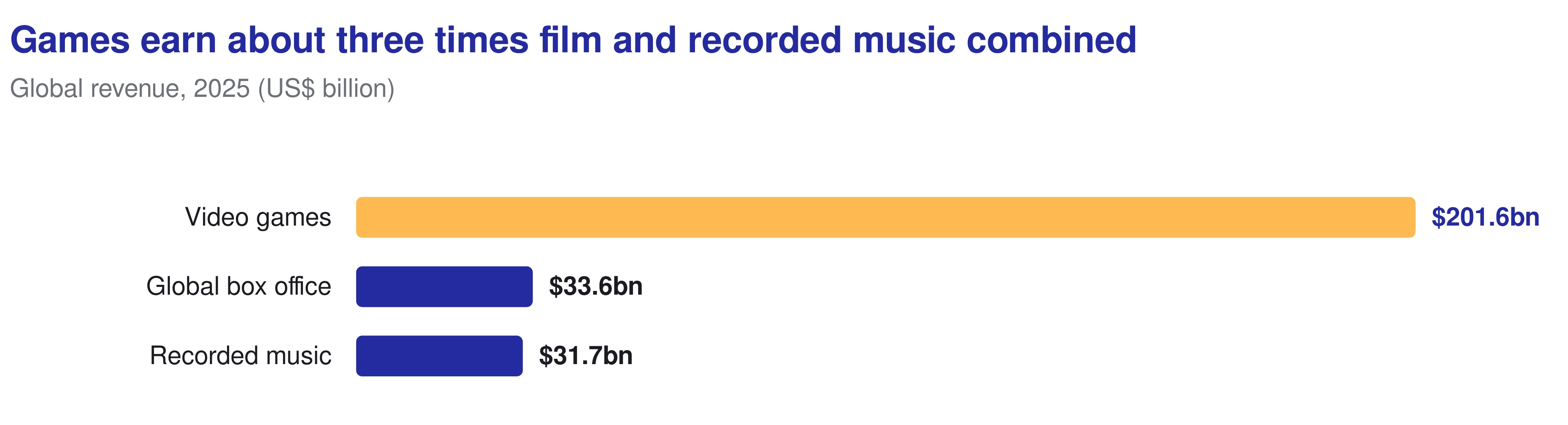
Source: Newzoo (games), Gower Street Analytics (global box office), IFPI Global Music Report 2026 (recorded music).
Reach has followed revenue. When the extended look at Grand Theft Auto VI premiered on Netflix in August, it became the most-watched film on the platform worldwide that week, with 31.1 million views, and lifted traffic to Netflix itself. A game trailer competing with films for a general audience’s evening would have been unusual a decade ago. It now shows how far the medium has moved into the mainstream.
EXHIBIT 3 · NETFLIX ACTIVITY AROUND THE GTA VI PREMIERE
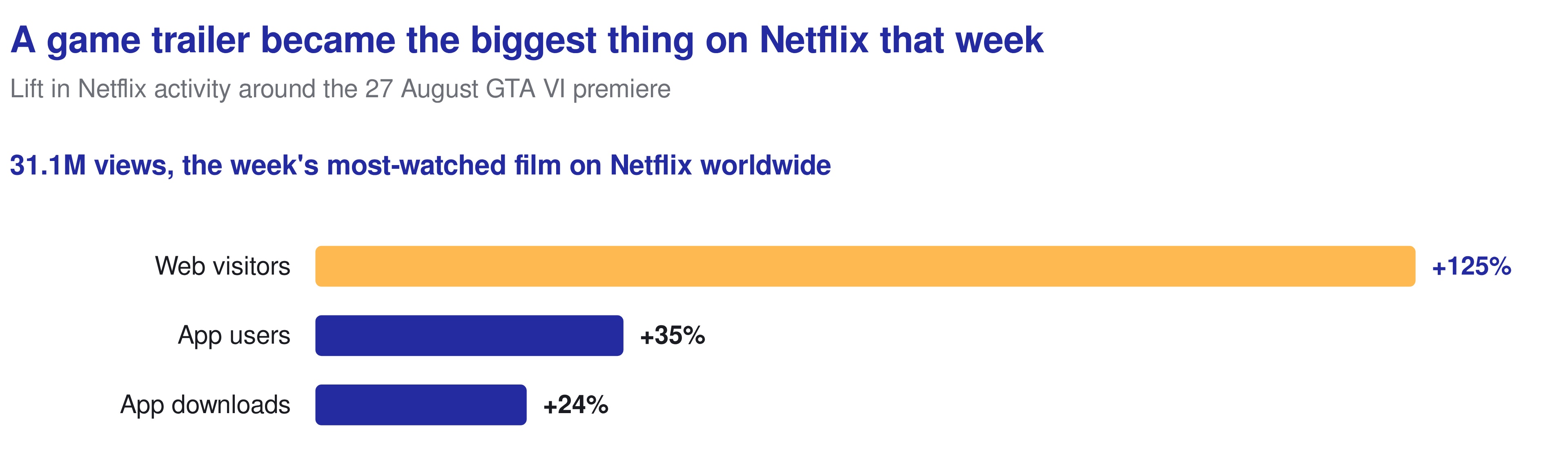
Source: Bloomberg Intelligence; baselines vary (prior hour, reveal day).
How the economics changed
Three shifts explain how gaming reached this scale.
The first is platform. For most of the industry’s history, playing meant owning a console or a capable PC. The smartphone removed that barrier. Mobile is now the largest platform, forecast at $121.1 billion, or 57% of global games revenue in 2026, against $46.9 billion for console and $45.9 billion for PC. Console, the format Grand Theft Auto VI launches on, now accounts for a little over a fifth of global spending.
EXHIBIT 4 · GLOBAL GAMES REVENUE BY PLATFORM, 2026 FORECAST
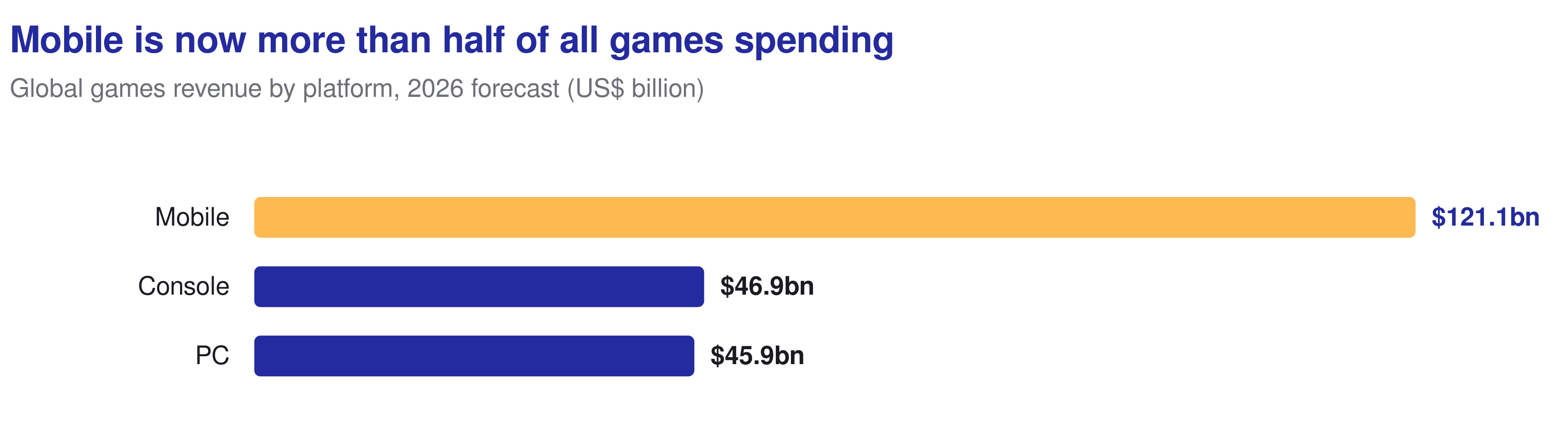
Source: Newzoo, Global Games Market Report 2026.
The second is the business model. The industry once sold boxed products: revenue arrived at launch and faded within months. Today a large share comes from what players spend after the initial purchase, through in-game items, season passes and subscriptions. Newzoo expects microtransactions to regain their position as the largest business model in 2026, while premium releases continue to sustain full-game revenue. A game is increasingly a service that runs for years rather than a product that sells for a season.
Grand Theft Auto V is the clearest example. Its online mode, launched in 2013, turned a single release into a recurring source of revenue that has outlasted an entire console generation. In 2025 it was still the second most-watched game on live-streaming platforms, with close to 1.9 billion hours viewed.
The third is where growth comes from. Newzoo forecasts that the global player base will grow 4.4% to 3.7 billion in 2026, with growth easing to about 3.2% a year through 2029. With most of the people who will ever play already doing so, the industry’s growth depends more on retaining and monetizing existing audiences than on finding new ones. That raises the value of the few games that hold attention for years and makes it harder for new releases to break through.
A costlier, more concentrated business
These economics reward scale, and the cost of competing at the top has risen with them. Development cycles for the largest titles now span the better part of a decade, and a single release can carry a budget few companies could absorb if it failed.
The result is an industry increasingly dependent on a handful of releases. Newzoo has said that without Grand Theft Auto VI, console revenue would likely have declined year on year in 2026. Most established live-service and evergreen titles, meanwhile, were flat or down in the first half of the year. When one game decides whether a whole platform grows, concentration becomes an industry-level issue rather than a company-level one.
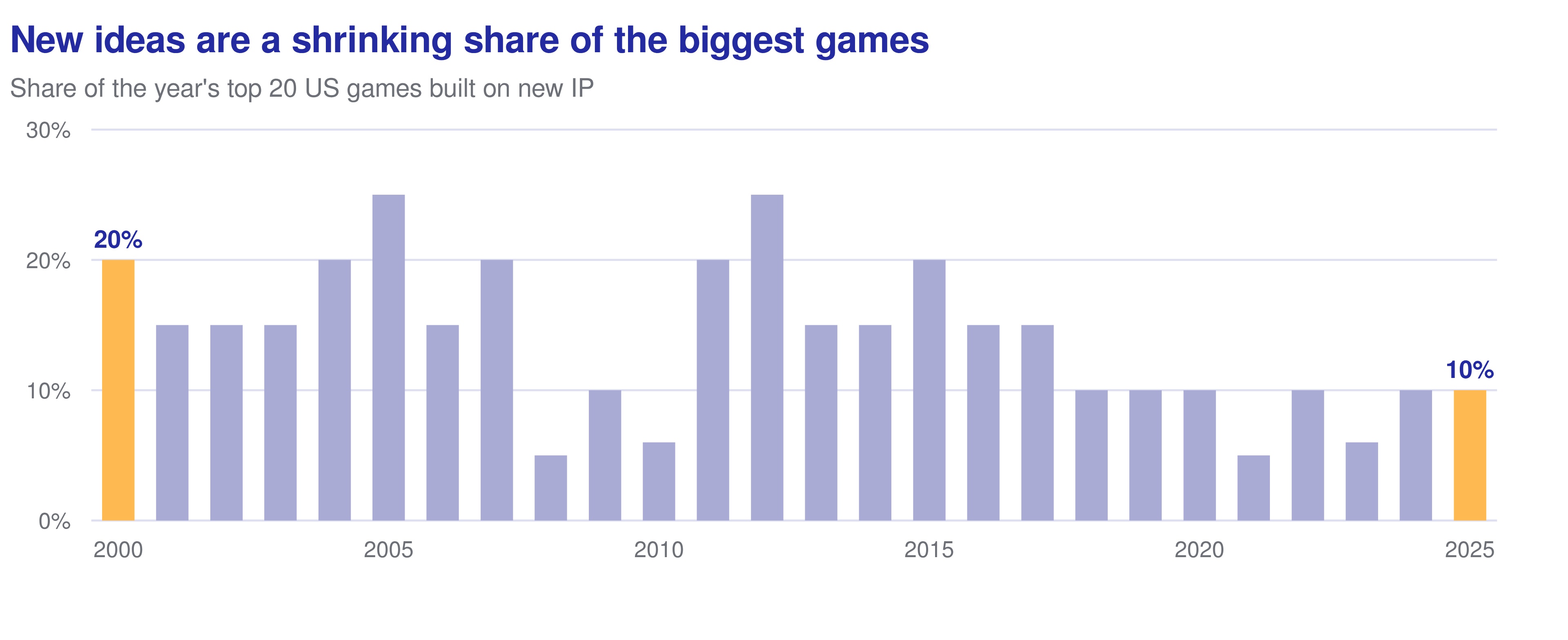
Risk appetite has adjusted accordingly. The share of the year’s top 20 US games built on new intellectual property fell from 20% in 2000 to 10% in 2025, as publishers have favored sequels, remakes and established franchises.
EXHIBIT 5 · SHARE OF THE YEAR’S TOP 20 US GAMES BUILT ON NEW IP
Source: Bloomberg, Circana; reconstructed from the broadcast chart.
Ownership has concentrated as well. The acquisition wave of the last cycle, including Microsoft’s purchase of Activision Blizzard for close to $69 billion, was financed by low interest rates and the pandemic surge in engagement. Higher rates and rising budgets were followed by layoffs, studio closures and a retreat to safer bets. Capital has since gathered around the publishers that own franchises with proven, multi-year demand. In August, Electronic Arts completed its $55 billion take-private by a consortium of Saudi Arabia’s Public Investment Fund, Silver Lake and Affinity Partners, the largest buyout ever funded by private equity.
Hardware and the cost of access
Major releases still move hardware. In the week after the Netflix premiere, UK sales of the PlayStation 5 rose by about a third and Xbox sales by slightly more. In the United States, PlayStation 5 sales rose 22% as launch approached.
The cost of playing at the leading edge, however, has risen. Higher memory and chip costs have pushed console prices up through this cycle rather than down. Depending on the model, current consoles sell for 27% to 72% more than they did at launch. The long-standing pattern, in which consoles became cheaper as they aged, has broken.
The industry’s response is to depend less on any single device. PC has become a far larger channel for major releases. Take-Two’s management has said that a title which drew 1–2% of its sales from PC twenty years ago can now draw 40–50%. The console is no longer the only way in.
Cloud: removing the console altogether
A larger shift would come from cloud streaming. A game run on a remote server, with the picture sent to the player’s screen the way a video service streams a film, would turn any phone or television into a games machine. Latency has been the obstacle. Take-Two’s management expects low-latency cloud streaming to become viable in about three years and has suggested it could expand the playable audience as much as tenfold. If that happens, hardware stops limiting who can play, and value in the industry shifts further towards those who own the worlds people want to spend time in.
Entertainment in the age of AI
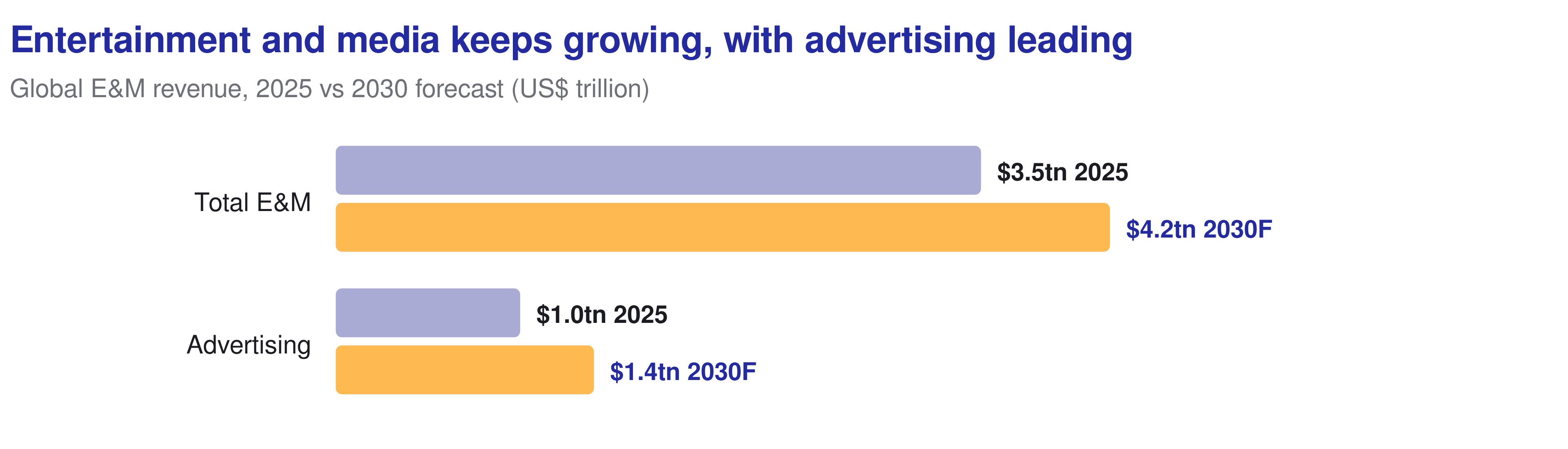
Gaming sits within a broader entertainment and media industry that continues to grow alongside AI. PwC estimates that global entertainment and media revenue rose 5.3% to $3.5 trillion in 2025, and forecasts $4.2 trillion by 2030, a compound annual growth rate of 3.4%. Advertising passed $1 trillion for the first time in 2025 and is forecast to reach $1.4 trillion by 2030, with AI-driven targeting and personalization a central driver. PwC also expects in-person and live experiences to be a major source of growth, a reminder that audiences still pay a premium for shared, human experiences.
EXHIBIT 6 · GLOBAL ENTERTAINMENT AND MEDIA REVENUE, 2025 VS 2030 FORECAST
Source: PwC Global Entertainment & Media Outlook 2026–2030.
In games, AI raises a more direct question about the cost of making content. Models that can generate interactive environments have prompted debate over whether productions on the scale of Grand Theft Auto VI mark the end of the big-studio era. Rockstar’s leadership argues the opposite: that AI will make games larger and more ambitious rather than cheaper, extending what developers can build rather than replacing them, without making a hit any easier to create.
We think both paths lead to the same place. If AI lowers the cost of producing content, supply will rise and scarcity will move elsewhere: to intellectual property audiences already know, to distribution, and to the communities that keep players engaged. If AI instead raises ambition, budgets at the top will keep climbing and the number of companies able to compete will keep shrinking. Either way, value accrues to the owners of durable worlds and to the platforms that reach their audiences, rather than to production capacity alone.
What the launch tells us
Grand Theft Auto VI tests the premise now shaping entertainment broadly: that the most valuable asset is not a single release but a persistent world that audiences return to for years. The game that launched this week is not even its final form. Its online world is due to follow about a year later, and its predecessor’s online mode has held its audience for more than a decade.
The launch also shows the strain in the model. Gaming now earns more than film and recorded music several times over, yet its growth rests increasingly on a small number of releases that only a handful of companies can afford to make. Across the sector, the questions that matter are the ones this launch raises: who owns the worlds that audiences keep returning to, what it costs to build the next one, and whether AI widens or narrows the field of companies that can.
***
Please click here to add Ionic Wealth as your preferred and trusted news source on Google