


Nvidia Q3 FY27 Earnings and Read-Through on the Broader Semis Space

Updated 18 Nov 2026•5 min read

What Just Happened
- Reported in an eventful week: the US tightened rules on Chinese access to AI chips held offshore, and Huang publicly offered to return.
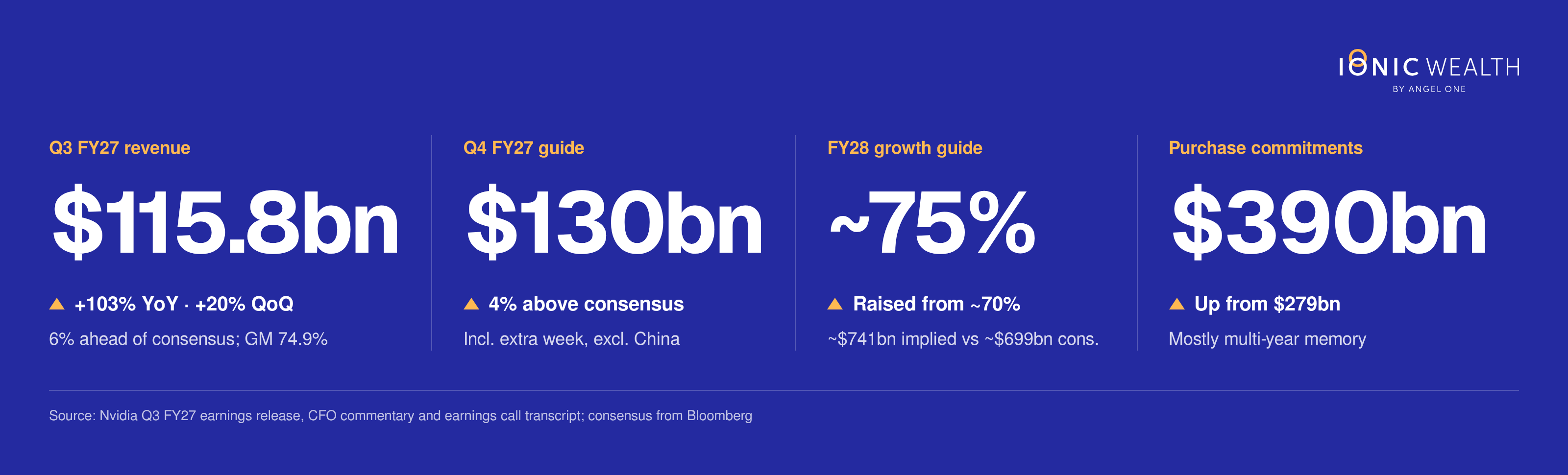
- Beat on every line in the first quarter without Jensen Huang as CEO: revenue 6% ahead, GM 74.9% vs 74%, EPS $2.68 vs $2.47.
- Underlying Q4 growth is ~6% QoQ excluding the extra week and China from the $130bn guide.
- FY28 growth raised to ~75% off a higher base. The 72–73% FY28 GM was reiterated, with Q4's 71–72% the low point as old orders ship at old prices while memory costs rise.
- Vera Rubin contributed nearly $20bn in its first quarter of shipments, the fastest product ramp in Nvidia's history.
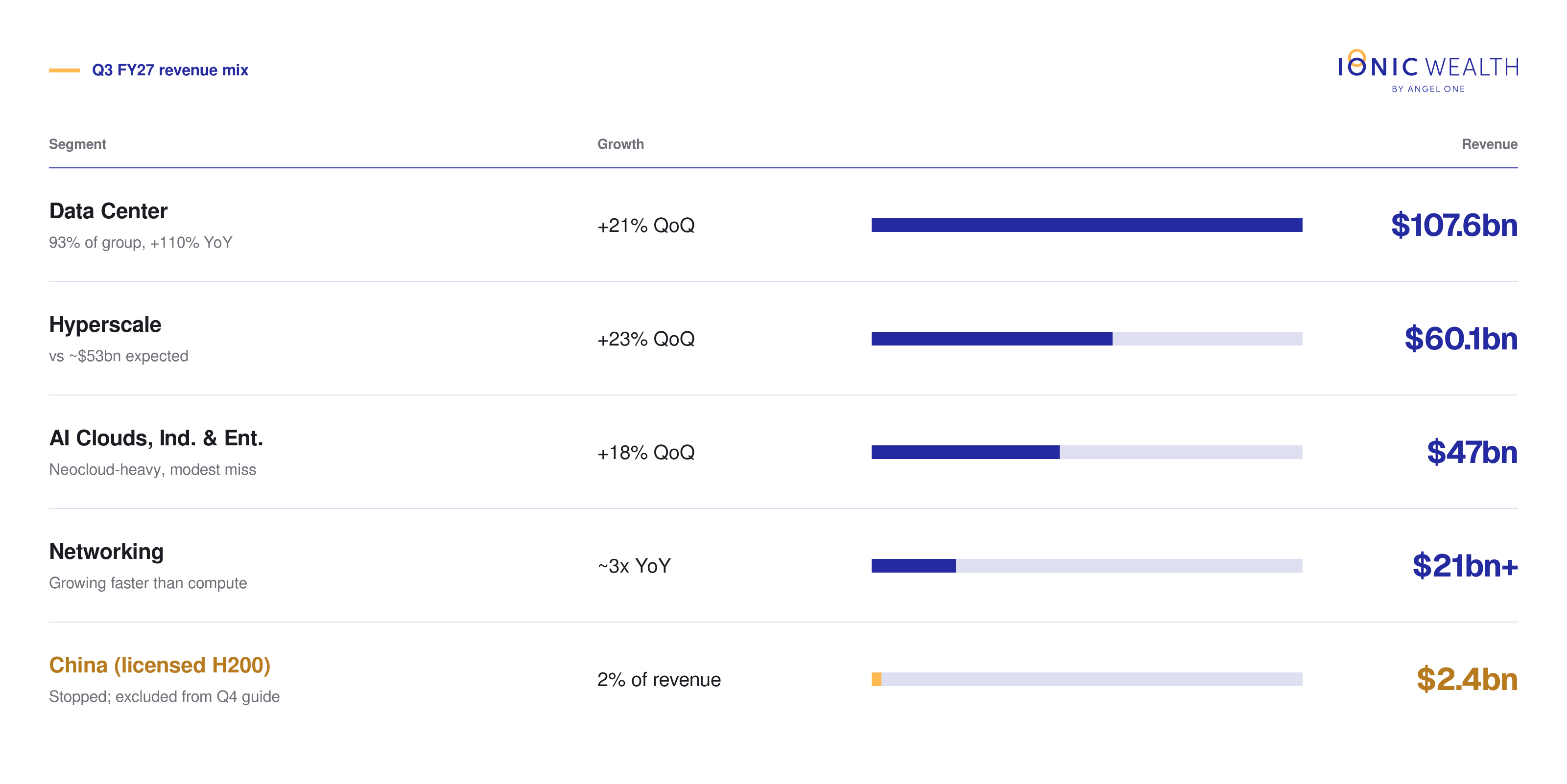
- AI Clouds, Industrial & Enterprise (ACIE) grew 18% QoQ, a modest miss that ended three quarters of outgrowing Hyperscale. China H200 sales ($2.4bn) have since stopped.
Key Takeaways From The Commentary
- Leadership and the CEO search. The board does not intend to reinstate Huang, who had publicly offered to return. Heidrick & Struggles has been retained with no set timeline, and the search emphasises candidates able to handle national-security and export-control scrutiny. The board investigation is ongoing, and leadership remains open until a permanent CEO is named.
- Relationship with Washington. Licensed H200 shipments have stopped, the Q4 guide excludes all China data-center compute, and the board has set up a National Security and Export Control Oversight Committee. The new licence rule for China-headquartered firms renting chips in third-country data centres affects a channel estimated at a low single-digit share of revenue. US hyperscalers and labs can absorb much of this capacity, while Alibaba and Tencent are prioritising domestic chips.
- Supply chain. Purchase commitments rose to $390bn from $279bn, mostly multi-year memory, with $203bn due in FY28, broadly the cost base for 75% growth at a 72–73% GM. New packaging and substrate agreements and a TSMC leadership visit indicate suppliers remain engaged. Visibility is lower beyond FY28: commitments fall to $92bn in FY29 and supplier terms will be renegotiated under new leadership.
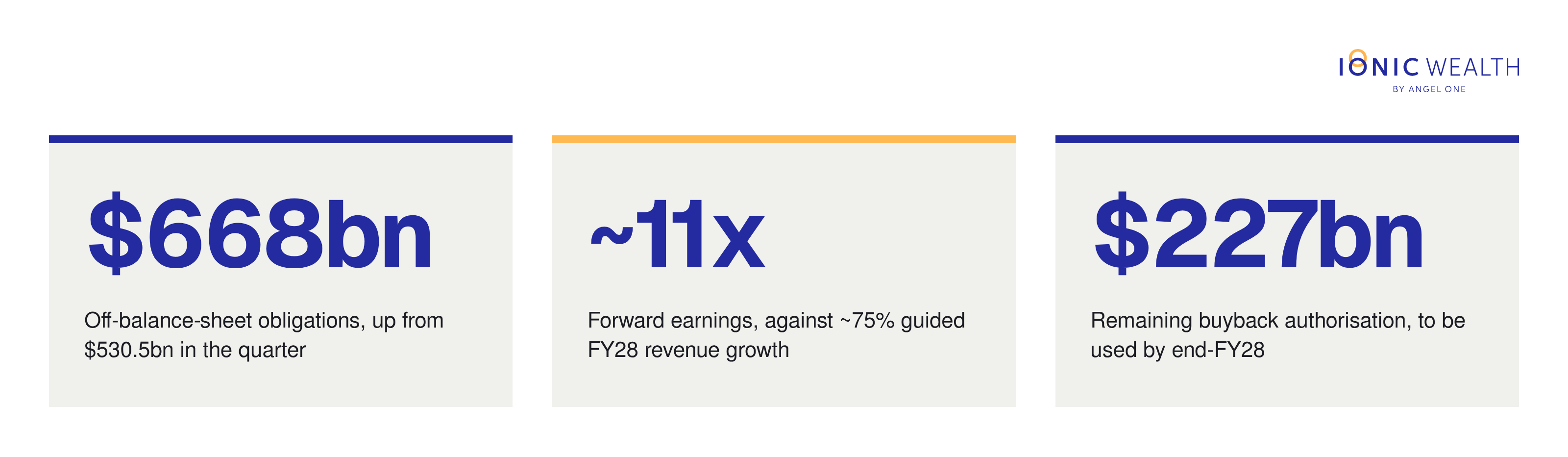
- Customer financing. Debt guarantees and capacity rent-backs continue, mainly for neoclouds, and will be reassessed as other capital becomes available. Neocloud commitments fell to $32bn from $36bn, and support applies only once a customer has land, power, shell, its own financing and capacity online. $105bn of the $118bn in guarantees relates to one OpenAI campus in Ohio building from FY29. Offbalance-sheet obligations rose to $668bn from $530.5bn.
- Capital return. A record $28bn was returned in Q3 ($22bn buybacks, $6bn dividends). All excess FCF after strategic needs goes to shareholders, with the remaining $227bn authorisation (over 5% of market value) to be used by end-FY28. The order of priority is supplier prepayments, then committed investments, then selective customer guarantees.
What It Means For The Semiconductor Space
AI hardware demand into 2027 is largely under contract, with Nvidia committing capital years ahead to secure memory, packaging and capacity. The read-through differs by sub-sector.
- Memory. Most of the $390bn commitments is multi-year memory, and Nvidia is accepting a 71–73% GM to absorb higher costs. Memory suppliers hold pricing power, relevant for SK Hynix, Samsung and Micron.
- Foundry and advanced packaging. Rubin's ~$20bn first quarter and new packaging and substrate agreements point to continued demand at TSMC, ASE, Ibiden and Unimicron.
- Networking and optics. Networking nearly tripled YoY to over $21bn, growing faster than compute as clusters scale. Relevant for Broadcom, Arista, Coherent, Credo, Ciena and Corning.
- Servers. Hyperscale grew 23% QoQ and Rubin reached hyperscalers within about a month, supporting volumes at Foxconn, Quanta, Wiwynn, Celestica and Dell, with margins mix-dependent.
- Custom ASICs. Frontier labs, ~15% of data center revenue this year, are using more custom chips. No share impact was quantified and both GPU and ASIC demand are growing; key to monitor for Broadcom, Marvell, MediaTek and Alchip.
- Equipment and test. Commitments into FY29 imply further memory and leading-edge capacity, feeding ASML, Lam Research, Tokyo Electron and Advantest with a lag.
- China. With H200 sales at zero and the offshore rental channel restricted, US vendors' China exposure is reduced, while domestic substitution benefits SMIC, Cambricon and Hua Hong.
- Neoclouds. The ACIE miss, lower neocloud commitments and stricter guarantee conditions mean CoreWeave, Nebius and IREN will rely more on external financing.
- Pricing of compute. Token prices are down ~60% since May while GPU rental rates rise: Hopper re-contracted at up to 2x, B300 rates up 60%+, cloud backlog $2.5tn from $2tn. Relevant to the debate on useful life of installed GPUs.
Key Takeaways
- Near-term execution. With FY28 demand and supply largely under contract, Nvidia looks positioned to execute over the next 12–18 months under interim leadership.
- Duration of the build-out. The raised FY28 guide, a $2.5tn cloud backlog and rising GPU rental rates indicate demand exceeds supply through 2027.
- Value across the supply chain. Memory, advanced packaging and networking are capturing a growing share of AI spend, as seen in Nvidia's commitments and its margin trough.
- A more measured Nvidia. Closer alignment with Washington, stricter customer financing and higher shareholder returns lower tail risk, but may limit the ecosystem-building that has supported its position.
- Areas of pressure. China data-center revenue is now zero, and neoclouds face tighter financing as Nvidia scales back support.
What To Watch Next
- Huang's statement before Congress on 1 December. Any detail on the resignation, the investigation or China policy.
- Hardware earnings next week. Whether FY28 orders reflect underlying demand or partial pull-forward ahead of export rules and price increases.
- The 10-Q and supplemental disclosure, due within weeks. Further detail on guarantees, neocloud exposure and the timing of commitments.
- Export rules and the CEO search. Implementation of the third-country rental rule, and the timeline and profile of a permanent CEO.