


Who Keeps the Profit in an AI Rack


Updated 17 Nov 2026•6 min read
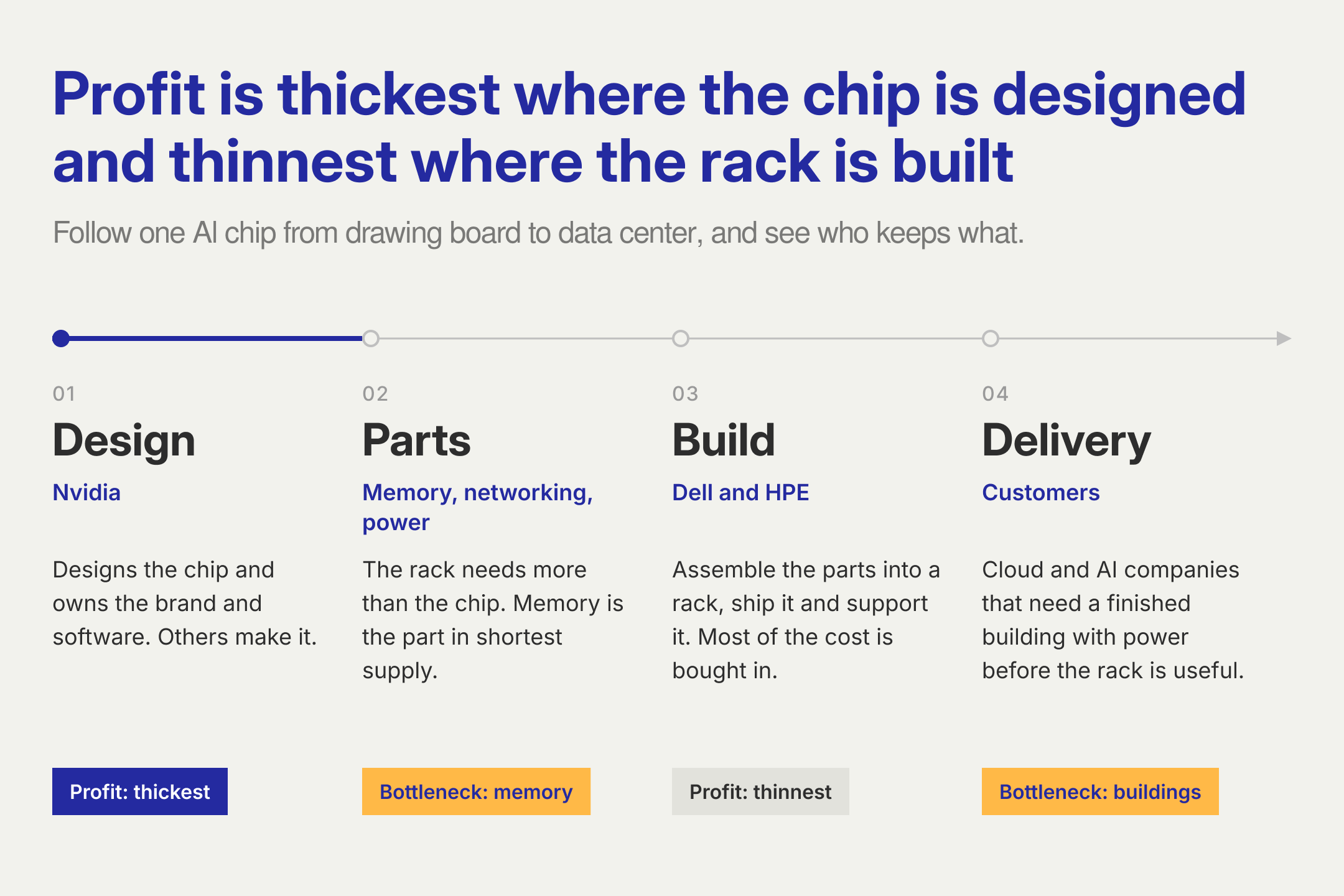
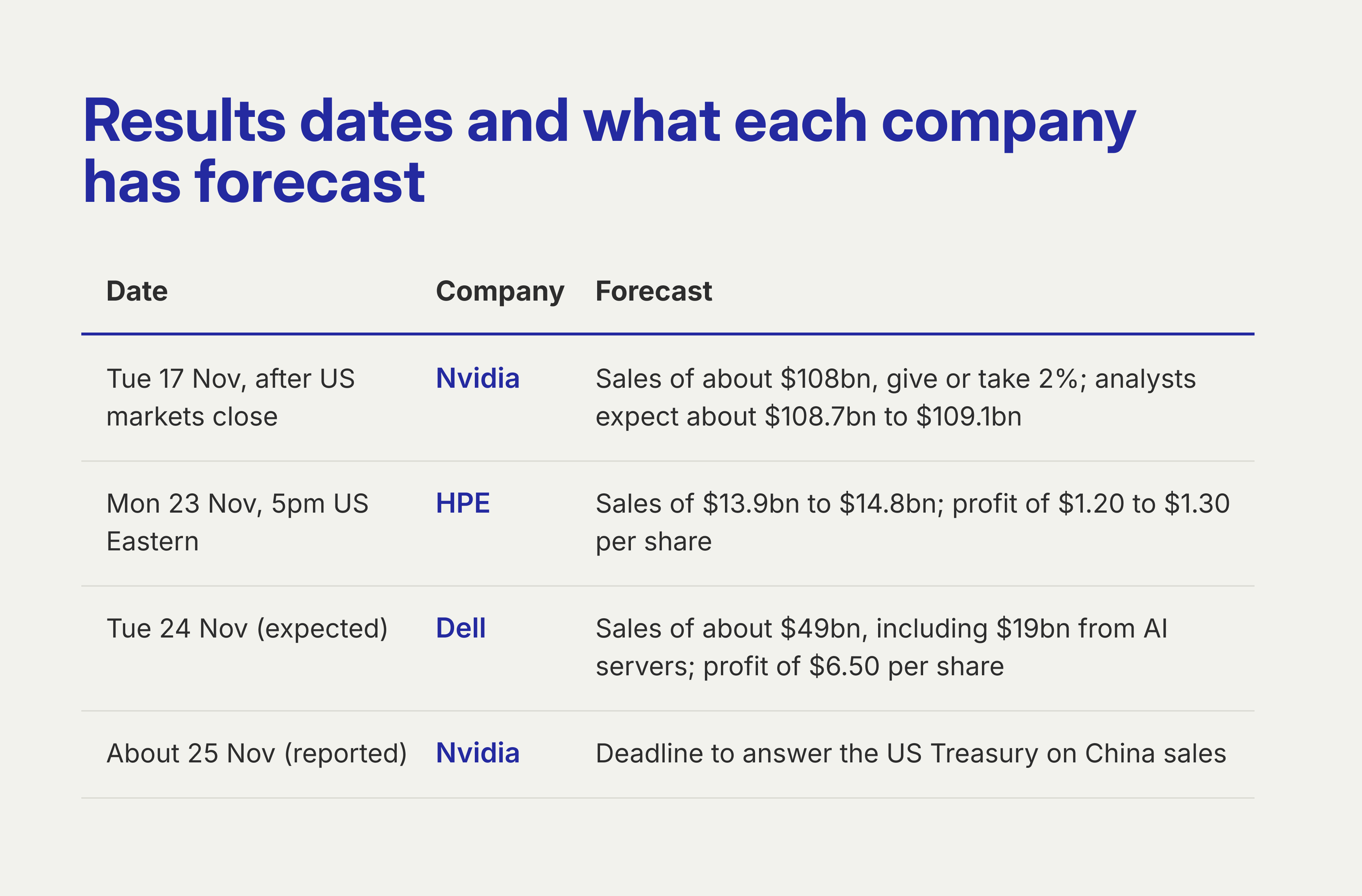
An AI chip and the rack it ships in are sold by different companies, and the profit is split very unevenly between them. Every AI rack that reaches a data center carries two very different profit stories. In the quarter ended 26 July, Nvidia earned about $64bn of operating profit. Dell and HPE, the two best-known companies that turn its chips into racks customers can buy, earned about $6.8bn between them in the quarter ended 31 July. Between the 7 October close and a pre-market quote on 9 November their shares fell by roughly 40% while orders kept piling up, with Dell alone holding $95bn of AI server orders at the end of July that it had not yet delivered. Both fell again on Monday 16 November, by roughly 4% to 6%. Some of the decline reflects the distance between those two profit figures and some reflects the wider AI selloff and the Nvidia leadership news. The picture is easier to read once we follow a single chip from design to delivery. Along that route, profit is thickest where the chip is designed and thinnest where the rack is built, and the next eight days of results (Exhibit 3) will show whether the flow between the two keeps moving.
Exhibit 1: Following the chip from design to delivery
Step 1: Who designs the chip?
Nvidia designs the AI chips, the links that join them and the blueprint for a whole rack, meaning the tall cabinet of chips, memory and cables that runs AI software inside a data center. Other companies manufacture the chips to its design. We call Nvidia the design and brand owner and its position is unusual: in the quarter ended 26 July it kept about 66 cents of every sales dollar as operating profit.
Step 2: What goes into the rack?
A chip cannot run without memory, and as we covered in our previous editions, memory is now the part everyone is short of. HPE called it the hardest input to get, with no sign of relief and Dell expects demand to outgrow the parts it can buy through 2027. The evidence sits in small details, such as Dell only just being able to lengthen its price quotes from about two weeks to a month because memory prices have steadied enough to look further ahead. Orders waiting for supply are a different situation from orders waiting for buyers and therefore must be analysed in a different manner.
Step 3: Who builds the rack?
Dell and HPE are the system integrators. They build racks from Nvidia's blueprint, add cooling, storage and support, arrange financing for customers, and sell the finished system to cloud companies, governments and large businesses.
Exhibit 2: Operating profit kept from each dollar of sales
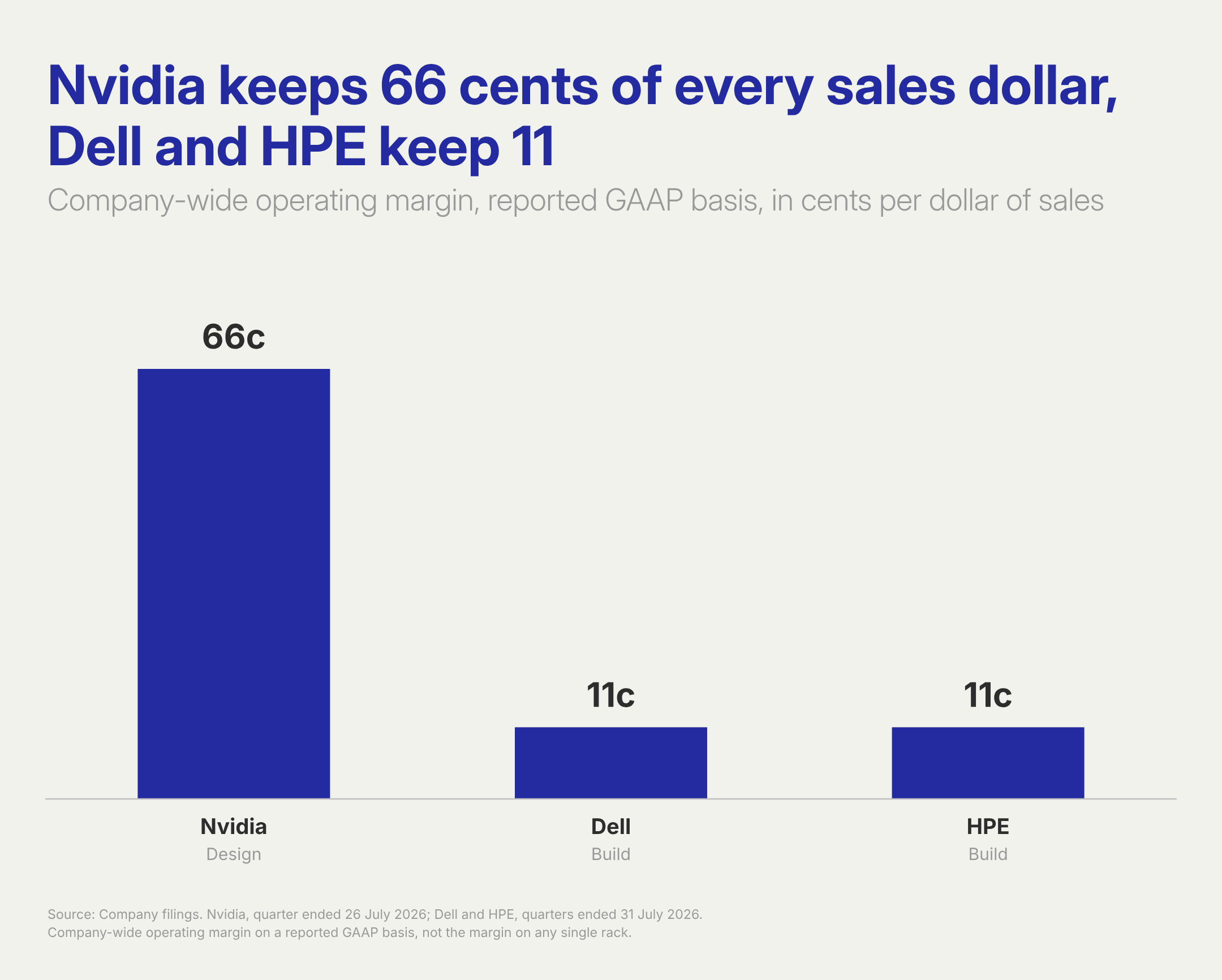
Operating margin is the like-for-like measure, and on it, using reported GAAP results, Nvidia kept about 66 cents while Dell and HPE each kept about 11 (Exhibit 2). Both builders say AI racks earn less than the rest of their business, HPE expects its AI-related margin to shrink in its fiscal 2027 (November 2026 to October 2027). Dell sold $16.4bn of AI servers in the quarter ended 31 July, and much of that revenue is probably Nvidia's chips passing through Dell on the way to the customer.
Step 4: Is demand slowing?
The racks then go to customers, and the bottleneck moves again, from parts to buildings. A listed wafer-scale chip challenger said on 12 November that data center availability is a constant constraint across the industry, and a neocloud builder delivering capacity to a hyperscaler said on 5 November that some deliveries had slipped after a customer-requested design change. One quarter cannot settle whether demand is falling, but the facts so far are consistent with a queue more than a slowdown: Nvidia forecast $108bn of sales for its current quarter, which ends in October, after $96.2bn in the quarter ended 26 July, leaving out China data-center compute. With memory short and buildings late, a beat or a miss in any one quarter may say more about timing than about appetite for AI, so a more useful signal in Nvidia's report is what it says about deliveries and memory costs.
Orders waiting to be filled show interest, which differs from delivery or cash, so two signs are worth tracking. Dell says it checks customers' financing and building readiness to limit its exposure to risky projects, and HPE's share of orders from governments and large businesses, which earn it more, has fallen to 61% from above two thirds.
A wobble at the top of the chain
The first link in the chain is now in question. Nvidia announced on 12 November that Jensen Huang had resigned as chief executive, with finance chief Colette Kress serving as interim CEO. Over the weekend, press reports said Huang was discussing a return, with allies lobbying the board; on Monday, reports citing people familiar with the matter said the board is not considering it, even though the US President said he would not mind seeing him reinstated. Separately, the US Treasury Secretary has urged the board to hire from outside and asked for answers within 10 days on export-control compliance on China sales (Exhibit 3).
In the near term we expect little to change: supply agreements are signed, and the board has said operations and customer commitments will continue without interruption. The harder gap to fill is Huang’s role in arranging financing and supplier deals. Nvidia capped its guarantee on a frontier AI lab’s data center campus at $105bn, below the roughly $250bn once reported to be under consideration, and the guarantee applies only on default. Nothing in the order books shows an effect yet; today’s forecast is the first hard evidence.
What to watch in the next eight days
Each report checks a different stop on the route (Exhibit 3). Nvidia's forecast shows how much is entering the chain, and the HPE and Dell results show how much comes out the other end and how much of it they keep.
Exhibit 3:
The opposing view is that the selloff has gone too far, since Dell has beaten profit expectations five quarters running and it still holds a very large order book. The cautious case runs the other way, resting on slower AI-lab revenue growth, tighter financing and data center delays feeding into lower accelerator spending for 2027 to 2030.
A cautious stance comes in play if, Dell showed its AI servers earning a clearly higher margin than today; if Nvidia forecast below its recent pace or trimmed its longer-term growth outlook, which would suggest 2028 demand is being pulled into 2027; or if orders were delivered more slowly even as memory supply improved, which would point to weaker demand rather than short supply.
Until then, the open question is how much of each rack’s profit is left once the design owner has taken its share.
***
Please click here to add Ionic Wealth as your preferred and trusted news source on Google