


Is AI Credit Stress Spreading?

Updated 29 Oct 2026•13 min read

Pockets of Strain for Now, Hyperscalers Remain Key to the AI Equation | October 2026
The global economy has looked fragile for some time, but markets have been held up by strong corporate earnings. The ongoing wars, both between US-Iran and Russia-Ukraine have disturbed the global trade supply, especially impacting oil & gas flows. This has led to an increase in inflation globally, with most economies seeing inflationary pressures broadening. Key global Central Banks, including the US Fed, have adopted a tighter monetary policy in an attempt to curb inflation.
In mid-October, as inflation continued to be higher and yields remained stubborn, along with bouts of anxiety around the AI trade, markets witnessed a sharp surge in Credit Default Swap (CDS) spreads, especially for some of the neo-cloud companies, which saw spreads rising close to 1100 bps. A material market sell-off followed: the Nasdaq 100 retreated by 6.5%, semiconductor ETF by 16.3%, and emerging market AI proxies, South Korea (Kospi) and Taiwan (Taiex) fell by 18.3% and 5.4% respectively, between October 7-October 16, 2026.
Source: Bloomberg
This raises a critical question: Is this the beginning of a systemic credit contagion?
The short answer is that while the stress is real, it remains confined to a narrow segment of the market. The bigger question is whether it can spread.
In December 2025, we compared the AI boom with the dot-com bubble in “US Tech Cycle: Irrational Exuberance or Rational Momentum?”. Much of that analysis still holds- capex is growing far faster than revenue, market concentration remains extreme, and AI adoption is real and broadening.
However, two key differences we highlighted have weakened. The Fed, which was cutting rates then, has turned back to tightening. And the build-out, which we noted was funded mainly by Hyperscalers’ balance sheets, large institutions and sovereign funds, is increasingly being financed with debt, through bonds, private credit, off-balance-sheet vehicles and loans secured on chips. This article looks at that shift in AI financing, and what it means for credit risk and global markets.
AI Financing Structure
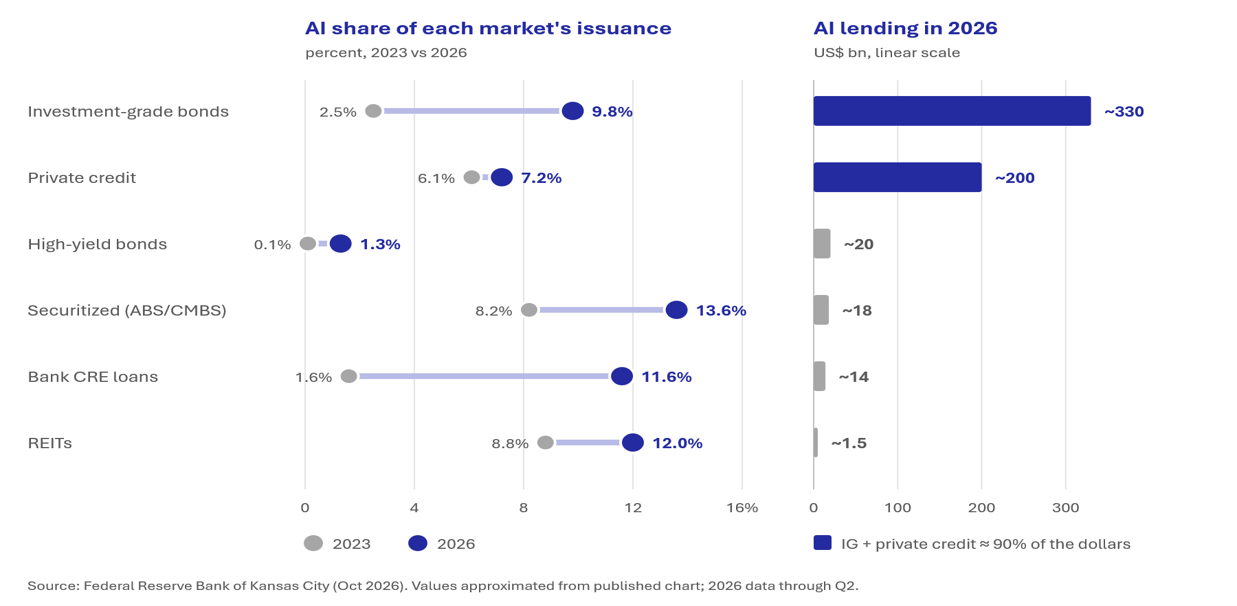
Investment grade (IG)+ private credit accounts for roughly 90% of the AI financing currently. While there are ways to track risk in IG bonds, it is very difficult to gauge the risk in private credit, which accounts for ~34% of AI financing. For reference, IG bonds are bonds issued by companies (or governments) that credit rating agencies judge to have a low risk of default.
Exhibit 1: Over 90% of AI lending is concentrated in the investment grade bonds and private credit markets
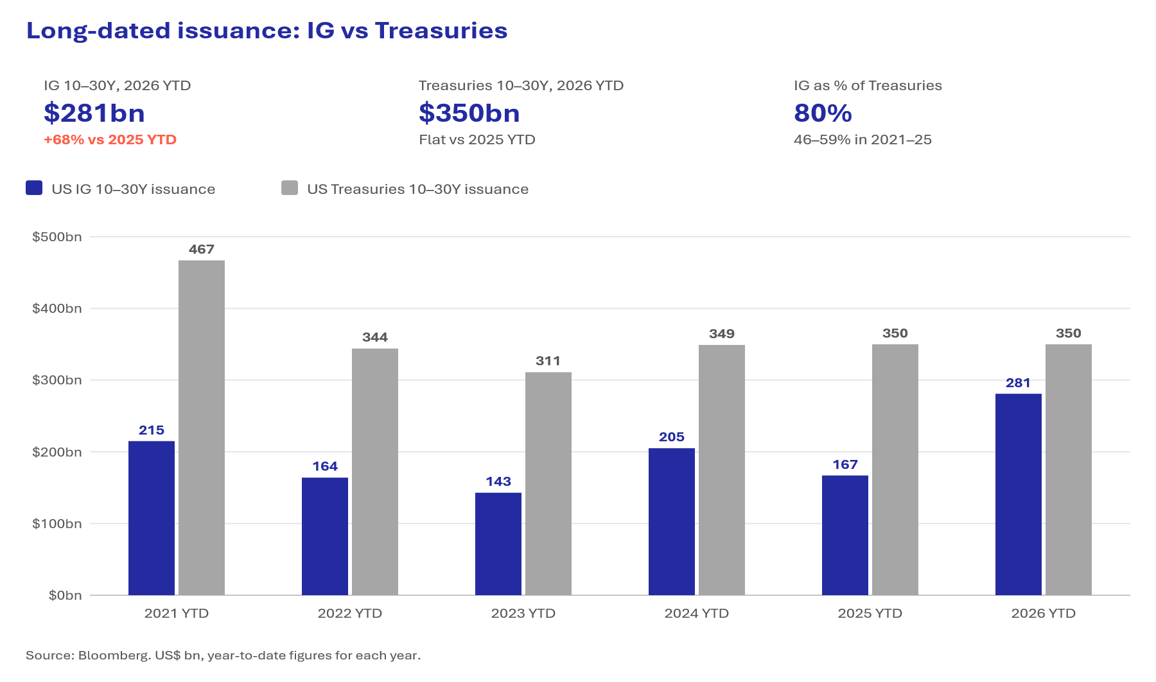
The argument on corporate bond issuances crowding out US government borrowing is largely correct, as seen with investment grade bond issuances (10Y-30Y) grown by about 68% year-over-year and account for about 80% of US treasury issuance (10Y-30Y) in 2026 YTD.
Exhibit 2: Long-dated IG issuances have grown by over 65% YoY while Treasury supply has stayed flat
....and within investment grade bond issuances- tech, media and communications bond issuances have grown the fastest over the last 5 years
Exhibit 3: More than a third of non-financial IG issuances now comes from tech, media and communications
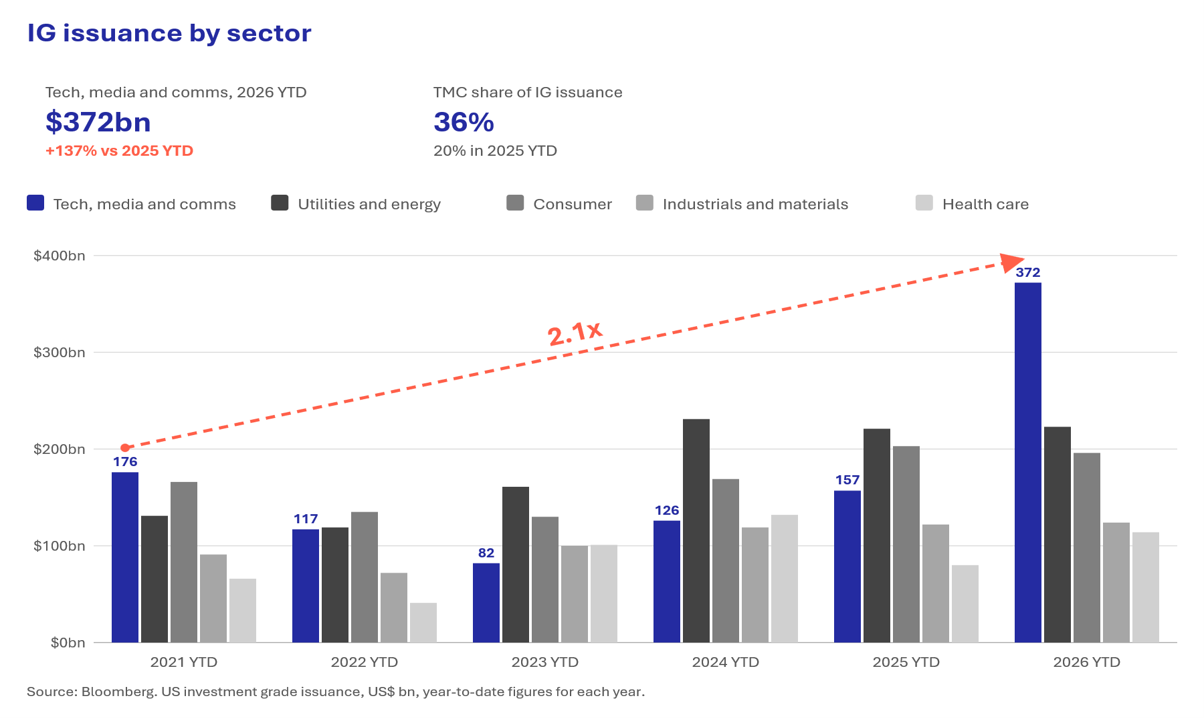
Put simply, AI has become one of the biggest borrowers in the bond market, and it is borrowing for the long term.
Where is the stress showing?
Two measures tell us how worried lenders are. Option adjusted spreads (OAS) show how much extra yield investors demand over US Treasuries to lend to a company. Credit default swaps (CDS) spreads show the cost of insuring that loan against default. When either rises, it shows that investors are getting nervous or cautious about the credit situation.
Recently we have seen OAS and CDS spreads increasing, but this is largely concentrated in HY- tech segment, essentially stress is building from the bottom of the credit ladder.
Exhibit 4: So far, credit spread widening is concentrated at the lower end of the ratings ladder
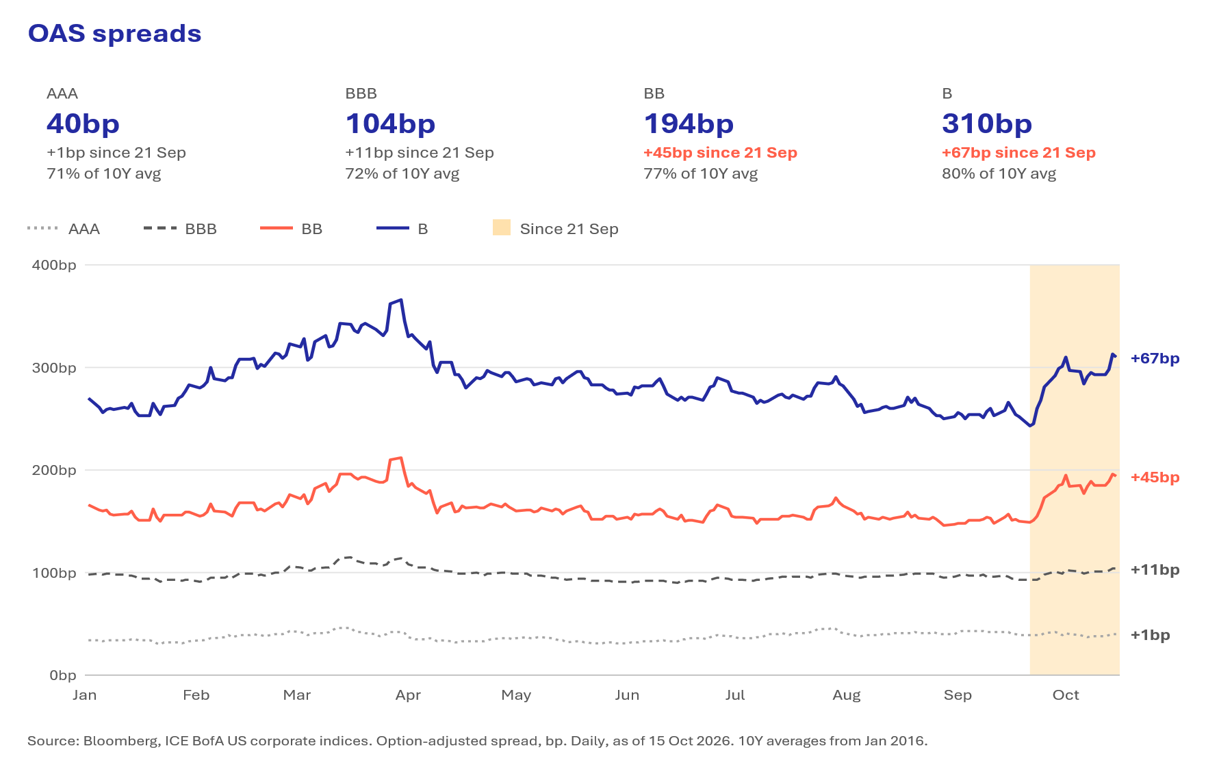
Since September 21, 2026, spreads on B-rated bonds have widened by 67bps and on BB-rated bonds by 45bps, while BBB and AAA barely moved. Even so, every rating band is still below its 10-year average. This is early stress, not panic.
Exhibit 5: Default insurance has risen sharply for high-yield bonds, while investment-grade remains steady
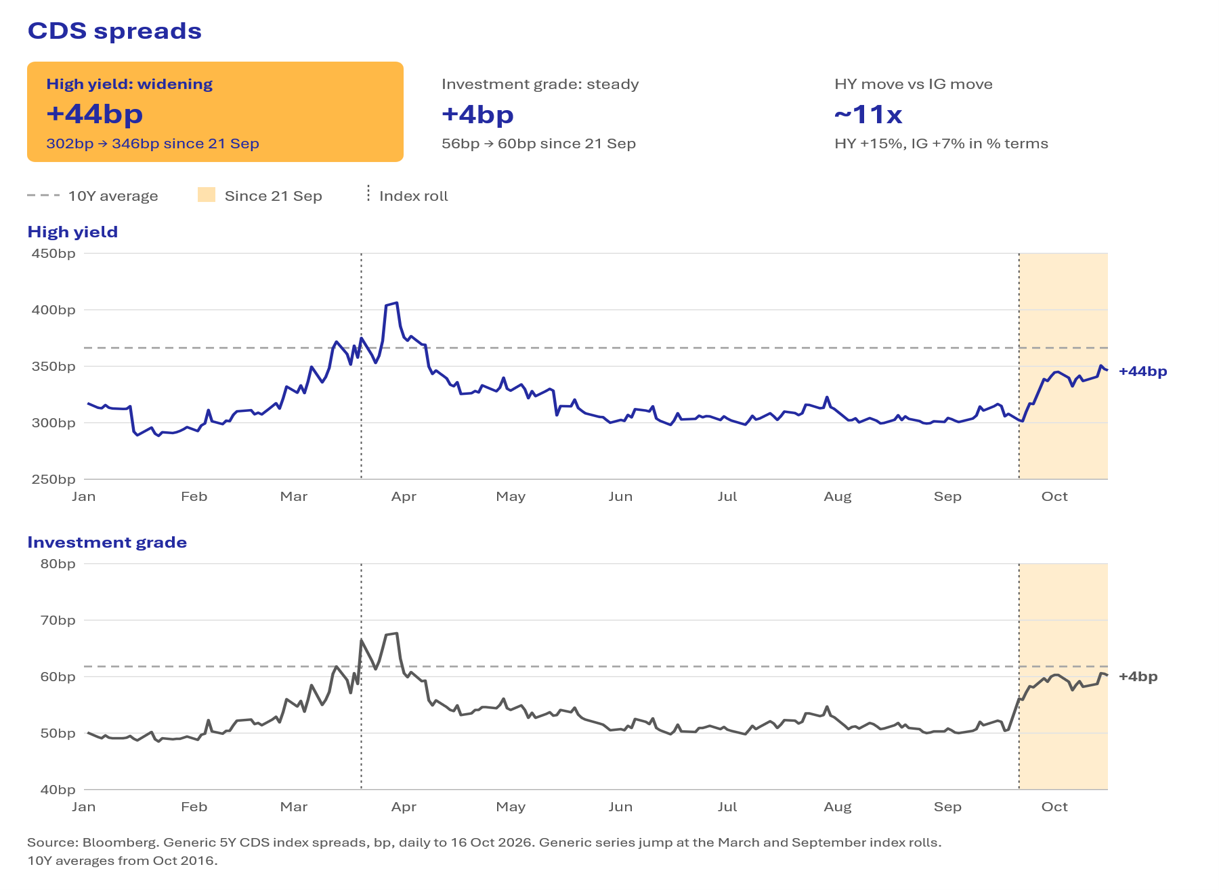
Default insurance tells the same story: high-yield CDS is up 44bps since September 21, 2026, investment grade just 4bps. Comparing credit spreads across sector and quality pairs- Tech HY is clearly the segment showing the stress as of now.
Exhibit 6: CDS spreads in high-yield tech have widened the most
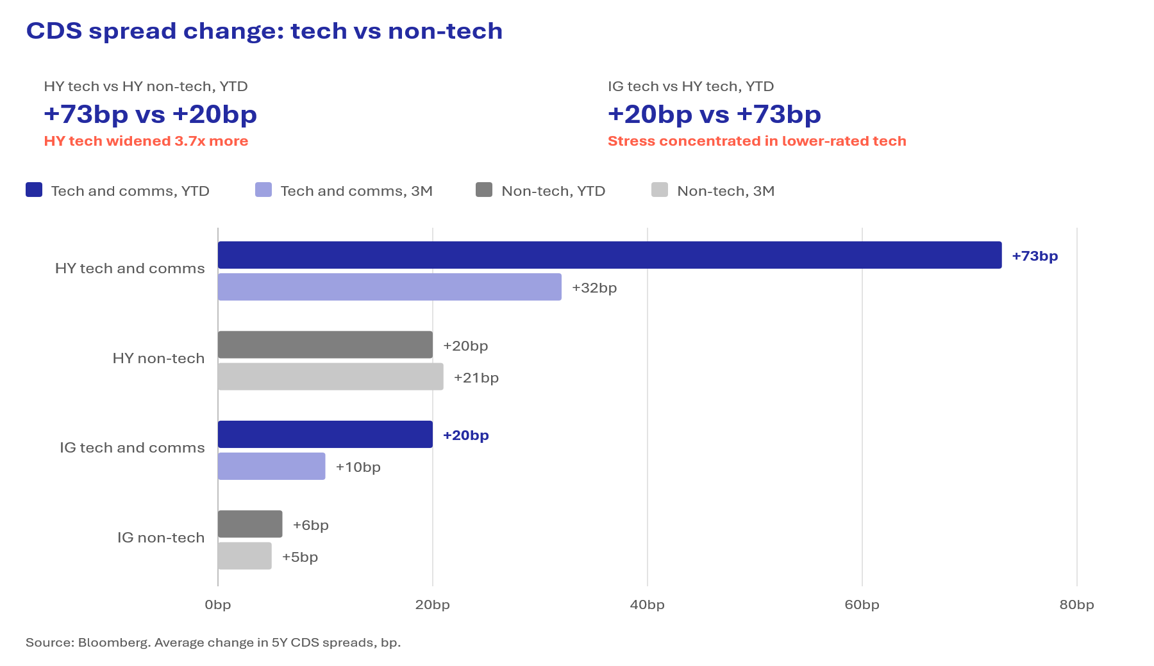
Exhibit 7: Only 3% of AI lending trades in a market where stress is showing — the other 97% is calm or unpriced
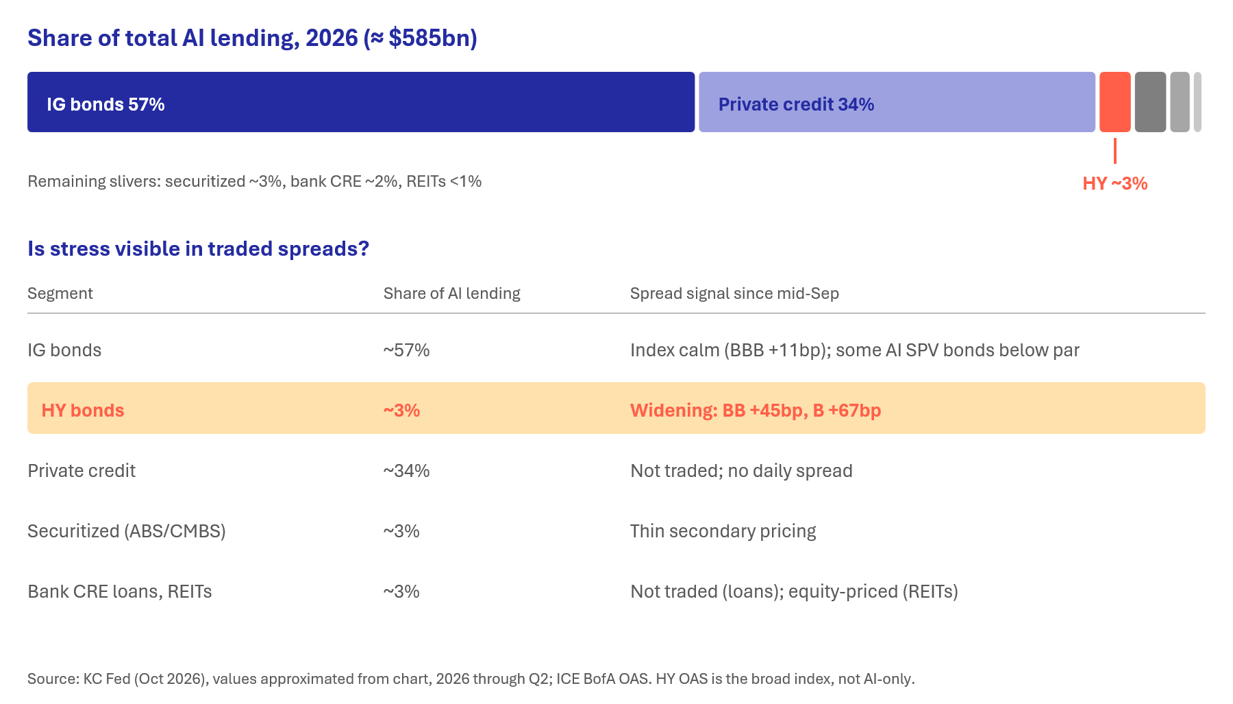
The rest sits in investment-grade bonds, which are calm, or in private credit, bank loans and securitised deals, which do not trade every day. If there is stress there, it does not show up yet.
Why the 3% matters: the AI money loop
The AI borrowing data suggests that the high yield segment is showing signs of stress which accounts for only 3%, while the remaining 97% is calm or unpriced. Below we do an analysis of why that 3% matters and how it can seep into the remaining 97%.
The reason is that, in AI, suppliers, customers and lenders are tied together. The chart below maps the chain: who builds what, and how each layer pays for it.
Exhibit 8: Hyperscalers finance AI investments largely through internal cash flows, while independent labs and neoclouds rely more on external financing, making them more vulnerable if AI monetisation disappoints
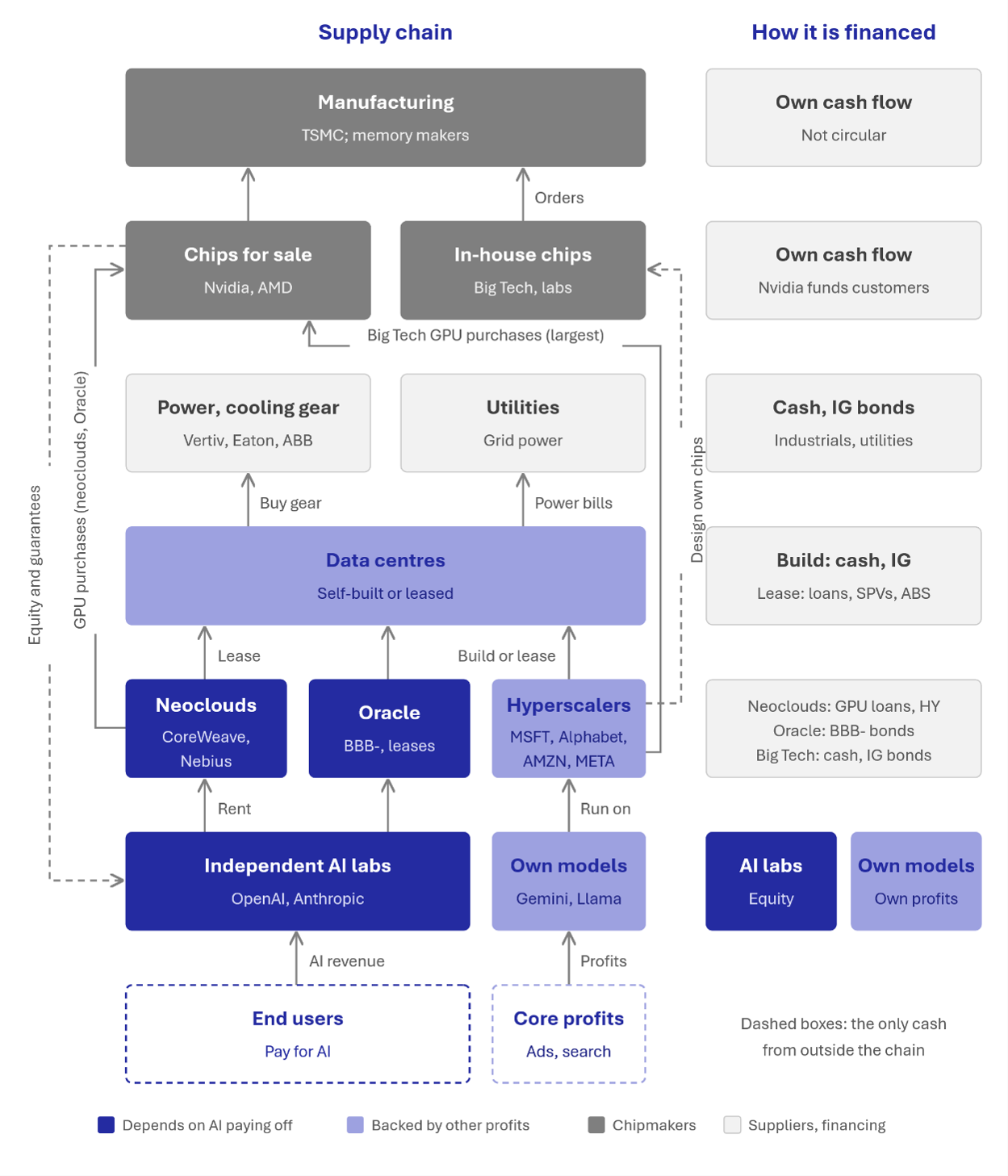
How to read it: Money flows up the chain. End users pay AI companies, AI companies pay cloud providers rent, and cloud providers pay for data centres and chips. On the right is how each layer raises money. Chipmakers and Hyperscalers use their own cash and cheap investment-grade bonds. Neoclouds such as CoreWeave rely on expensive loans secured against their computing contracts and chips, while AI labs such as OpenAI depend on raising equity.
The loop. Much of this money moves in a circle. A simple example:
- A chipmaker invests in an AI lab.
- The lab signs a multi-year contract to rent computing power from a cloud company.
- The cloud company takes that contract to a bank or private credit fund and borrows against it.
- It spends the loan on chips, from the same chipmaker.
Every step depends on one thing: the AI lab earning enough from its users to keep paying the rent. Today, AI revenue is far smaller than these commitments, and the gap is being filled with more equity and more debt.
This is not hypothetical. Nvidia owns about 10% of CoreWeave and has agreed to buy its unused capacity. It has also invested in OpenAI, whose largest computing contracts are with Oracle, Microsoft, Amazon and CoreWeave.
One important difference. Not all AI is paid for this way. Alphabet, Meta and Microsoft build their own AI models and fund them from search, advertising and cloud profits. Independent labs such as OpenAI and Anthropic depend on AI revenue and on raising new money.
So if independent labs struggle, the pain lands first on the companies that built capacity for them and those that lent against their contracts: Oracle, the neoclouds and their lenders. It becomes a system-wide problem only if Hyperscalers decide AI is not earning enough and cut their spending.
From what we know, Anthropic’s IPO filing offered five revealing takeaways:
a) revenues soared from USD 1.2 billion in H1-2025 to USD 16.3 billion in H1-2026
b) operating losses narrowed from USD 2.1 billion to USD 693 million, with Q2 marking the company's first quarterly operating profit of USD 974 million
c) revenue per dollar of compute expense surged 5.2-fold to USD 2.08 between Q1-2025 and Q2-2026
d) Anthropic held USD 131.7 billion in cash and short-term investments as of June, alongside USD 3.9 billion in H1 operating cash flow
e) its enterprise footprint expanded rapidly, with more than 11,900 customers spending at least USD 100,000 annually as of September, up from roughly 950 a year earlier.
This is more positive than negative for now. Having said that, there are more independent labs and they’re all riding on high expectations. Markets don’t have a lot of appetite for a slip.
Who can pay their own?
Exhibit 9: Oracle and CoreWeave face greater financing risk, with capex exceeding cash flow and debt >3x EBITDA, unlike cash-rich Hyperscalers
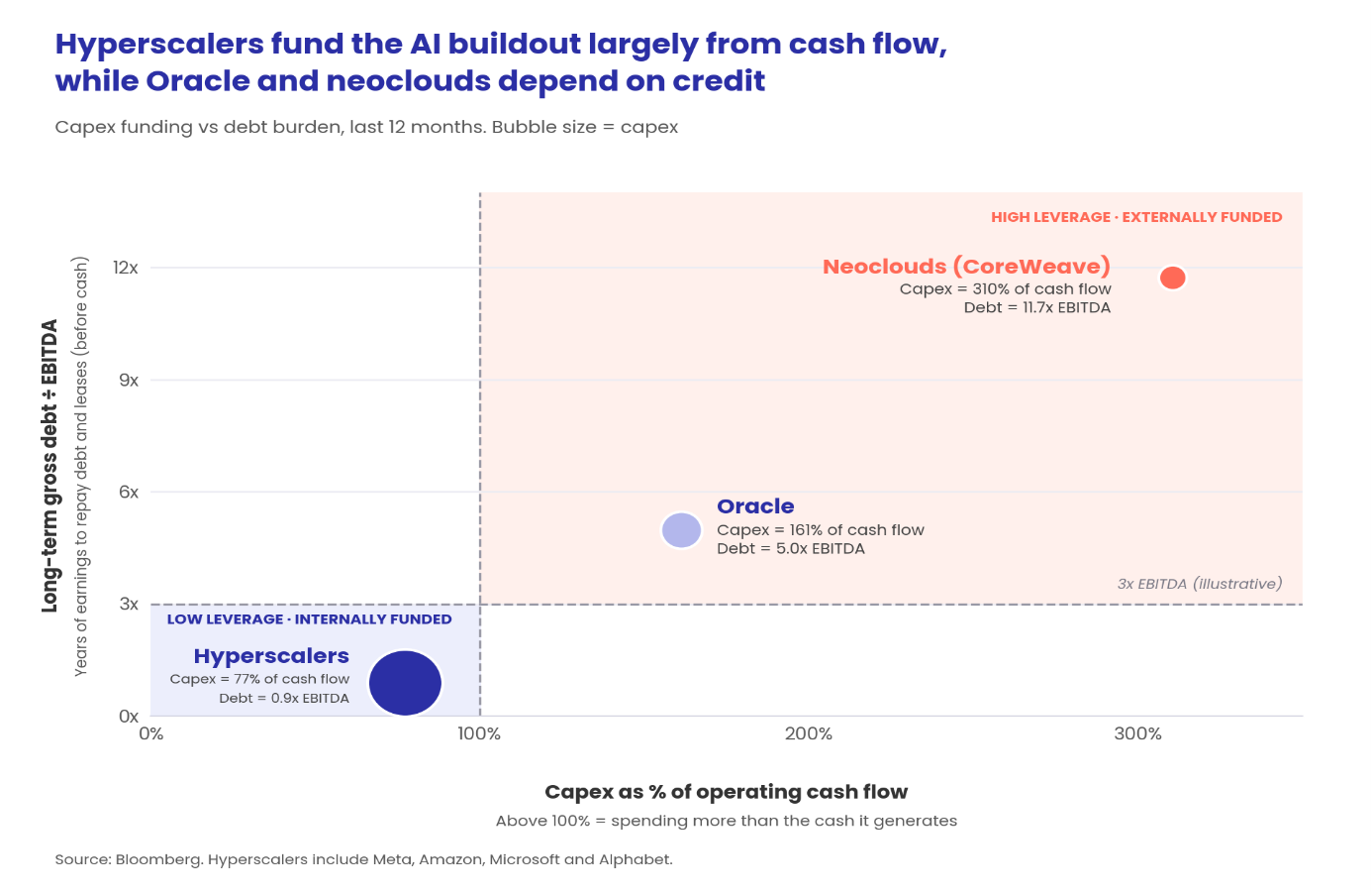
Strong revenue and earnings growth have allowed Hyperscalers to scale up AI investment while keeping credit stress contained.
Oracle is where the costs of the AI build-out become harder to ignore. Its core software business still generates strong cash: operating cash flow more than doubled in the year to August 2026. But its AI spending is growing even faster. Capex rose 176% year-on-year to 161% of operating cash flow, pushing free cash flow to −USD 28.7bn. Unlike Meta, Microsoft, Alphabet and Amazon, which can fund their AI investment from far larger cash flows, Oracle relies more heavily on borrowing. Its BBB- credit rating, one notch above high yield and well below the AA- to AAA ratings of the major hyperscalers, reflects that difference. Leverage is showing some pressure with net debt to EBITDA at 3.9x and gross debt to EBITDA 5.0x), although operating earnings are comfortably able to cover interest cost. As long as free cash flow stays negative, further expansion will need more financing, leaving Oracle exposed to higher borrowing costs or a downgrade. If AI demand or monetisation falls short, Oracle could face growing funding needs just as returns weaken, and any pullback would hit the data centre developers, chipmakers and lenders that depend on its spending.
Neoclouds such as CoreWeave sit at the most vulnerable end of the AI financing chain, where debt-funded expansion depends on sustained customer demand and continued access to capital. In the 12 months to June, CoreWeave’s debt grew far faster than revenue, while capex substantially exceeded operating cash flow. Operating earnings were insufficient to cover interest cost, and operating income excluding depreciation and amortisation met less than half of scheduled debt service, leaving little room to absorb a setback without fresh financing.
How the stress could spread?
Because everything in the AI chain is connected, one weak link can put pressure on the whole system. It would most likely start with the independent AI labs. If their revenue doesn’t grow fast enough, they may struggle to keep paying for the computing power they’ve committed to. That pressure passes straight to the neoclouds, which rely on those payments to repay their loans.
If a neocloud can’t repay, its lenders take back the chips that secured the loan and try to sell or rent them out. More chips on the market pushes down rental and resale prices. That weakens the collateral behind every other GPU-backed loan, so lenders become more cautious with all neoclouds, not just the one in trouble With borrowing harder and more expensive, neoclouds buy fewer new chips, and the slowdown reaches chipmakers’ order books.
So far, the stress has only travelled part of the way. It has moved from the neoclouds to the companies that look most like them, or that share their exposure. Oracle, which is heavily tied to OpenAI, has seen its CDS hit a record, and shares in memory-chip makers have fallen sharply. Within investment grade, tech CDS has risen 20bp this year against 6bp for non-tech, so investors are separating AI-linked borrowers from everyone else. But the stress hasn’t reached Hyperscalers or the wider bond market.
Whether it does depend largely on how long Hyperscalers can keep paying for its build-out from its own cash. For now it still can: capex takes up 77% of operating cash flow. But that cushion is shrinking fast. In the year to June, capex grew 75%, more than twice the 34% growth in operating cash flow. Free cash flow has fallen for two years in a row, from USD 233bn in H1 2024 to USD 150bn in H1 2026, and the four companies have together moved from USD 8bn of net cash in H1 2024 to USD 71bn of net debt in H1 2026. Leverage is still low. But if spending keeps outpacing cash generation, Hyperscalers will have to choose between borrowing more and slowing its investment. If it slows down, the pressure would reach neocloud revenues, chip demand and data centre financing all at once.
Will AI revenue catch up? AI Adoption is real and growing really fast
Exhibit 10: Business AI adoption has more than doubled to ~56% since 2023, supporting the case for continued AI demand
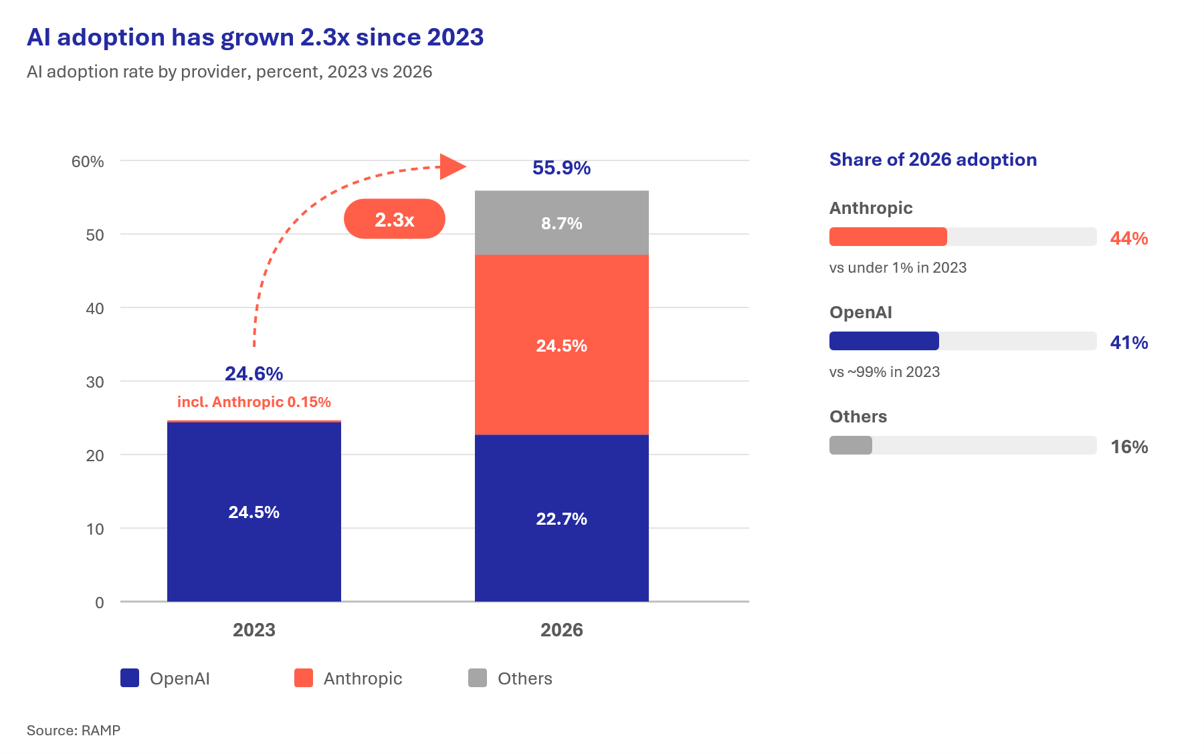
Business AI adoption has more than doubled since 2023, reaching nearly 56%. This broadening user base supports the outlook for sustained AI infrastructure demand. The next test is whether adoption translates into measurable productivity gains and recurring revenue, allowing investment to generate returns rather than relying on continued capital spending.
Exhibit 11: AI token spending has risen 66x since early 2025, reflecting a surge in usage across businesses
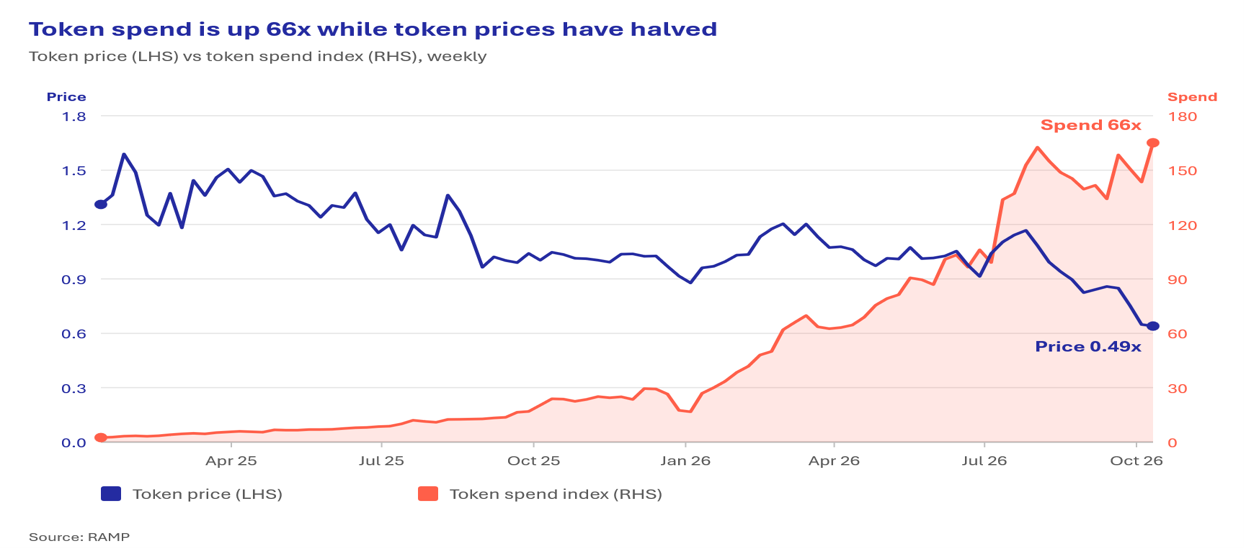
Token prices have roughly halved since early 2025, yet spending is up 66 times. Part of the price fall reflects competition: cheaper models are now good enough for many tasks, and some buyers are switching to them from the most expensive ones. Lower prices are likely encouraging wider use, alongside new applications such as coding tools and AI agents. So far, the growth in usage has far outweighed the fall in prices. The question is whether that continues as new adoption slows. If buyers keep moving to cheaper models, AI companies will need ever more usage just to keep revenue growing, while their computing costs stay locked in by multi-year contracts.
Exhibit 12: AI spend per employee has surged, reaching USD 9,568 per month for the top 1% versus USD 15.70 at the median
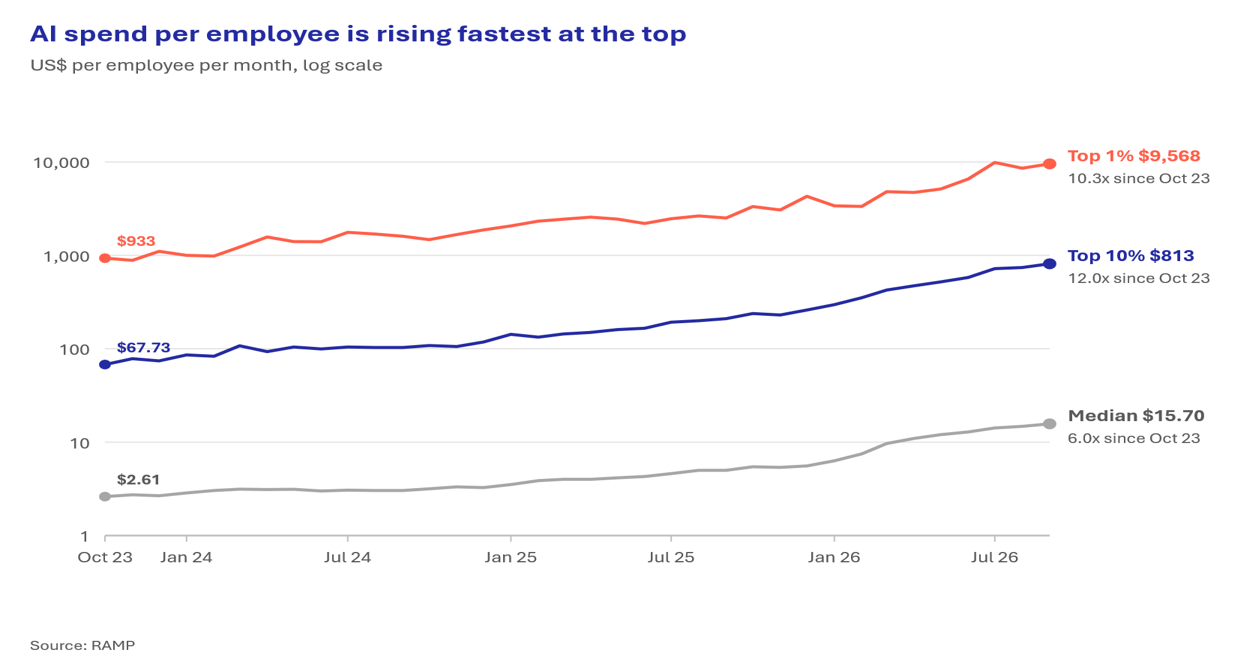
AI spending per employee varies hugely. The median firm paying for AI now spends USD 15.70 per employee a month, six times more than in October 2023, which shows that demand and willingness to pay are rising across the board. But the heaviest users are pulling ahead even faster: the top 10% of firms now spend about 52 times the median, up from 26 times. AI demand is growing, but it still depends heavily on a relatively small group of intensive users. How quickly spending broadens across the wider economy will decide how durable that demand is.
Annexure
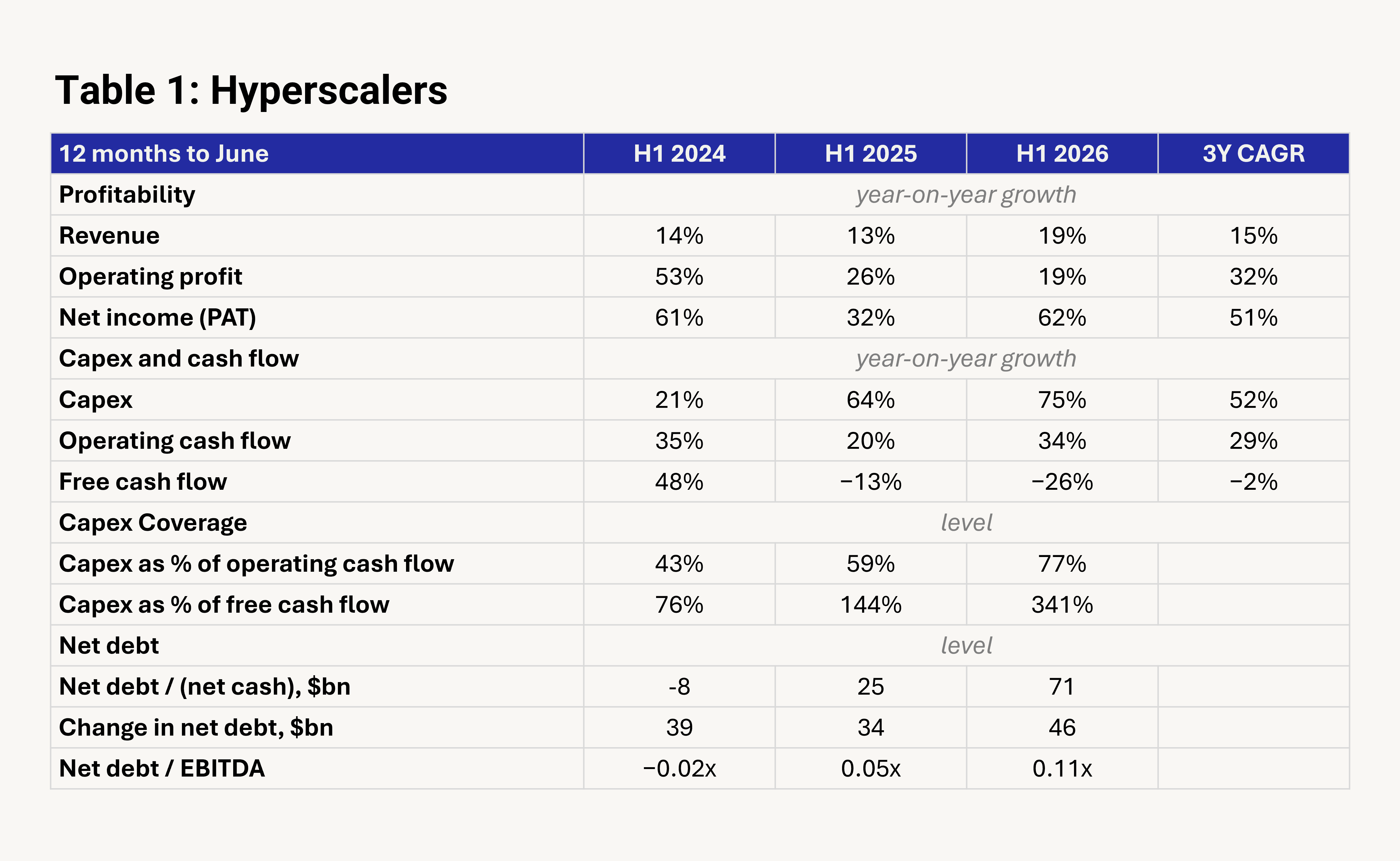
Source: Bloomberg. Hyperscalers include Meta, Amazon, Microsoft, Alphabet, Debt includes long term debt + long term leases + current portions of long term debt and leases
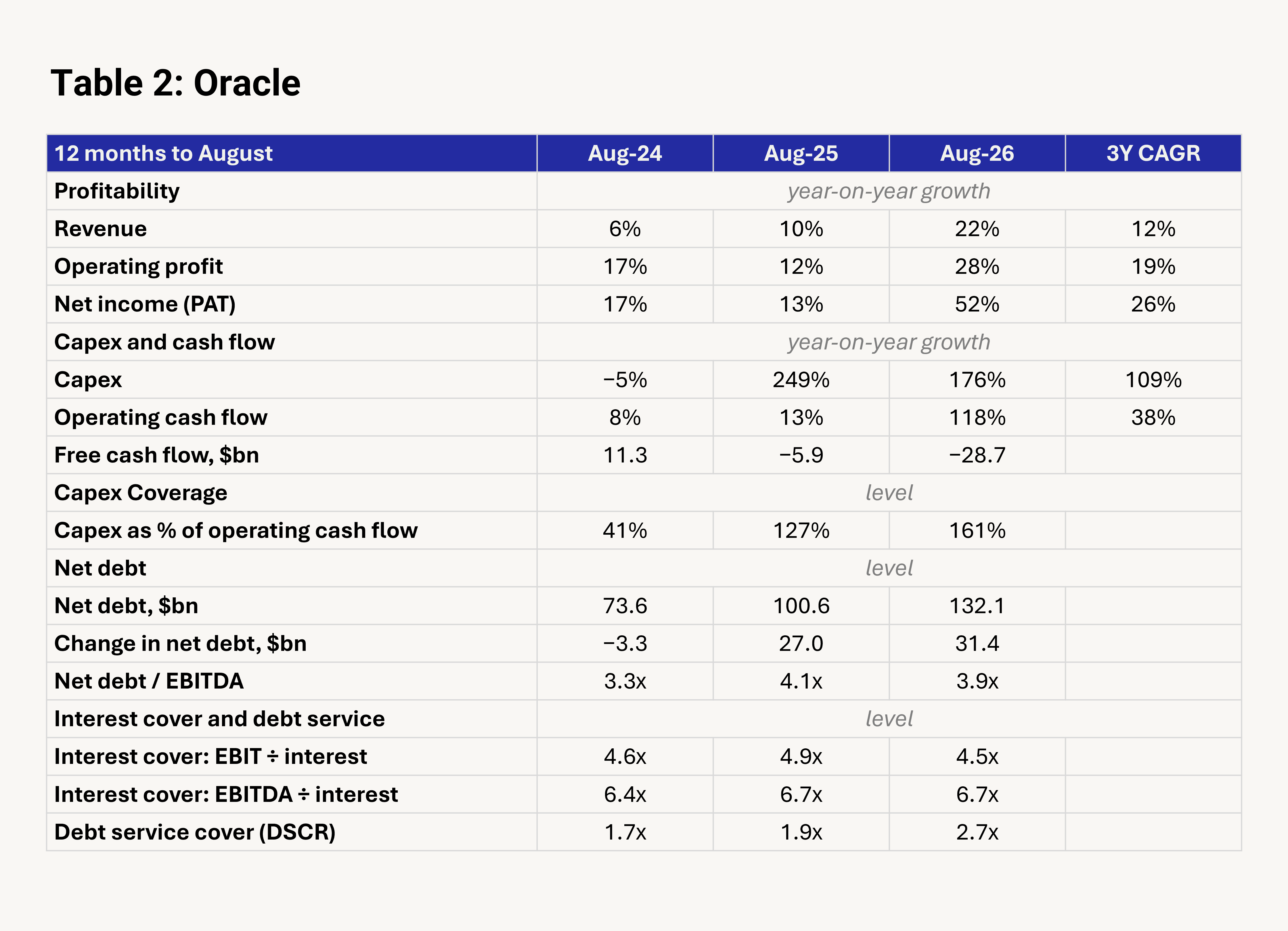
Source: Bloomberg, Debt includes long term debt + long term leases + current portions of long term debt and leases
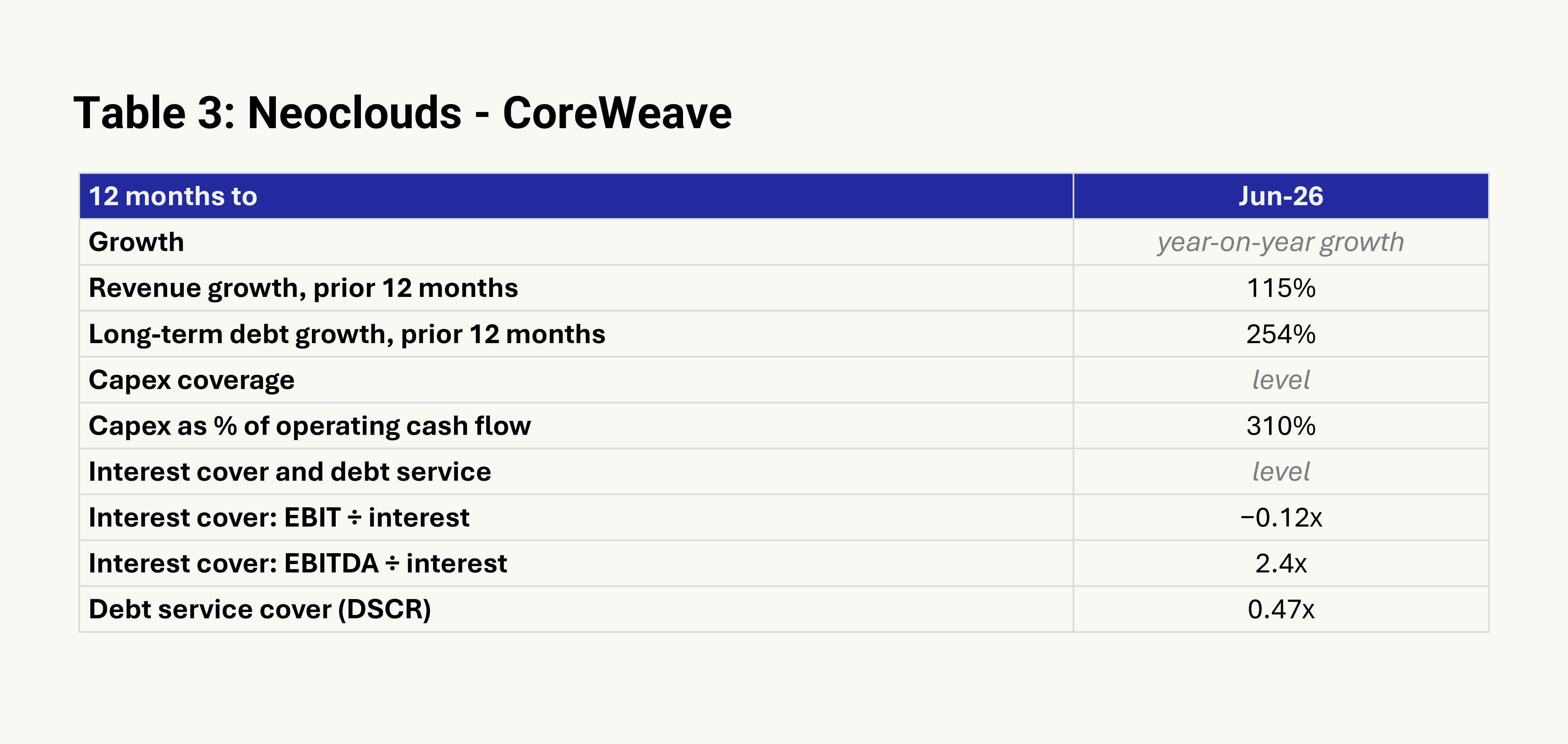
Source: Bloomberg, Debt includes long term debt + long term leases + current portions of long-term debt and leases