


India equities: the event window, 27 October to 5 November

Updated 27 Oct 2026•5 min read

Market note
26 October 2026
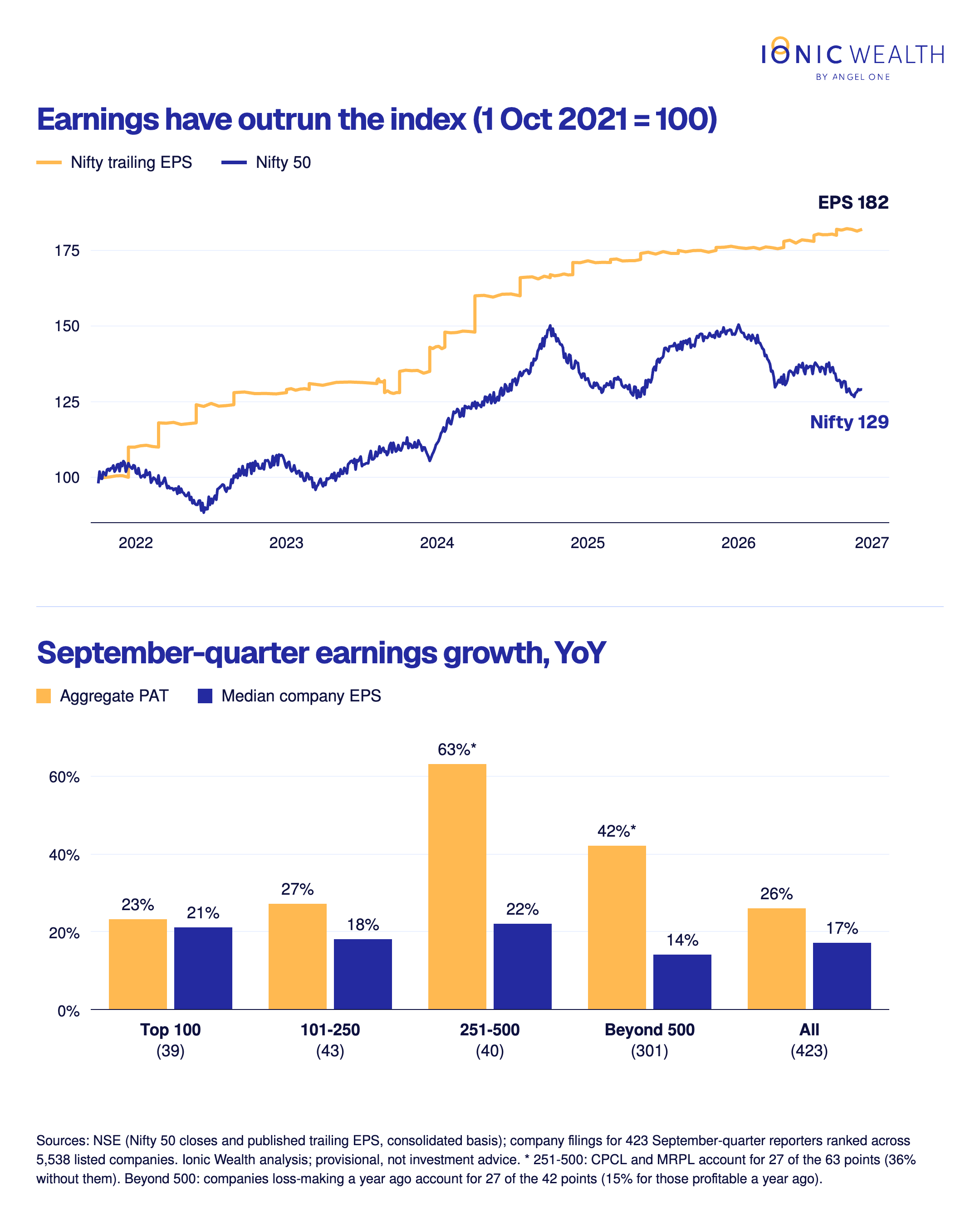
- Earnings are strong. The 423 companies with September-quarter results grew aggregate PAT 26.5% and sales 22.6%. Aggregate PAT rose more than 20% in every size bucket (top 100: 22.9%) and median EPS rose 17.3%.
- The near-term backdrop is the opposite. Israel's election, the Fed, ECB, BoJ and BoE and the US midterms all fall between 27 October and 5 November, with the US-Iran standoff unresolved throughout. Brent has risen from under $97 to $114-116 this month.
- At home, Jio IPO refunds and the October F&O expiry fall on 27 October, and the NSE MTF book is unwinding from ₹1.51 lakh crore at end-September. Mid and small caps have fallen hardest.
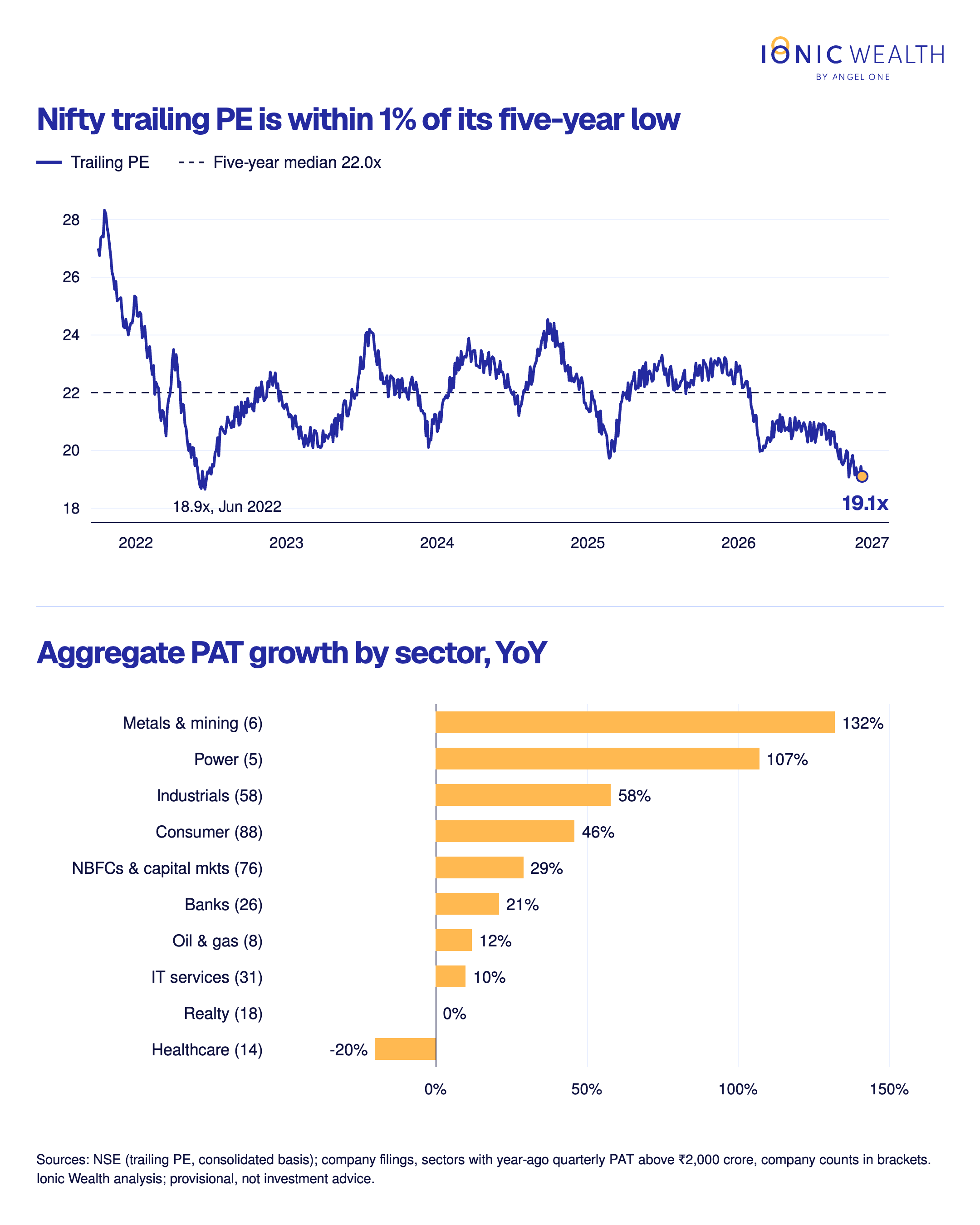
- Prices have absorbed much of this. Nifty closed at 22,600 on 23 October, 14.2% below its January high; at 19.1x trailing earnings it is within 1% of its five-year low (median 22.0x), while mid and small cap multiples sit far higher in their ranges. We see size risk-reward as market neutral and hold our 60:40 large to mid and small cap weights for now.
- Levels: first support 22,230-22,330 (the October and March 2026 lows), critical support 21,800 (the March to June 2024 lows) and critical resistance 23,600 (the February to March 2025 rebound highs and the July 2026 low).
- Risk case: escalation after the midterms, Brent above $120 or a hawkish Fed path, with a close below 22,230 opening the way to 21,800.
- Opportunity case: a US-Iran deal could unwind much of October's rise in Brent, about ₹4.7 lakh crore of Jio money is unblocked from 27 October and earnings keep compounding. The right response depends on each investor's leverage, horizon and risk tolerance.
The calendar: what is priced, and the two-way case with our view
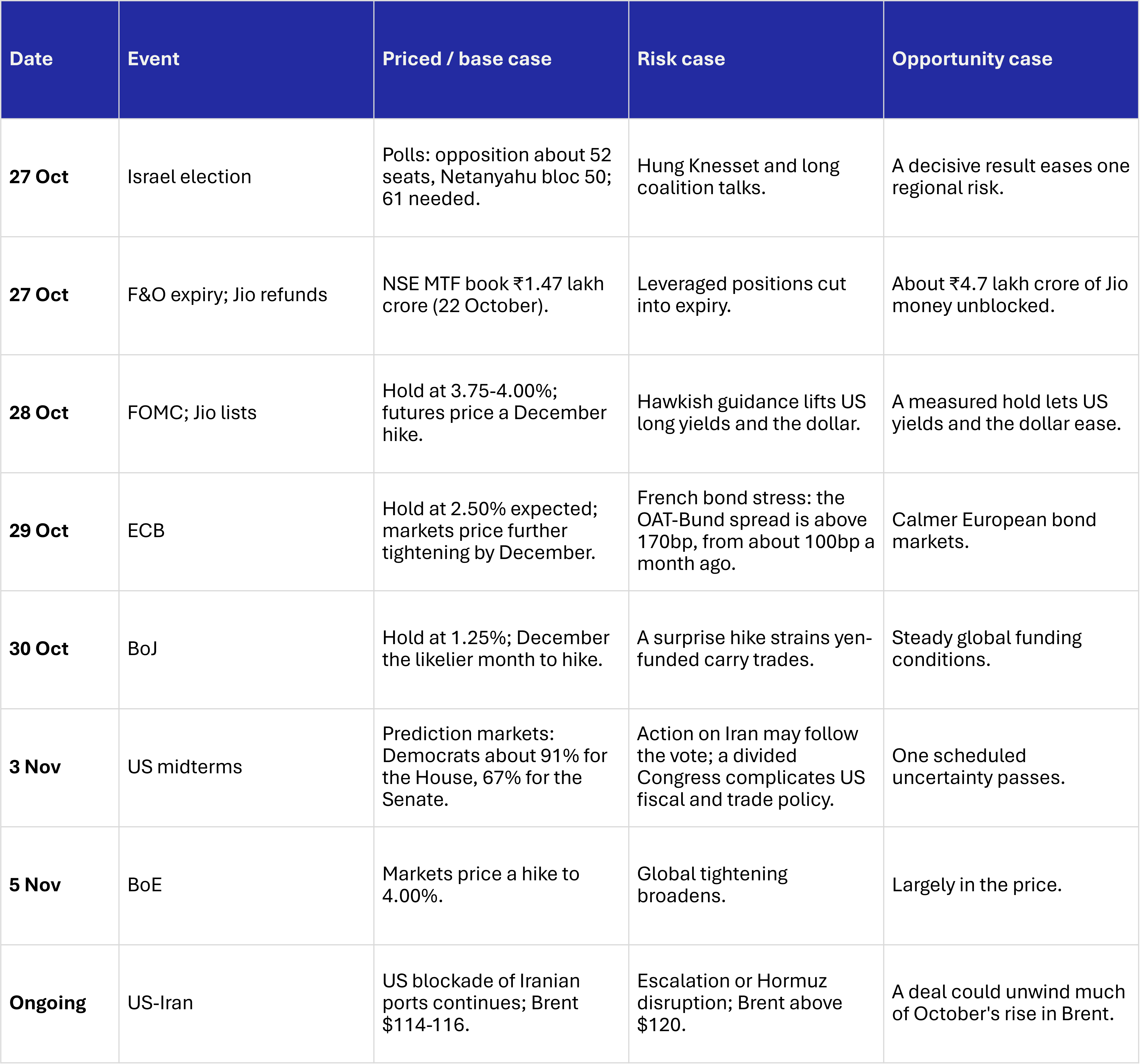
Event dates: Israel Central Elections Committee; Fed, ECB, BoJ and BoE published meeting calendars; US election calendar; NSE (F&O expiry); Jio offer timetable. Market pricing as of 23-26 October from fed funds futures, money-market pricing and prediction markets; Israeli opinion polls.
Sources and method. NSE (index, EPS, PE, MTF, ownership, provisional flows); company filings for 423 September-quarter results to 26 October; NSE PE and RBI 10-year yield for the earnings-yield percentiles (monthly from 2011; Midcap 150 from 2016, Smallcap 250 from 2021); fed funds futures, money-market and prediction-market pricing; Israeli polls; Jio offer documents and exchange bid data; market breadth data (Chartink, 23 October); Ionic Wealth analysis. Aggregates sum company-level PAT; median EPS covers companies profitable a year ago; Jio release is 22.2 times bids on 19.75 crore shares at ₹1,119 less allotment.
What it means for India?
- Earnings. Banks grew aggregate PAT 21% (27% excluding HDFC Bank) and NBFCs, capital-market firms and insurers 29%; metals and power more than doubled. IT grew 10%, oil marketing companies fell and healthcare declined 20%.
- Crude and the rupee. Oil hits India's import bill, rupee and margins at once; BPCL and HPCL EPS fell 21% and 6%. The rupee has steadied at 94.9; our working scenario is 92-93 over six months if crude and the dollar ease.
- Positioning and flows. FPI ownership of NSE-listed companies fell to 15.1% in June 2026 (15.8% in March), the lowest in at least 17 years. DIIs bought ₹10,942 crore last week against FII sales of ₹2,697 crore; light foreign positioning limits forced selling.
- Valuation and size. Against the 10-year yield at 7.47%, the Nifty 50 earnings-yield gap sits at the 18th percentile of our monthly series since 2011, the Midcap 150 at the 56th and the Smallcap 250 at the 100th; on absolute PE the Nifty 50 is in the bottom 1% of five years. With earnings strong across the board we see size risk-reward as market neutral and keep our 60:40 large to mid and small cap weights for now, a modest tilt against the 65:35 market split. Financials are cheapest (Bank Nifty 12.7x, 5th percentile) but with domestic ownership heavy may need foreign buying for a bid.
- Liquidity. Jio's ₹30,213 crore issue drew about 22 times on its non-anchor book, releasing about ₹4.7 lakh crore from 27 October, much of it institutional or borrowed. The MTF book is still 39% above its March level.
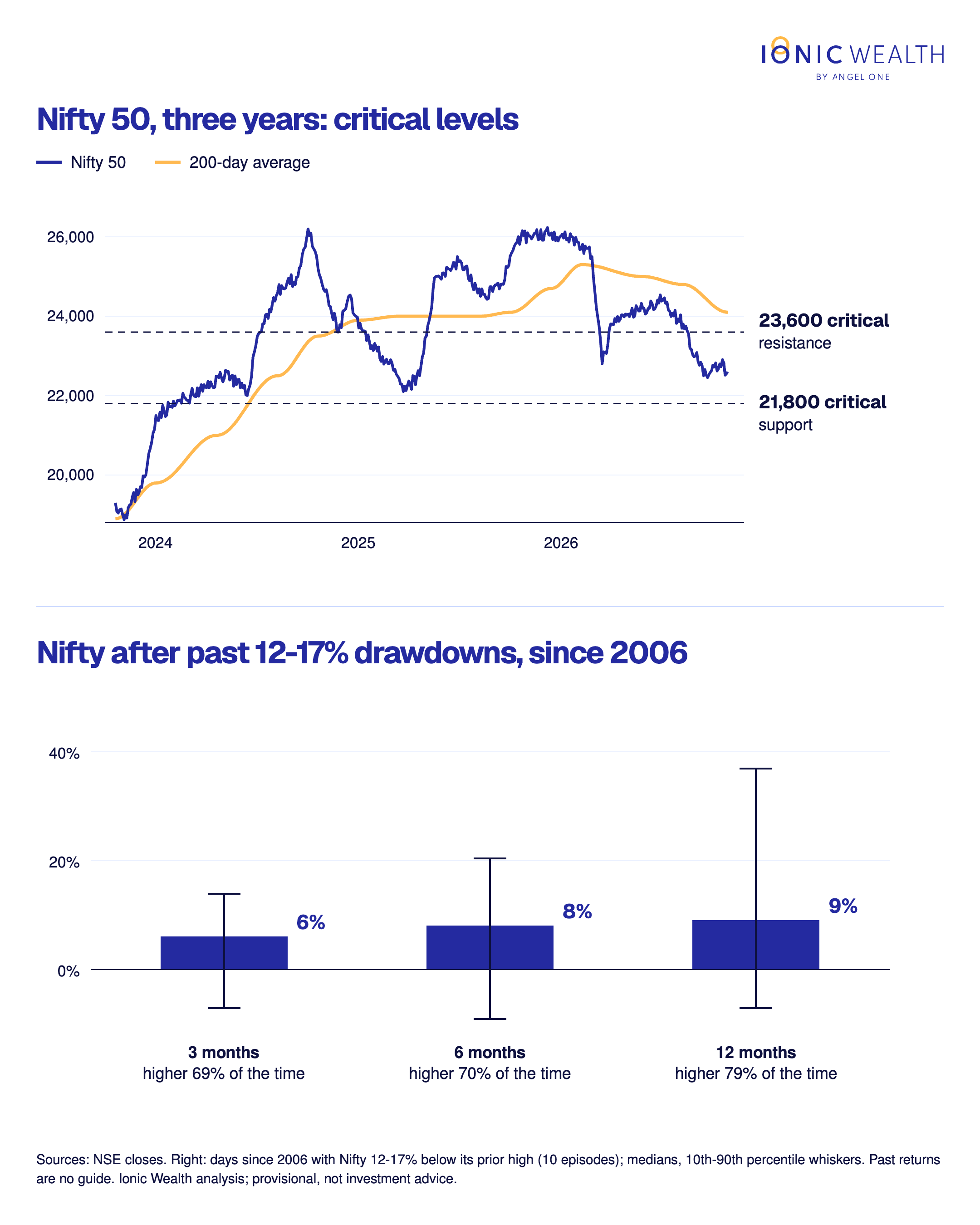
Technical read. Nifty is testing the 21,800-22,330 support zone that held in April 2025 (22,162), March 2026 (22,331) and on 8 October (22,232); 21,800 is the March to June 2024 base. Above, the first hurdle is the short-term averages near 22,700-22,800, then 23,600 (the early-2025 rebound highs and the July 2026 low); only a move above 24,500-24,800, the 2026 rebound highs, would restore the uptrend. The Midcap 150 and Smallcap 250 sit about 12% below their September highs with 14-day RSI near 28, and 7% of stocks are above their 20-day average, as washed out as at the March 2026 low, which preceded the April rebound. That low was confirmed in stages: the breadth washout first, then a broad buying surge with most stocks up 4% or more in a day, then trend repair as stocks above their 200-day average climbed back towards 40% (25% today). The washout is partly in place; we watch for the next two before calling a durable low.
Two paths through the window

Our standing view and what we watch
We remain constructive on the Indian earnings cycle: the September quarter has been strong across size buckets, while the next ten days carry heavy geopolitical and policy risk that cuts both ways. We see size risk-reward as market neutral and hold our 60:40 large to mid and small cap weights for now. Investors carrying leverage may want to review it before expiry; those with cash and a long horizon may consider staggering entry only for the next couple of weeks, in discussion with your advisor. Overall our views, weights and deployments remain broadly the same and we continue to watch Brent, USDINR, US long yields and DXY, bank credit, the MTF book and FII flows.