



PRIM, PMS or Mutual Funds: Which one works better for You under SEBI’s New Rules?

 Shobhit MathurIonic Wealth | Co-Founder
Updated 8 Oct 2026•8 min read

India’s portfolio management landscape is changing.
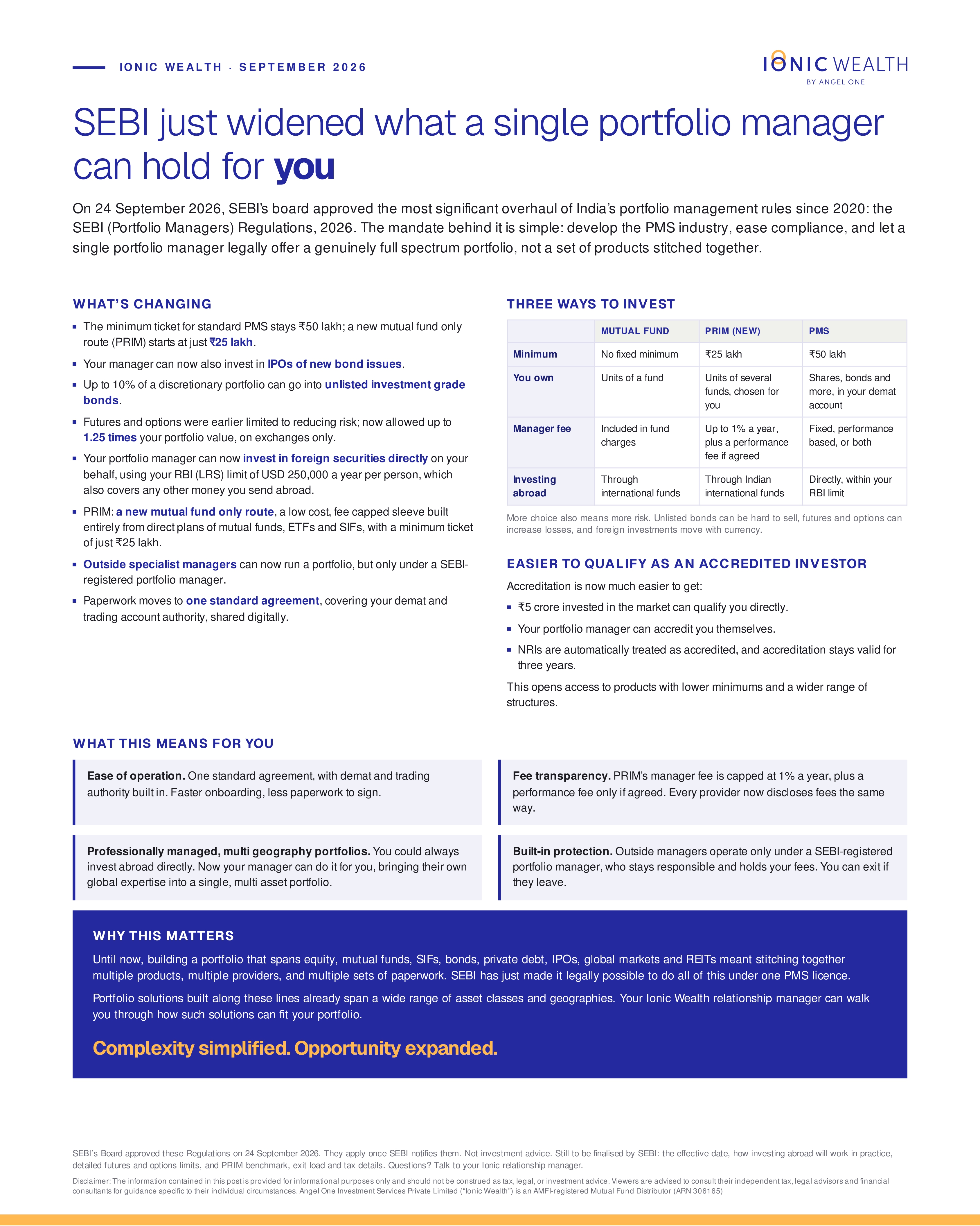
On 24 September 2026, SEBI’s board approved a major overhaul of the portfolio management framework through the new SEBI (Portfolio Managers) Regulations, 2026. The changes are designed to give portfolio managers greater flexibility, simplify compliance and, importantly, allow investors to access a much wider range of assets through a single managed portfolio*.
One of the most interesting additions is PRIM, a new mutual-fund-only portfolio management route with a minimum investment of ₹25 lakh.
That creates a new question for investors: if you already have mutual funds, why consider PRIM? And if you have ₹50 lakh or more, when does PMS make more sense?
The answer depends less on which option is “better” and more on how much control, convenience, diversification and professional management you want. Note: SEBI’s Board has approved the new portfolio management framework, but the official circular and detailed operational guidelines are yet to be issued. Certain aspects, including the implementation timeline, PRIM’s tax treatment, benchmarking, exit-load framework and the detailed rules around overseas investments and derivatives, may therefore be subject to further clarification. Investors should consider the framework discussed below as an overview of the changes approved by SEBI’s Board and refer to the final circulars and guidelines before making any investment decisions.
What exactly is the newly proposed PRIM portfolio
Is PRIM better than a direct mutual fund portfolio?
Not necessarily, because they are fundamentally different.
A mutual fund is an investment product, while PRIM is a portfolio management service built around mutual funds. Under PRIM, investors with a minimum ₹25 lakh can have a SEBI-registered portfolio manager select and manage a portfolio of direct-plan mutual funds, ETFs, index funds and SIFs. The manager decides how much to allocate to each fund, monitors the portfolio and rebalances it when required. With a traditional mutual fund portfolio, the investor makes those decisions themselves.
That distinction is important. An investor who is comfortable selecting a few low-cost funds, deciding the allocation and staying disciplined through market cycles may find mutual funds to be the simpler and more cost-efficient option. PRIM is designed for someone who wants to delegate those portfolio-level decisions to a professional.
In other words, PRIM does not replace mutual funds. It acts as a wrapper for ease of execution and for adding a professional expertise of fund selection around them. Does PRIM mean paying for two levels of professional management?
Effectively, yes. The underlying mutual funds already have fund managers who decide which stocks, bonds or other securities to hold within each scheme. The PRIM manager operates one level above them. Their role is to decide which funds belong in your portfolio, how much to allocate to each and when that allocation needs to change.
This addresses a common problem with self-managed portfolios. Investors tend to add funds over time: one for large caps, another for mid caps, then a debt fund, perhaps a thematic or international fund. Each investment may have looked attractive when it was bought, but the portfolio as a whole can eventually become fragmented or unintentionally concentrated.
A PRIM manager looks at the portfolio as one unit and takes responsibility for keeping the allocation aligned with the overall strategy. There is, however, a cost to that additional layer. The PRIM manager can charge a fixed fee of up to 1% a year, with a performance fee also permitted if agreed upon. The underlying funds continue to have their own expense ratios. How much freedom does a PRIM manager have?
A PRIM manager can select funds across fund houses and categories, giving them flexibility to construct the portfolio based on the investor’s requirements rather than limiting them to one fund provider.
There are also safeguards around conflicts of interest. No more than 25% of the portfolio can be invested in schemes belonging to the manager’s own group. The manager makes the allocation and rebalancing decisions, while the investor continues to own the underlying units and receives consolidated reporting on the portfolio.
There is however, one practical limitation when it comes to SIFs. Since SIFs require a minimum investment of ₹10 lakh per investor per AMC, a ₹25 lakh PRIM portfolio can realistically access SIFs from only one or two fund houses. Who Is PRIM Really For?
PRIM occupies an interesting middle ground. It sits between do-it-yourself mutual fund investing and full-service PMS. For investors who are comfortable choosing and managing their own funds, traditional mutual funds may remain the most efficient option.
For investors with ₹25 lakh or more who want professional allocation and rebalancing but prefer a fund-based portfolio, PRIM creates a new route.
For investors with ₹50 lakh or more who want access to direct equities, bonds, IPOs and international investments under one professionally managed portfolio, PMS may be more suitable.
This makes PRIM particularly interesting for investors who have gradually accumulated multiple mutual funds but no longer want to manage the portfolio themselves. However, the success of the category will ultimately depend on one thing: whether managers can demonstrate meaningful value after fees, expenses and taxes.
PMS Gets a Wider Investment Toolkit
While PRIM creates a new lower entry point into professionally managed portfolios, the changes to PMS may have an even broader impact.
What changes for PMS investments under the new rules?
The 2026 framework significantly expands the investment universe available to portfolio managers.
Some of the key changes include:
IPOs and new bond issues: PMS managers can now invest in these opportunities for clients.
Unlisted bonds: Up to 10% of a discretionary portfolio can be invested in unlisted investment-grade bonds.
Futures and options: Derivatives, which were earlier primarily permitted for risk reduction, can now be used more extensively, subject to the prescribed limits and exchange-based framework.
Foreign securities: PMS managers can invest directly in overseas assets on behalf of clients, within the applicable regulatory framework.
This wider toolkit can create more opportunities, but it also makes portfolio construction more important. Unlisted bonds can carry liquidity risk. Derivatives can magnify losses. Foreign investments introduce currency and global-market risks. More investment choices do not automatically create a better portfolio. The value lies in how those choices are combined. What does the new framework change for global investing?
For investors looking beyond Indian markets, this could be one of the most significant developments.
Until now, most regulated overseas exposure for Indian mutual fund investors came through international mutual funds and ETFs. That route has faced capacity constraints, with an industry-level overseas investment limit of USD 7 billion and a USD 1 billion limit for overseas ETFs at the fund level.
The new PMS framework allows portfolio managers to invest directly in foreign assets on behalf of clients, bringing global exposure into the same professionally managed portfolio as their Indian investments.
This can include listed foreign equities and debt, overseas mutual funds, ETFs, index funds and foreign government securities. The distinction is subtle but important. Investors could already invest abroad on their own. What is new is the ability to have a portfolio manager incorporate those investments into the overall portfolio strategy.
How much can a PMS investor invest abroad?
Overseas investments are made in the investor’s own name, with the required consent and subject to FEMA and the Liberalised Remittance Scheme. The practical limit is therefore linked to the investor’s LRS limit of USD 250,000 per person per financial year, which also covers other eligible remittances made abroad.
There are tax considerations as well. Remittances above ₹10 lakh a year attract 20% TCS, which can subsequently be adjusted against the investor’s tax liability. The precise implementation of overseas investing under the new PMS framework will become clearer as further regulatory guidance is issued.
If PRIM starts at ₹25 lakh, why would someone choose PMS instead?
Because the two offer very different levels of portfolio flexibility.
PRIM is limited to Indian mutual fund products. That means investors can access diversification through mutual funds, ETFs, index funds and SIFs, but cannot use PRIM to directly hold individual equities, bonds or IPOs.
PMS has a much broader toolkit. If your objective is to combine direct equities, bonds, IPOs and global investments under a single portfolio manager, PMS may offer a better fit. If you prefer a professionally managed fund-based portfolio and want access to that service at a lower entry point, PRIM may be more appropriate.
The difference between ₹25 lakh and ₹50 lakh, therefore, is not just about the minimum investment. It also reflects the breadth of investment choices available to the portfolio manager.
How will PMS & PRIM performance be measured and benchmarked under the new framework?
The new framework also puts greater emphasis on making performance easier to evaluate.
Each PMS approach is classified under a defined strategy such as equity, debt, hybrid or multi-asset. APMI provides benchmarks for these strategies, with the manager selecting the applicable benchmark. Performance is measured on a time-weighted basis and reported net of fees and expenses, giving investors a clearer picture of the returns they actually retain.
Managers also cannot simply change benchmarks to present their performance in a more favourable light. If a benchmark is changed, investors must be offered an exit without an exit load, and the previous track record cannot simply be carried forward under the new benchmark.
For PRIM, the benchmarking framework has not yet been specified. Until that framework is finalised, investors should ideally compare a PRIM portfolio’s net return with an appropriate low-cost index or index-fund combination that has a similar asset allocation.
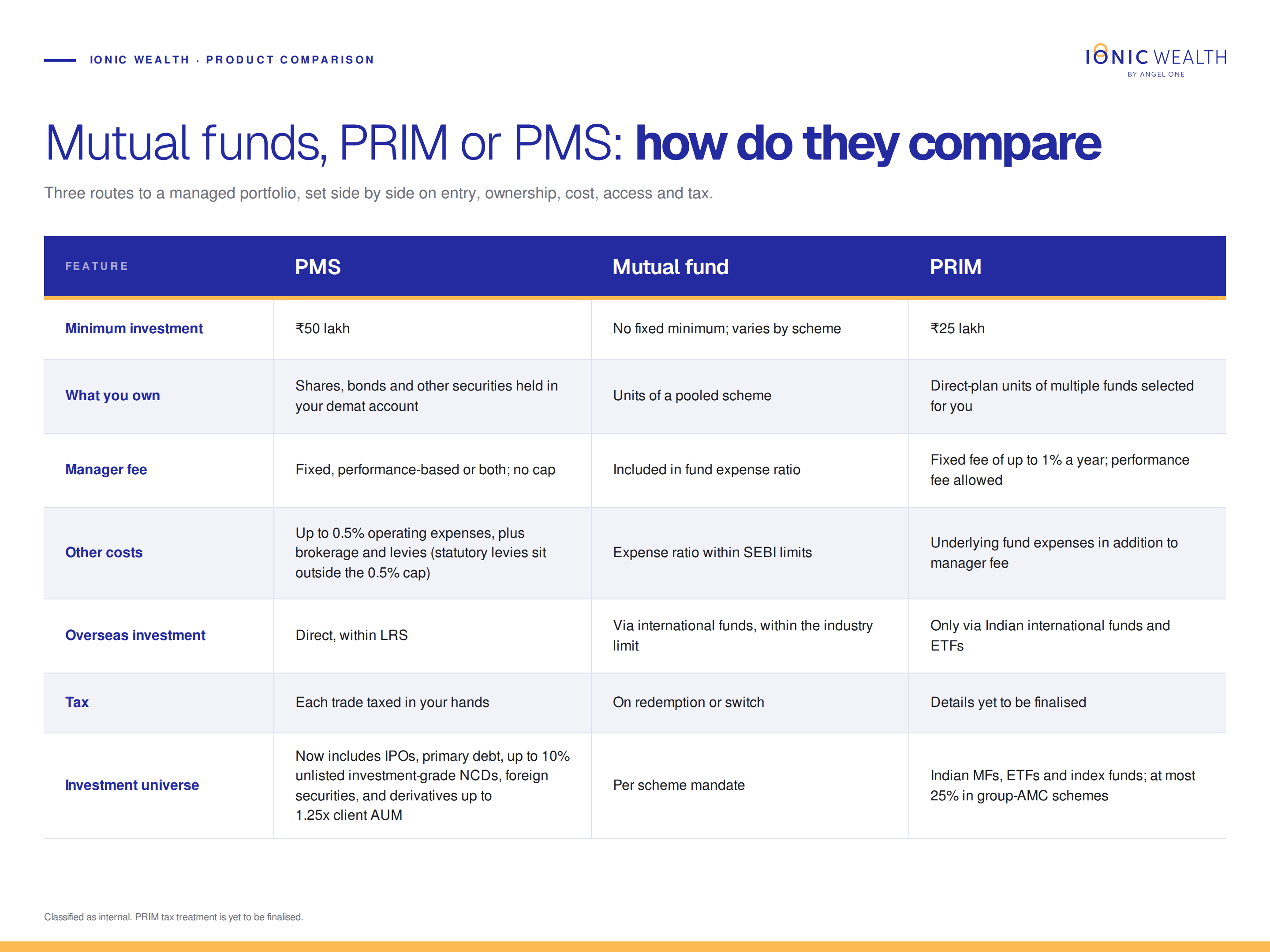
Ultimately if you are to choose what suits you the best, the choice comes down to three questions:
- How much capital do you have?
- How much control do you want to retain?
- And how much responsibility are you willing to delegate? ***