
Vantage Point by Ionic Wealth: The DRAGONS
 AI Summary
This article introduces "DRAGONS" (Desi Rooted, Global Opportunity Navigators) as a rising cohort of globally mobile Indians driving economic growth, underscoring government support and Union Budget 2026's potential to facilitate their cross-border wealth strategies.
Key Takeaways
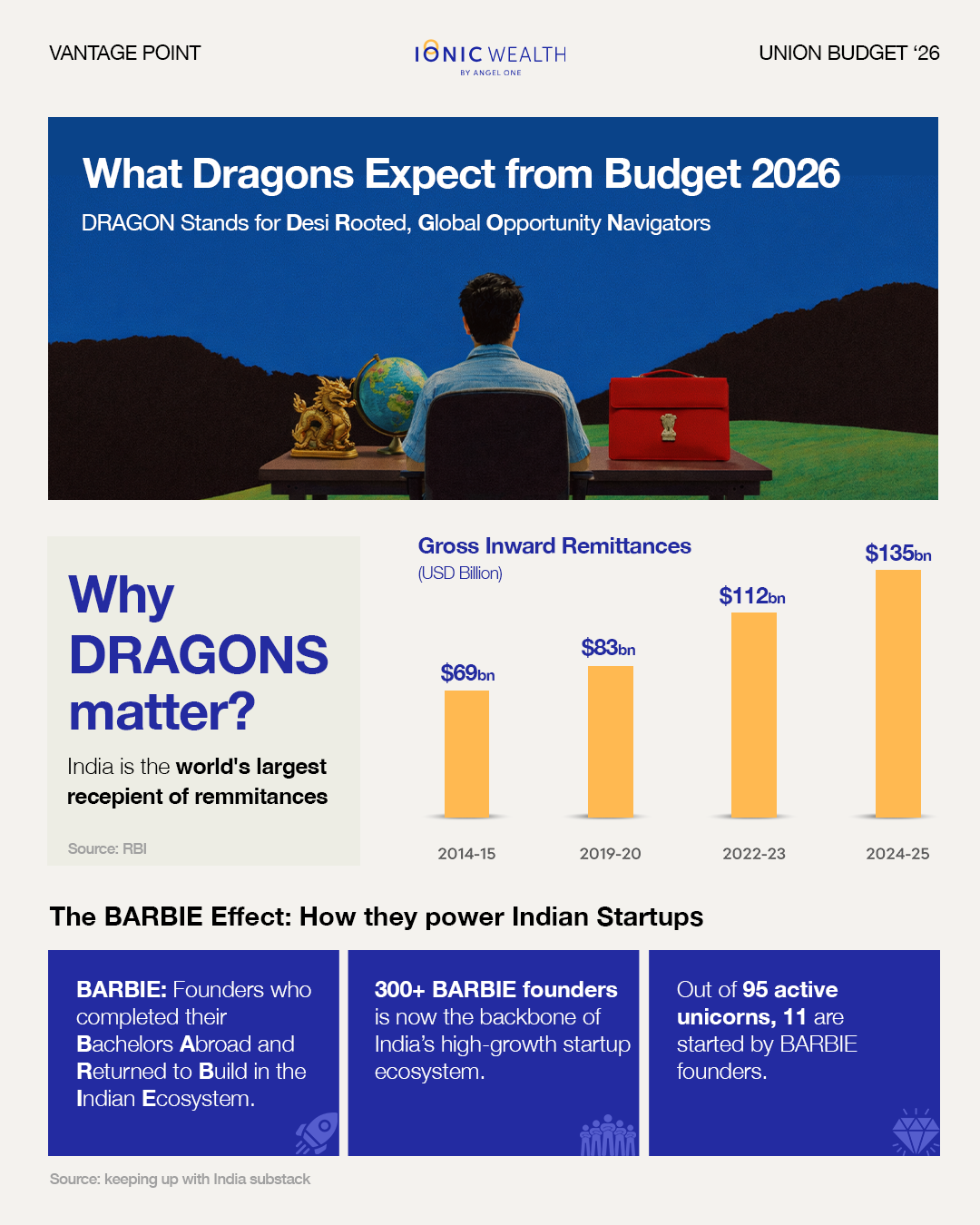
- Globally mobile Indians, including NRIs and returning professionals (BARBIEs), are significant economic contributors; India received US$87 billion in remittances in 2020.
- Union Budget 2026 is expected to address cross-border tax friction (e.g., Foreign Tax Credit reform, TDS simplification for property sales), incentivize "reverse brain drain," and enhance global financial integration (e.g., dividend tax rationalization for IFSC units).
- These evolving policies and the DRAGON cohort's rise create new opportunities for cross-border wealth planning, impacting long-term portfolio strategy by enabling efficient capital and capability movement.
Union Budget 2026 - Rising Importance of the Desi Rooted, Global Opportunity Navigators (DRAGON)
Aspirations of globally mobile Indians have transitioned from seeking survival abroad to commanding global leadership and building world-class ecosystems at home.
Indian-origin executives have been at the helm of some of the world’s most influential organisations. Indian cross-border professionals are leading across domains from tech giants like Microsoft and Google to global institutions like the World Bank and iconic brands like Chanel and Pepsico. Their success is a testament to blending the rigour of Indian education with global perspectives - an increasingly common trait among NRIs and returning Indians.
At the same time, a new cohort, labelled BARBIEs (Bachelors Abroad Returning to Build in the Indian Ecosystem), is now taking over headlines. They represent niche US undergrad returnees who have launched high-growth companies like Zepto and aspire to solve problems at "India scale" - leveraging distribution, speed, and execution to build consumer brands, fintech, and software tools.
All-in-all, we see an increasing resurgence of the intention to build upon cross-border wealth planning opportunities, while maintaining homegrown roots, i.e. the Desi Rooted, Global Opportunity Navigator (‘DRAGON’) is awakening; an evolution that has direct implications for cross-border wealth planning
Government Adds Fuel to the Flames
On the path to the “Viksit Bharat 2047” vision, the Government has been focused on creating an enabling environment for sustained growth and development. We have increasingly seen the importance of the globally oriented Indian playing out, both as an economic contributor abroad and as a potential catalyst for economic growth.
Economic Connectivity and Remittances: India remains the world’s largest recipient of remittances, receiving US$87 billion in 2020, a substantial portion of which originated from the United States. These inflows form a meaningful component of India’s forex reserves and underscore the macroeconomic importance of the NRI diaspora. Legal Privileges and Formal Engagement: Through the OCI framework, the government has offered extensive privileges to the Indian diaspora including long-term visa-free travel, property ownership rights, and access to domestic educational institutions. This is particularly relevant for NRIs and returning Indians evaluating long-term residency and tax status in India. The engagement is further reinforced through formal platforms like the annual Pravasi Bharatiya Divas.
Safety and Crisis Management Resolve: India has also demonstrated capacity and commitment to protecting globally mobile Indians during periods of international stress, most notably through large-scale evacuation efforts like Vande Bharat and Operation Kaveri.
Taken together, these measures reflect a clear strategic intent. Globally mobile Indians are no longer viewed as peripheral stakeholders but form an integral part of India’s long-term growth and development agenda.
Ionic Wealth View: The economic relevance of globally mobile Indians lies in their ability to connect Indian growth with global capital and capability.
Wind beneath the DRAGONs’ Wings
While the direction of policy is evident, the upcoming Union Budget 2026 will be closely watched for how these signals translate from intent to implementation, particularly for NRIs and returning Indians. For the aspirations of the DRAGON cohort, expectations focus on reducing friction, improving certainty and aligning institutional frameworks with global standards.
1. Mitigating Cross-Border Tax Friction and Compliance: For globally mobile professionals, the ability to operate seamlessly across jurisdictions remains a critical enabler.
- Foreign Tax Credit (FTC) Reform: There is a strong call for FTC relief at the point of withholding. Currently, salaried individuals with foreign income often face double taxation until they file their returns, which locks up essential funds; the expectation is that the Budget will allow employers to factor in these credits during monthly TDS.
- Alignment of Filing Timelines: Taxpayers often face a mismatch between Indian and international tax calendars (such as the US). The sources indicate an expectation to extend the deadline for filing revised or belated returns from December 31 to March 31 to accommodate finalised foreign tax details.
- Property Transaction Simplification: For NRIs selling property, the current system blocks 12.5%–31.2% of funds in TDS, creating liquidity challenges linked to capital gains tax and TDS on NRI property sales. There is a demand to shift to a digital "challan-cum-statement" system, similar to that used for resident sellers, to improve liquidity.
2. Incentivising the "Reverse Brain Drain" and Talent Mobility: With the return of globally trained professionals emerging as a policy priority, the focus now shifts to reducing the frictions associated with relocation and reintegration.
- Targeted Returnee Benefits: Expectations include structured incentives aimed at returning professionals, such as transitional tax relief, housing support, and access to specialised research or innovation grants.
- Clarity on Compensation (ESOPs & Secondments): To support mobile talent, there is a demand for a standard formula for ESOP taxation based on where services were rendered during the vesting period. Additionally, companies seek safe harbour provisions for employee secondments to ensure they do not inadvertently create a Permanent Establishment (PE) in India.
- Global Capability Center (GCC) Growth: to attract senior leadership and specialised talent for GCCs, there is an expectation of a concessional 15% corporate tax rate for new centres, aligning India more closely with competing global hubs.
3. Enhancing Global Financial Integration and IFSC Competitiveness
Positioning India as a global financial hub requires regulatory parity with established international centres such as Dubai and Singapore, particularly within GIFT City (IFSC).
- Dividend Tax Rationalisation: While interest income is exempt, non-resident shareholders in IFSC units still face a 10% dividend tax. Removing this is a key expectation to attract long-term foreign capital.
- Regulatory Certainty: There is an expectation of clarity on GAAR exemptions for IFSC units, which can potentially provide predictability for global investment funds.
- Educational Remittance Relief: Families of students who are seeking overseas education are seeking additional relief on the TCS exemption thresholds (currently at 10 lakh per financial year) as in practice, the relief is limited and upfront tax continues to strain cash flow management.
4. Strengthening the Research and Innovation Ecosystem
For DRAGONs building global solutions from India, domestic innovation capacity is as important as policy certainty.
- Increased R&D Investment: There is a push for raising public R&D spending towards 3% of GDP, with emphasis on strategic sectors such as space-tech, quantum computing, renewable energy, and AI.
- Entrepreneurial Infrastructure: Founders operating at “India scale” expect targeted infrastructure support, including compute-credit schemes that improve access to GPUs for AI model training without reliance on offshore infrastructure.
- Digital Transformation: Initiatives such as Digital Land Ledgers are expected to be prioritised to enable innovators in rural sectors to unlock formal finance, improve transparency, and enable market access.
For a cohort that already operates across borders by default, the real differentiator for DRAGONs will be execution, not intent.
The Union Budget 2026 has the potential to move from broad signalling to targeted enablers, with long-term implications for NRI wealth management and cross-border portfolio strategy. As India moves towards its 2047 ambition, the question is no longer whether globally oriented Indians will participate in the country’s growth story, but whether policy will allow them to do so at full throttle.
Ionic Wealth View: Long-term wealth creation benefits most when capital, capability, and credibility move freely across borders. The DRAGON cohort plays a critical role in this transmission by sourcing global capital, anchoring enterprise in India, and scaling into international markets.
Globally mobile Indians matter to portfolios not because they move capital, but because they improve how capital compounds
.jpeg)
Don’t miss other posts in our curated coverage of Union Budget’26
Introducing Vantage Point: Here
The Luminaires: Corporate titans and promoters: Here
The Disruptors: Founders, CXOs, Professionals: Here
Enjoying this article
Share it with the world!
WHAT'S
NEW
Collection of latest reads for you

US Delivers Expected Rate Hike, Reaffirms Focus on Price Sta...
Ionic Wealth Macro Desk on 17 Sept 2026
The Fed raised rates 25 bps to 3.75–4.00% in a unanimous vote, with the dot plot pointing to one more hike in 2026. Growth and jobs stay resilient, but inflation above 3% now isn't seen h...

Macro Headwinds Weigh On Market Sentiment, US Fed Decision I...
Ionic Wealth Macro Desk on 16 Sept 2026
Oil above $100/bbl. US 10Y past 5%. DMs down 1.7%, EMs down 3.4%. INR slips despite RBI support. All eyes now on the Fed's 16th September call — Ionic Wealth holds its 70:20:10 allocation...

What goes inside a AI data center?
Ionic Global Research on 15 Sept 2026
AI is transforming data centres from traditional computing facilities into massive, power-intensive infrastructure. This edition explores the rise of AI data centres, their shift from meg...
Ionic Wealth Newsletter
Investment insights
made simple
Sign up for our newsletter about wealth, markets, and more.




AMFI Registered Mutual Fund Distributor
Angel One Wealth Limited (AOWL)
CIN AOWL - U66190MH2023PLC411784
Angel One Investment Services Private Limited (AOISPL)
ARN AOISPL - 306165
CIN AOISPL - U66190MH2024PTC426203
SEBI Registered Research Analyst Number- INH000020305
Mutual fund investments are subject to market risks, read all scheme related documents carefully.
Registered Office: 601, 6th Floor, Ackruti Star, Central Road, MIDC, Chakala, Andheri (East), Mumbai - 400 093
Copyright © 2025, Ionic Wealth | All rights reserved