



Union Budget 2026: Vantage Point by Ionic Wealth

Updated 23 Jan 2026•5 min read

Union Budget 2026 - Introducing Vantage Points
"The pitch has too much bounce this morning."
An innocuous announcement that we often hear from the commentator’s box before the day’s play. But it can have a totally different meaning, depending on the perspective of the listener.
To the batsman, it signals caution: play late, keep it tight.
To the bowler, it’s an invitation: hit the deck, let the pitch do the work.
To the keeper, it means staying sharp, hands ready, eyes level.
For the captain, it shapes the day’s strategy: field placements, bowling changes, batting order.
And for the spectator, it’s little more than background noise before the real action begins.
None of these perspectives is wrong.
And yet, none of them tells the whole story.
A clearer picture only emerges when we take a step back and see the game from every Vantage Point.
The Union Budget is no different.
Its real impact is not captured in soundbites, but in how it plays out across citizens, businesses, capital allocators, policymakers, and global participants. Over the coming days, Vantage Point by Ionic Wealth will examine the Union Budget 2026 through the eyes of those actually on the field:
- The Luminaires: Corporate titans and promoters
- The Disruptors: Founders, CXOs, professionals
- The Citizens: Taxpayers and investors
- The DRAGONs: Desi rooted, global opportunity navigators
- The Policymakers: Government through a fiscal lens
- India’s CFO: The Finance Ministry
- The Sectoral Lens: Industry insights
It’s the same pitch, the same match.
But very different games are being played.
Not Just February 1st
The Union Budget is no longer only a single day event. Over the past few years, it has taken on a more critical role of setting the tone for the fiscal and monetary policy that gets implemented through the year. As we approach Union Budget 2026, it is worth pausing to trace how this cycle has played out since the last Budget.
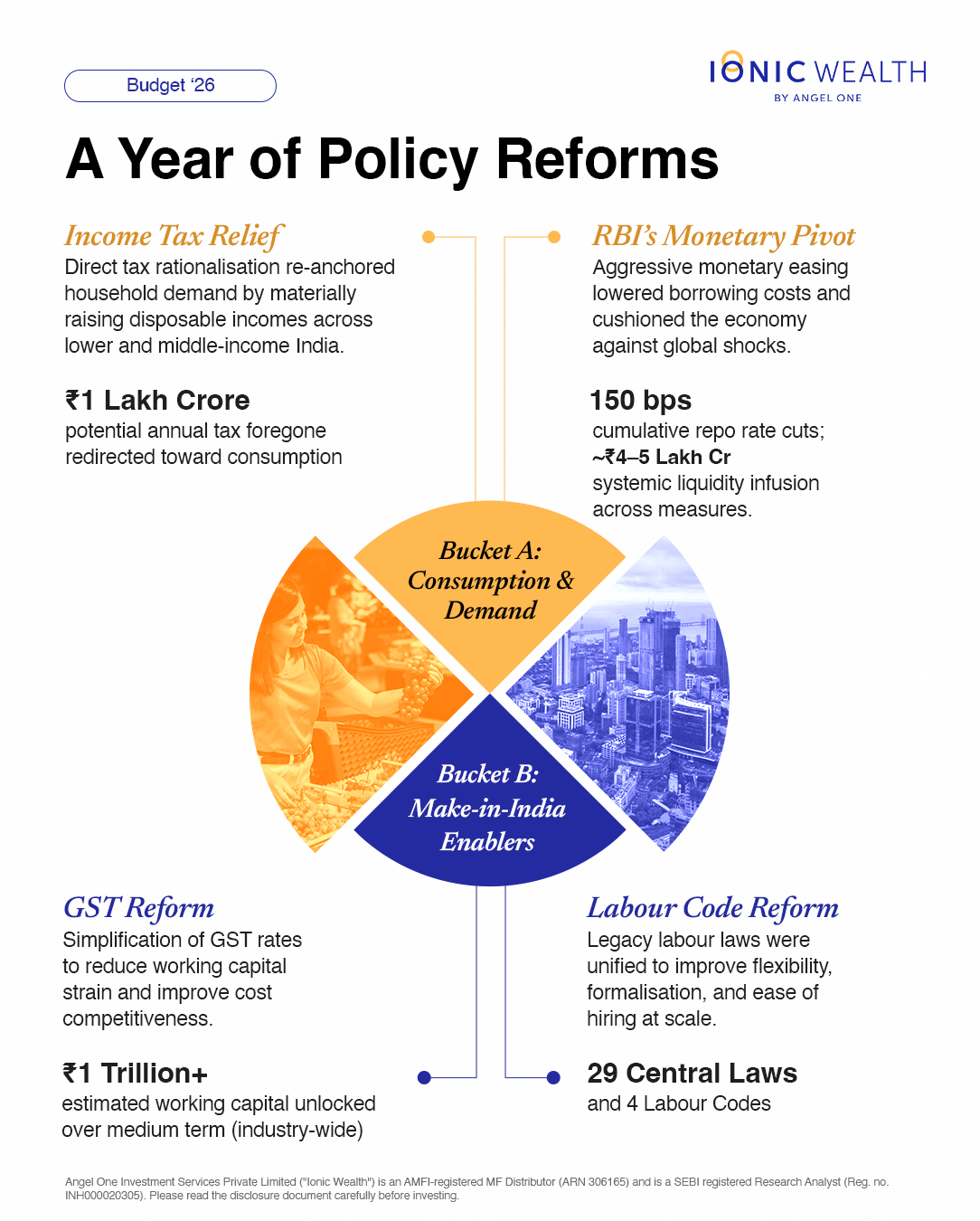
Union Budget 2025 marked a deliberate shift in emphasis. While maintaining fiscal discipline, the Government chose to re-anchor growth around domestic demand, with a clear focus on middle-class consumption and MSMEs. This was not an isolated move. Over the subsequent twelve months, fiscal intent was reinforced by monetary easing and long-pending structural reforms, even as the global environment grew more volatile amid US-led trade disruptions and tightening financial conditions elsewhere.
What followed was not a single policy lever being pulled, but a coordinated response. Fiscal measures put incremental spending power in the hands of households.
- Monetary policy acted as a shock absorber, easing financial conditions and lowering borrowing costs across the system.
- Structural reforms worked quietly in the background to improve efficiency, reduce friction, and prepare the ground for the next phase of manufacturing and export-led growth.
Together, these measures tell a broader story. FY26 was not just about supporting near-term demand; it was about balancing consumption resilience with medium-term competitiveness. These two strategies - protecting India’s consumption demand, while addressing manufacturing constraints - are best understood when viewed together, not in isolation.
The infographic below captures the four policy shifts that defined this transition year, and sets the context for the choices now confronting Union Budget 2026.
The Three Big Balancing Acts Ahead
As India approaches Union Budget 2026, the ambition of Central goals may have to reckon with the constraints of the Fiscal math. This makes the policy challenge no longer about intent, but about sequencing, prioritisation, and balancing the trade-offs.
The pitch has already been prepared; what matters now is how the next phase of play is managed.
We highlight three balancing acts that may define this Budget.
1. Supporting growth, while staying within the Fiscal plan
The first constraint is fiscal arithmetic.
FY26 tax collections have tracked approximately 3–4% below initial projections till November, reflecting slower direct tax growth and stabilisation of GST collections. At the same time, expectations of continued policy support remain elevated for corporates and MSMEs as they navigate a more challenging global environment marked by slower trade momentum and rising tariff-related frictions.
Union Budget 2026 therefore faces a practical challenge: sustaining growth momentum while remaining aligned with the Government’s stated consolidation path, including the medium-term objective of moving toward a 4.5% fiscal deficit-to-GDP ratio. This places greater emphasis on the composition, efficiency, and calibration of the Government’s capital expenditures.
2. Financing future capabilities, without diluting near-term priorities
The second balance is strategic.
India has articulated a clear ambition to build future-oriented deep tech capabilities across AI, semiconductors, advanced electronics, clean energy technologies, etc. The announced ₹1 lakh crore Research, Development and Innovation (RDI) Fund signals a long-term commitment to productivity, technology leadership, and innovation-led growth.
However, near-term growth conditions remain uneven. Private capex continues to be selective, increasing the role of public investment and PSU capex in sustaining demand and enabling supply-side readiness. Budget 2026 must therefore determine how capital is allocated between long-gestation capability building and investments that support the current cycle, while keeping fiscal space and execution capacity firmly in view.
3. Continuity of consumption demand, while improving tax compliance
The third balance is policy continuity.
Consumption was the core focus of Budget 2025, with deliberate measures aimed at supporting household demand. With private consumption contributing roughly 56% of India’s GDP, preserving the stability of this engine remains important. As the economy moves into FY27, the emphasis now shifts from further stimulus to maintaining continuity in consumption growth, particularly as external demand conditions remain uneven.
At the same time, India’s consumption-led growth model increasingly depends on steady progress in broadening the tax base and improving compliance.
Budget 2026 sits at the intersection of these balancing forces.
It therefore becomes critical to take a deeper look, from different Vantage Points, and see how effectively it advances (and enhances) measures set in motion. It is worth recognising that Union Budgets rarely deliver uniform outcomes. A single measure can be a tailwind for one stakeholder, a constraint for another, and largely immaterial for a third.
That is why this series looks beyond headline numbers. In the days ahead, Vantage Point by Ionic Wealth will examine Union Budget 2026 as a collection of policy signals, interpreted differently by those actually on the field.
Next up: The Luminaires: Corporate Titans and Promoters
How India Inc. is reading the pitch ahead of Budget 2026.
Stay tuned!
.jpeg)