
Post-Vesting Holding Period: Tax Impact of Holding vs Selling RSUs Immediately
 AI Summary
Key Takeaways:
- Budget 2024 has transitioned foreign RSU taxation to a flat 12.5% LTCG rate (without indexation), offering a lower tax liability from the previous 20% LTCG rate (with indexation benefits) for long-term holders.
- The Indian Income Tax Act mandates the FIFO (First-In, First-Out) accounting method, requiring you to calculate gains based on the FMV and exchange rates of your oldest vested shares first.
- Dividend Reinvestment Plans (DRIP) significantly increase compliance complexity by creating hundreds of micro-holding periods that must each be disclosed as individual line items in Schedule FA.
- While employer-granted RSUs may not consume your annual LRS limit, they remain subject to strict FEMA regulations and carry heavy penalties for non-disclosure under the Black Money Act.
Many executives sell vested RSUs immediately because they typically trigger minimal or no capital gains tax, and the proceeds can be used to diversify their portfolios and avoid concentration risk.
However, selling RSUs immediately may not always be that easy. Many companies force their executives to hold RSUs due to trading windows, promoter guidelines, or deliberate portfolio strategy. These trading windows are locked around major corporate events, such as mergers, acquisitions, earnings calls, or changes in control, to prevent insider trading.
Holding foreign equity in India is not a passive endeavour. And if you are a tech executive retaining your RSUs past the vesting date, get ready for a long list of reporting and compliance requirements. Holding RSUs requires complex First-In, First-Out (FIFO) accounting for capital gains, creates fragmented holding periods through dividend reinvestment, and requires strict adherence to both the Income Tax Act and the Reserve Bank of India’s Overseas Portfolio Investment (OPI) regulations.
We will look at each of these requirements, starting with FIFO accounting requirements.
How Does the Income Tax Department Track the Sale of Shares from Multiple Vesting Dates?
When you sell your shares, you need to calculate the capital gain based on their Fair Market Value (FMV) as of the vested date. This very requirement can become an accounting nightmare if you are selling shares that have accumulated over years of quarterly vesting.
Because the Indian Income Tax Act strictly requires the First-In, First-Out (FIFO) method of capital gains accounting for shares held in dematerialised form. So, the shares that first entered your demat account are legally deemed to be sold first.
How does this affect you? The holding period and the capital gain are calculated on the FMV and the specific exchange rate of the oldest vesting, regardless of your current portfolio average cost. Let’s understand this with the help of an example.
Suppose Rahul’s employer vested 25 shares of $100 each on January 1, 2022, and another 25 shares of $150 each on January 1, 2024. And he sold 25 shares for $200 on February 3, 2025. Then, under FIFO accounting rules, his oldest, January 1, 2022, shares will be deemed sold, and long-term capital gains (LTCG) tax will apply, as the holding period for the sold shares is 37 months.
Many tech executives historically retained RSUs to take advantage of indexation on long-term capital gains. In Budget 2024, the government eliminated indexation for unlisted and foreign equities and reduced the LTCG to a flat 12.5% from the previous 20% with indexation.
Did Budget 2024 Destroy the Tax Benefit of Holding Foreign RSUs Long-Term?
All unlisted and foreign equities sold after July 23, 2024, are subject to 12.5% LTCG tax without indexation. Is this a good thing or a bad thing?
In indexation, the FMV of your foreign equity holding was adjusted through the Cost Inflation Index (CII), which artificially raised your cost of acquisition and lowered your capital gain. With this benefit gone, the mathematical incentive for long-term holding has changed. Let us understand this math with the above example of Rahul.
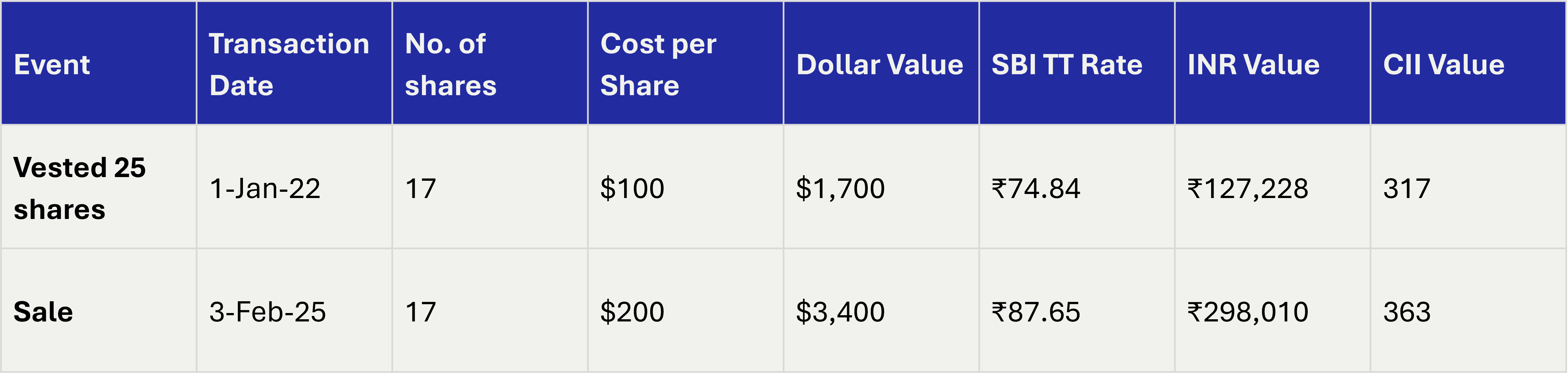
Note: We reduced the number of shares sold to 17 to account for the Perquisite Tax (TDS at the executive's slab rate) the employer deducted from the 25 vested shares.
Indexed Cost of Acquisition = Cost of Acquisition x (CII of Transfer Year/CII of Acquisition Year)
In our example, the Indexed Cost of Acquisition = ₹1,45,690 (₹1,27,228 x (363/317)
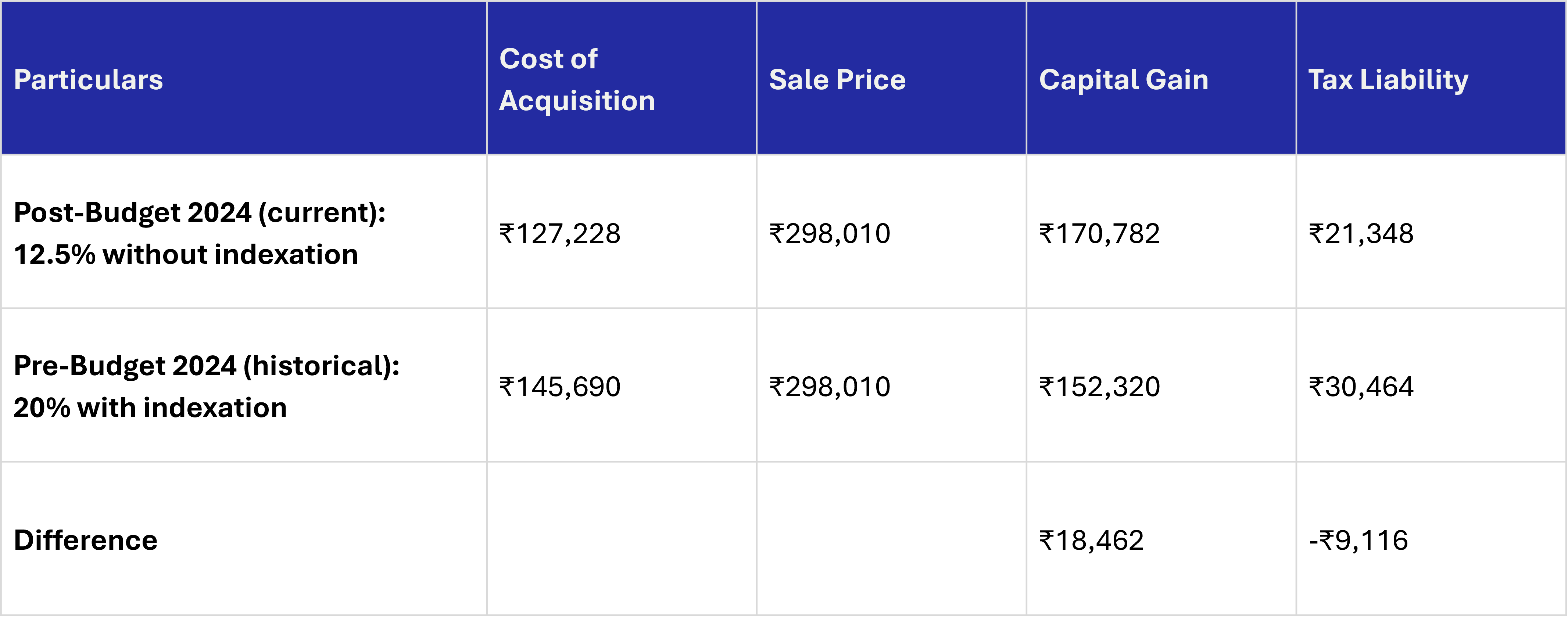
Although indexation reduced his capital gain by ₹18,462, the lower tax rate of 12.5% without indexation helped Rahul save ₹9,116 in taxes.
In this case, Budget 2024 has improved the tax benefit of holding foreign RSUs for the long term by reducing the tax rate. This, of course, depends on the appreciation of the share price and length of the holding period. The math may change but it is worth knowing the tax implications of holding foreign RSUs for the long term.
How Do Dividend Reinvestment Plans (DRIP) Fracture Your Holding Period?
Holding foreign equities becomes taxing when the dividend angle comes into play. If this dividend comes with a dividend reinvestment plan (DRIP), it could fracture your holding period.
Many mature, dividend-paying tech stocks like Apple and Microsoft offer DRIP. Several foreign brokerages use auto-reinvesting as a default option. In DRIP, your dividend amount is reinvested to buy fractional shares, which are great for compounding. However, they are only good in a tax-advantaged account. For tech executives working in India, DRIP is a tax reporting nightmare for four reasons.
- Reinvesting dividends doesn’t relieve you from the 30% withholding tax on dividends which can be reduced to 25% if a Form W-8BEN has been filed. (Note: A 15% tax rate is applicable if a Form W-8BEN has been filed by a company that holds 10% or more voting stock, which is not applicable for individual investors)
- Every single reinvested dividend creates a brand new micro-holding period and a new fractional cost basis.
- When you sell, you must calculate the holding period of hundreds of fractional shares separately to determine if the gain is short-term or long-term.
- Each fractional acquisition must be reported as a separate line item in Schedule FA (Foreign Assets) of your ITR, whether you sell it or not.
DRIP spreads your holding period and makes foreign asset reporting and tax calculation a Herculean task.
Does Transferring Vested Shares to a Personal Brokerage Reset Your Tax Timeline?
While we are on the topic of the holding period that begins from the vesting date, let’s address a common query executives have about it. Most executives receive their vested RSUs on employer-mandated platforms (such as E*Trade or Morgan Stanley). They want to migrate these shares to their own demat account.
Does this asset transfer change your vesting date and thus reset your holding period?
The answer is no.
Transferring vested shares between your own demat accounts or to a foreign brokerage does not constitute a "transfer" under Section 2(47) of the Income Tax Act. It is not a taxable event, as no asset sale occurred.
Your original vesting date remains the day your employer transferred the shares to your foreign brokerage account. However, you must meticulously preserve the original vesting statements; when you transition, the new broker may not carry over historical cost basis data required for a tax audit.
How Do You Harvest Losses if Your Company Stock Suffers a Multi-Year Drawdown?
So far, we have only talked about capital gains from the sale of vested equity shares. But the needle can also point south, and prolonged holding periods could result in losses rather than gains. You can stop this loss from growing and instead harvest it to reduce capital gain. Let’s see how.
Suppose you held vested shares for over 24 months, and the stock price collapsed. You now hold a Long-Term Capital Loss, which you can use by harvesting it at the right time.
When you have a significant capital gain in a particular tax year, sell your RSU shares and realise the capital loss. This way, you can offset your capital gain with a capital loss.
Note that capital loss cannot be used to offset salary. Salary and capital gains/losses are two separate income sources, and they are taxed differently.
Long-term capital losses can offset only long-term capital gains, whereas short-term capital losses can offset both short-term and long-term capital gains. These gains can be generated from the sale of completely unrelated assets, such as Indian real estate or domestic equity mutual funds, as long as it falls under capital income. This requires precise timing of asset sales within the same financial year to neutralise the broader portfolio tax hit.
Even if you are unable to use your entire capital loss, you can carry it forward for 8 assessment years to offset future capital gains, provided that the ITR is filed before the due date under section 139(1).
Are Unsold Foreign RSUs Classified as Overseas Portfolio Investment (OPI)?
The vested foreign equity shares held by an Indian resident are classified as Overseas Portfolio Investment (OPI), as clarified in the August 2022 update to the FEMA Rules.
While Indian companies report aggregate OPI details to the RBI via Form OPI, the individual executive's primary responsibility is ensuring these are reported annually in Schedule FA of their Income Tax Return.
Acquiring such shares from an employer grant where no funds were remitted from India, does not consume your annual $250,000 LRS limit. However, holding these assets requires you to be meticulous with disclosures to avoid heavy penalties under the Black Money Act, which governs foreign asset reporting.
Note: Readers should also note that, while the individual executive’s primary obligation is Schedule FA disclosure while filing income tax, FEMA compliance operates at two levels, Individual (Schedule FA, Income Tax) and company (Form OPI (Overseas Portfolio Investment), RBI). Generally, the company files the Form OPI on its own with the Authorised Dealer (AD) Category-I Bank, which then reports to the RBI. But for executives working at smaller Indian subsidiaries where the parent company may not have established OPI reporting infrastructure, this reporting obligation falls on the executive. Not reporting this can lead to a penalty under the FEMA Act.
Conclusion
Holding your foreign RSUs past the vesting date is a calculated trade-off. The math following Budget 2024 is clear: the transition to a 12.5% flat LTCG rate has simplified tax calculations and, in many cases, lowered total tax outgo compared to the previous indexed regime. However, this lower rate comes at the cost of rigorous record-keeping and a heightened burden of proof during tax audits.
Frequently Asked Questions (FAQs)
Do I pay tax if the foreign company spins off a new subsidiary while I hold the RSUs?
Receiving shares of a spun-off entity is generally not taxed immediately depending on the tax treatment of the spin off and applicable tax laws; however, the original cost basis of your parent company RSUs must be apportioned between the parent and the new subsidiary for future capital gains calculations.
What happens to my holding period if the tech company goes private in a buyout?
A cash buyout forces the immediate liquidation of your vested shares, abruptly ending your holding period and triggering an unavoidable capital gains tax event in that financial year.
Does my holding period pause if the foreign stock is temporarily suspended from trading?
No, the holding period for Indian tax purposes is strictly chronological and calendar-based, continuing uninterrupted regardless of the stock's trading status on the foreign exchange.
If I pass away during the holding period, do my heirs owe capital gains tax immediately?
No, the transmission of shares via inheritance is exempt from capital gains tax in India; your heirs inherit both the original vesting cost basis and your accumulated holding period.
Enjoying this article
Share it with the world!
WHAT'S
NEW
Collection of latest reads for you

Resilience Amid Uncertainty: Global Markets Regained Some St...
Ionic Global Research on 11 Sept 2026
Emerging markets led a broad August rebound as resilient earnings offset AI-return jitters and Fed rate-hike risk, with large caps and defensives outperforming small caps. The Pantheon re...

ECB Hikes Rate To 2.50%, War Driven Inflation Takes Priority
Ionic Wealth Macro Desk on 11 Sept 2026
ECB delivers its second 25-bps hike of 2026, pushing the deposit rate to 2.50% as an energy-led inflation spike (3.3% in August) overshadows a modest growth upgrade. Lagarde signals infla...

Semis: 9 turns of de-rating, c.20 points of EPS accretion
Ionic Global Research on 8 Sept 2026
Semiconductor stocks just went through their sharpest valuation reset of the year, the SOXX index's forward P/E fell from roughly 29x in late June to 19.6x now, even as forward earnings e...
Ionic Wealth Newsletter
Investment insights
made simple
Sign up for our newsletter about wealth, markets, and more.




AMFI Registered Mutual Fund Distributor
Angel One Wealth Limited (AOWL)
CIN AOWL - U66190MH2023PLC411784
Angel One Investment Services Private Limited (AOISPL)
ARN AOISPL - 306165
CIN AOISPL - U66190MH2024PTC426203
SEBI Registered Research Analyst Number- INH000020305
Mutual fund investments are subject to market risks, read all scheme related documents carefully.
Registered Office: 601, 6th Floor, Ackruti Star, Central Road, MIDC, Chakala, Andheri (East), Mumbai - 400 093
Copyright © 2025, Ionic Wealth | All rights reserved