
How to Evaluate a PMS Fund Manager: 10 Due Diligence Questions
 AI Summary
Key Takeaways
- Moving into a PMS shifts the dynamic from buying a product to entering a stewardship relationship where the manager is legally bound to act in your best interest.
- Analyzing the research hierarchy ensures that the portfolio is driven by a sustainable team-based process rather than the singular reputation of a "star" manager.
- Robust operational infrastructure and independent custodianship are essential to provide the high level of asset safety required for HNI capital.
- Consistency across multiple market regimes—including crashes and stabilization phases—proves that a manager’s returns are the result of a repeatable process.
When you have ₹50 lakh to invest, you cross a invisible but critical boundary in Indian wealth management. At this stage, you can use a Portfolio Management Service (PMS).
When you move into a PMS, you are not just buying a slice of a fund. You move from being one of thousands of unit holders and enter a relationship where the fund manager is legally and ethically bound to act in your best interest. At this level of wealth, you aren't looking for a vendor. You are looking for a steward who is aligned with your long-term capital preservation.
And yet most High Networth Individuals (HNIs) evaluate PMS managers the way they evaluate mutual funds: trailing returns, a check of star ratings, and a comfort signal from the brand name. None of these tell an investor what they actually need to know: whether the manager has the discipline, the process, and the alignment to deserve a meaningful slice of their wealth for the next decade.
Performance can be a deceptive metric in the PMS world. A 30% return when the broader market has moved up by 25% might mean the manager took the right calls or that they took more risk than the index. You have to ask questions that probe the resilience of the investment philosophy, the alignment of incentives, the integrity of the operational backend, and the manager's behaviour in periods of stress.
In 2026, with the Securities and Exchange Board of India (SEBI) and the Association of Portfolio Managers in India (APMI) undertaking a comprehensive review of the PMS regulatory framework, and with industry AUM crossing ₹42.61 lakh crore, the bar for due diligence has risen. What follows is a stress test framed as 10 questions.
Is the Performance "Alpha" (Skill) or Simply a High-Beta Fluke?
A manager who delivers 30% in a year when the Nifty is up 25% by holding double the small-cap exposure and twice the volatility has not generated alpha. They have generated beta, which is not what the client is paying 2.5% to access.
The cleaner test is the Sharpe ratio (return per unit of total risk) and the Sortino ratio (return per unit of downside risk). In 2026, APMI requires all SEBI-registered portfolio managers to report their performance using the Time-Weighted Rate of Return (TWRR) method to eliminate the distorting effects of cash inflows and outflows. Investors must mandate that prospective managers provide their APMI-audited Sharpe and Information Ratios (consistently above 0.5) to prove their outperformance is statistically significant.
The second test is consistency across regimes. Look for performance through the March 2020 crash, the 2023 mid-cap volatility, and the 2025–26 stabilisation. A manager who performs in all three earned their alpha through process.
What Is the "Investing DNA" and Has It Suffered from "Style Drift"?
Every credible manager has a definable investment DNA. It’s a clearly articulated philosophy that explains what they will and will not buy. Value, growth, GARP, quality, deep value, momentum, contrarian. The label matters less than the discipline behind it.
An example of style drift is when a manager, defined as a value investor, quietly begins buying expensive growth names because those names are the ones generating returns in the current cycle. It is the most common form of process failure in active management and is almost always invisible in marketing materials. The way to surface it is by asking for specific examples — "Can you walk me through a position you held for 18 months while it remained out of favour, and explain the thesis for staying with it?"
Managers with genuine conviction will give detailed, contextual answers about specific stocks. Managers without it will pivot to general statements about long-term thinking.
What the investor is looking for is a manager with a defined Circle of Competence who stays inside it even when other parts of the market are running.
Under current regulations, APMI mandates that portfolio managers strictly define their Investment Approach (IA) and benchmark them against appropriate Total Return Indices (e.g., BSE 500 TRI). You can now surface style drift by comparing the SEBI-mandated quarterly portfolio holdings report directly against the manager's stated IA document.
What Is the "Active Share" and Am I Paying for a "Closet Index" Fund?
Active Share measures the percentage of a fund's holdings that differ from its benchmark index. A pure index fund has Active Share of 0%. A portfolio with no benchmark overlap has Active Share of 100%.
The academic literature on active management — most notably the Cremers and Petajisto research — sets the closet indexing threshold at 60%. A PMS portfolio with Active Share below this line is, in essence, charging an active fee for something that closely resembles the underlying index. An institutional-grade actively managed PMS should sit well above 60%, with the strongest concentrated strategies typically above 80%. Ask the manager directly, "What is your Active Share against the relevant benchmark, and how has it moved over the past three years?"
The economic logic is unforgiving. A portfolio with 30% Active Share is 70% benchmark. The manager has to generate enough alpha on the 30% to cover fees on the entire 100%.
Who Is Making the Decisions: just one Star Manager or a competent team?
Boutique PMS firms are often built around a star manager whose name is on the marketing material and whose face is in the press. The uncomfortable question is: who is actually doing the work?
In some firms, the star is genuinely the analyst, scuttlebutt-driven and deeply involved in every position. In others, the star is the salesperson, and the actual portfolio is constructed by a small team of analysts whose names the client will never learn. Neither model is inherently wrong, but they have very different implications for what happens when the lead manager is unavailable, sick, or has moved on.
The right question could be, "What does the research hierarchy look like, and what happens to the strategy if the lead manager is unavailable for six months?" A team-based approach with a documented and repeatable process is more durable than a single-person genius model.
How Much "Skin in the Game" Does the Management Team Personally Have?
The best managers eat their own cooking. The question to ask here is, "How much of the fund manager's personal net worth, and the firm's own capital, is invested in the exact same strategy you are selling to me?" In 2026, transparency on sponsor commitment is high. Most institutional-grade firms will disclose this without resistance.
SEBI’s evolving framework has significantly enhanced transparency here. Managers offering co-investment services must now submit detailed monthly reports on the SEBI Intermediaries Portal. A manager who has materially invested their own capital is reading the same drawdown statements as the client during bad months, which inherently changes how decisions are made under stress.
What Is the "Capacity" of This Strategy Before Alpha Starts to Decay?
Every strategy has a capacity ceiling beyond which alpha decays. A small-cap strategy that generates 22% returns at ₹500 crore AUM may struggle to generate 12% at ₹5,000 crore, because the manager can no longer buy enough of the small companies they like without moving prices and tipping off other investors.
The question to ask is whether the manager has honestly considered this: "At what AUM level will you stop accepting new funds to protect the performance of existing investors?" A manager who has a hard cap is prioritising returns over their own management fee income. But this is rare.
Large-cap and multi-cap strategies have more headroom; small and micro-cap strategies have very little. An HNI investing into a successful small-cap PMS at high AUM may be buying the worst version of that strategy.
Does the Risk Management Framework Exist Beyond the Pitch Deck?
Every manager has a risk management framework. The question is, has it survived contact with a real drawdown?
The specific things to ask for are concrete: "What are your hard limits on sector concentration — for example, maximum 20% in banking? What is the cap on individual stock weightage? What position size triggered the largest loss in your history, and what changed in the framework as a result?" Hard, numerical limits are a sign of an institutional process. Discretionary "we manage risk through judgment" framings are usually a sign that risk gets managed when it is convenient and ignored when it is not.
A useful datapoint to request is the drawdown analysis from the worst period in the manager's history: the peak-to-trough fall, the time taken to recover, and the changes made to the process afterwards.
How Do High Churn and "Hidden" Brokerage Impact My Net-of-Tax Alpha?
Because the PMS structure has the client owning the underlying shares directly in their demat account, every trade the manager executes is a tax event for the client. This is the structural disadvantage of PMS relative to mutual funds, where the fund's internal trading does not pass through to the investor's tax return.
The questions to ask: "What was your portfolio turnover ratio in the last financial year, and what is the average brokerage cost passed through to the client?" The implications, even at modest turnover, are material.
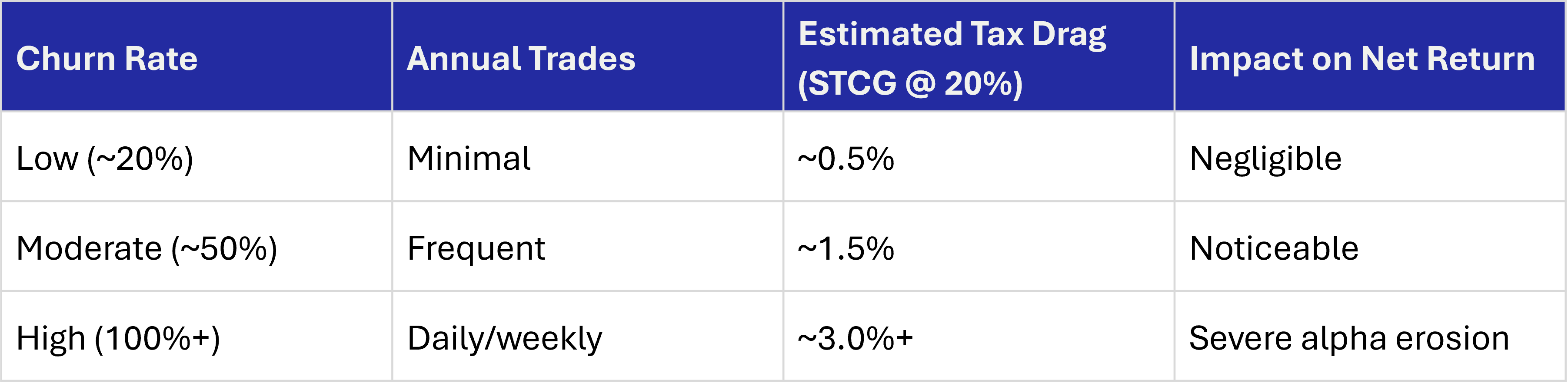
A high-churn strategy may show a strong gross return but deliver a much lower number to the client's bank account. Short-term capital gains under Section 111A are now a flat 20% (if STT is paid). Long-term capital gains (LTCG) are 12.5% above the ₹1.25 lakh exemption, with no indexation benefits. A 3% annual tax drag, compounded over a decade, surrenders roughly 30% of cumulative wealth to the tax department.
Is the Operational Infrastructure and Custodianship Institutional-Grade?
The investor is not just trusting the manager. They are trusting the systems behind the manager. SEBI's PMS regulations mandate an independent custodian, but which custodian and how clean the operational reporting are vary considerably across providers.
The right question is operational: "Which SEBI-registered custodian and fund accountant do you use, and can I access an independent digital dashboard for my holdings, NAV, and capital gains in real time?" Top-tier custodians must provide daily mark-to-market valuations in alignment with SEBI valuation norms, execute trade settlements, and process corporate actions.
What Is the Communication Protocol During a 20% Drawdown?
The final question is about behaviour under stress. Every manager sends a polished monthly newsletter when markets are up. The harder question is what happens when the portfolio falls 20% in a quarter.
The right question is direct, "Can I speak with the fund management team during periods of market stress, and how often do you conduct downside reviews with clients during a drawdown?" Some managers go quiet during bad periods, hoping the client will not notice or will move on. Others proactively schedule conversations, walk through the positioning, explain what is being done, and reassure or recalibrate as needed.
The right PMS manager is rarely the one with the loudest recent returns. They are the one who answers hard questions in specific terms, communicate during drawdowns, has skin in the game, and has thought honestly about when their own success will become a problem. These traits are visible in a careful 90-minute conversation. You should be willing to ask hard questions and disciplined enough to walk away when the answers are vague.
Conclusion
Selecting a PMS manager in today's market is a consequential decision that goes beyond chasing trailing returns; it’s about identifying genuine alpha-generating skill. Success lies in asking the hard questions regarding investment DNA, active share, and skin in the game—metrics that separate masters of the craft from lucky market participants.
Ionic Wealth simplifies this complexity for HNIs by conducting deep-dive operational audits and constructing custom portfolio architectures, protecting your capital from the hidden erosions of excessive turnover and style drift.
Note: In July 2026, SEBI released a consultation paper proposing a new Mutual Fund-only Portfolio Management Services (MF-PMS) category, lowering the minimum investment to ₹25 lakh and reducing provider net-worth requirements to ₹2 crore. This proposal outlines an important move in the direction of widening access to sophisticated wealth management.
According to Shobhit Mathur, co-founder Ionic Wealth, “What is equally important is how this proposition evolves. A mutual fund-only PMS should not be viewed as another distribution wrapper, but as a true portfolio management service where every investment decision is guided by portfolio strategy. With mutual funds as the underlying, portfolio churn is also likely to remain lower, making tax reporting simpler for investors. It also gives portfolio managers greater flexibility to use instruments such as ETFs and SIFs where they can improve portfolio outcomes, while making quality portfolio management more accessible."
The proposed reduction in the PMS investment threshold can help bring professionally managed portfolios to a much larger set of investors who have so far relied on distributors or managed their investments on their own. It gives them access to the same disciplined investment process and complete alignment of interest that has traditionally been available only at much higher investment levels. We await further details on how this segment will evolve.
Enjoying this article
Share it with the world!
WHAT'S
NEW
Collection of latest reads for you

US Delivers Expected Rate Hike, Reaffirms Focus on Price Sta...
Ionic Wealth Macro Desk on 17 Sept 2026
The Fed raised rates 25 bps to 3.75–4.00% in a unanimous vote, with the dot plot pointing to one more hike in 2026. Growth and jobs stay resilient, but inflation above 3% now isn't seen h...

Macro Headwinds Weigh On Market Sentiment, US Fed Decision I...
Ionic Wealth Macro Desk on 16 Sept 2026
Oil above $100/bbl. US 10Y past 5%. DMs down 1.7%, EMs down 3.4%. INR slips despite RBI support. All eyes now on the Fed's 16th September call — Ionic Wealth holds its 70:20:10 allocation...

What goes inside a AI data center?
Ionic Global Research on 15 Sept 2026
AI is transforming data centres from traditional computing facilities into massive, power-intensive infrastructure. This edition explores the rise of AI data centres, their shift from meg...
Ionic Wealth Newsletter
Investment insights
made simple
Sign up for our newsletter about wealth, markets, and more.




AMFI Registered Mutual Fund Distributor
Angel One Wealth Limited (AOWL)
CIN AOWL - U66190MH2023PLC411784
Angel One Investment Services Private Limited (AOISPL)
ARN AOISPL - 306165
CIN AOISPL - U66190MH2024PTC426203
SEBI Registered Research Analyst Number- INH000020305
Mutual fund investments are subject to market risks, read all scheme related documents carefully.
Registered Office: 601, 6th Floor, Ackruti Star, Central Road, MIDC, Chakala, Andheri (East), Mumbai - 400 093
Copyright © 2025, Ionic Wealth | All rights reserved