


Role of Power and Cooling in the data center buildout


Updated 20 Oct 2026•6 min read

We continue our data center series with power and cooling. Every AI chip needs electricity to run and generates heat that must be dealt with. As AI systems have grown more powerful, the demands for both electricity and means to reduce the heat load have hence risen sharply. Delivering that electricity and managing that heat now require their own dedicated infrastructure, and the companies that supply it have become an important part of the AI buildout.
What are power and cooling?
Every watt of electricity that goes into a chip comes out as heat. A data center therefore runs two systems side by side. The power system brings electricity from the grid, steps it down to a usable voltage, and delivers it to each rack without interruption. The cooling system removes the heat those racks produce before it damages the hardware. The two grow together; double the power going into a rack, and you have roughly doubled the heat that it generates, which therefore must be reduced.
Power
Electricity reaches a data center from the grid at high voltage. Transformers step it down, switchgear routes it and protects the system from faults, surges and overloads, and UPS (uninterruptible power supply) systems and batteries cover the seconds before backup generators start if the grid fails. Power distribution units and busways (enclosed overhead ducts that carry high-current electricity along a facility) then carry them to individual racks. Every step needs heavy electrical equipment and much of it is now in short supply.
Cooling
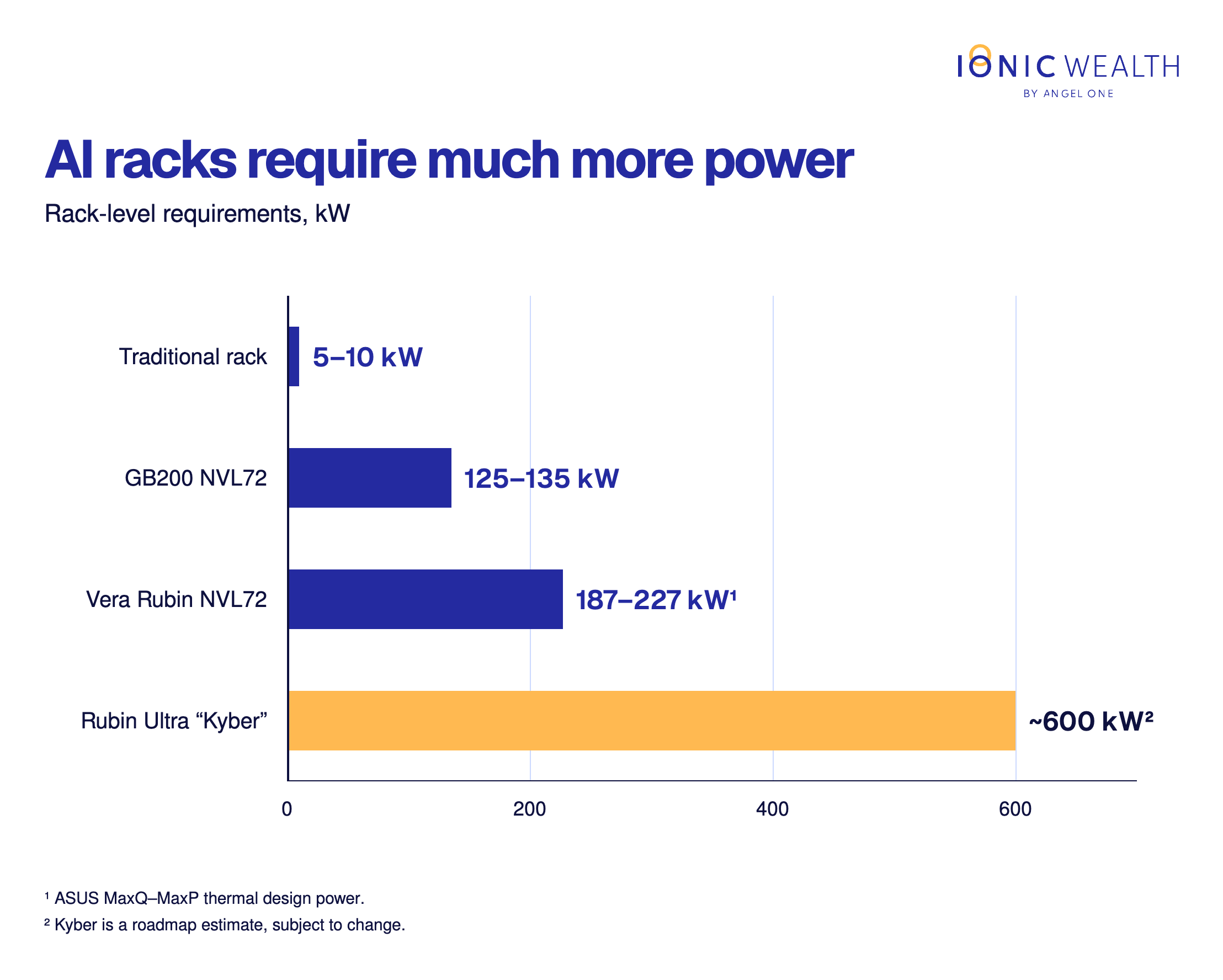
Traditional data centers are cooled with air. Fans push cold air through the servers, and the warm air is carried away to chillers or cooling towers. This works up to a point. A traditional server rack draws around 5-10 kW, roughly what a household uses when four to six air conditioners are running at full blast. Above roughly 40 kW per rack, air cannot remove heat quickly enough, and AI racks now sit far above that. The industry's answer is liquid cooling. In direct-to-chip cooling, metal cold plates sit on top of each processor with liquid running through them, and coolant distribution units (CDUs) circulate the liquid and carry the heat away. Immersion cooling where servers sit in tanks of non-conductive fluid is a smaller niche which is used at the highest densities.
How AI changed the requirements?
According to reports, average rack density across the industry jumped from 16 kW in 2025 to 27 kW in 2026, the largest single-year increase in a decade of the survey. AI racks are in another category altogether. NVIDIA's GB200 NVL72 rack reaches 132 kW peak power density, and its successor, the Vera Rubin NVL72, draws approximately 190 kW to 230 kW, with production from 2026. The Rubin Ultra "Kyber" rack arriving in H2 2027 is specified around 600 kW. In other words, a single next-generation rack will draw as much power as roughly 60-100 traditional ones and almost all of it has to be cooled with liquid.
Market size
Industry reports estimate that capex by the top eight cloud providers will roughly double to about $865bn in 2026 and rise to around $1.4tn in 2027 and a meaningful share of every new facility goes into power and cooling equipment. On electricity, the IEA expects data centre electricity consumption to reach about 945 TWh (terawatt-hour) by 2030, which to draw a meaningful comparison is slightly more than Japan's total electricity consumption today. The equipment makers' order books show the same trend. Vertiv, the largest pure-play supplier of data center power and cooling, ended 2025 with a backlog of $15.0 billion, up 109% on the prior year and now expects 2026 net sales of $14 billion, growth of 37% from 2025. At GE Vernova, the Electrification segment booked $2.4 billion in equipment orders to support data centers in Q1 2026, more than it booked in all of the prior year.
Why is power now the bottleneck?
Chips can be manufactured in months. Power infrastructure takes years. The average wait time for a grid connection in primary US markets now exceeds four years and in Northern Virginia, the world's largest data center market, that figure rises to seven years. The equipment is just as tight: generator step-up transformers, which raise the voltage of electricity leaving a power plant so it can travel long distances over the grid, now take more than 160 weeks (over three years) to arrive, compared with an average of 143 weeks in 2024. Many developers have responded by building their own power plants on site, but turbines needed to have them working are sold out too. GE Vernova's gas turbine order backlog ended Q2 2026 at 116 GW, up from 100 GW in Q1, and the company is taking reservations for 2031 deliveries. Scarcity is also showing up in prices: GE Vernova’s gas turbine orders in the first half of 2026 priced more than 20% higher on a dollar-per-kilowatt basis than Q4 2025 orders, with the company guiding the second half to the higher end of that range.
Who supplies it?
The supply chain splits into three groups.
- On the power side inside the building, the main suppliers are Schneider Electric, Eaton, Vertiv and ABB, which make switchgear, UPS systems and power distribution equipment.
- Grid-scale equipment such as transformers and turbines comes from GE Vernova, Siemens Energy and Mitsubishi Heavy Industries, among others.
- In cooling, Vertiv and Schneider Electric are the leading players in the data center liquid cooling market, with nVent, CoolIT and Stulz also holding a significant share. Liquid cooling is still a young market and estimates of its size vary widely between research firms, but they all point to rapid growth from a small base.
Current key debates
Grid or on-site power?
As grid connections take longer, more operators are generating their own electricity. This shifts demand from utilities towards turbine, fuel cell and battery makers, but it runs into the same equipment shortages.
Will efficiency slow demand?
Each new chip generation does more work per watt and liquid cooling uses less energy than air. The question is whether these gains reduce total power demand or simply allow more computing within the same power budget.
Is order momentum peaking?
Vertiv stopped reporting quarterly backlog and order numbers in Q4 2025, and its Americas organic growth decelerated from 44.3% in Q1 2026 to 21.1% in Q2 2026. Management attributes this to timing and capacity, but investors are watching closely.
Missed our previous deep dives? Catch up here: