
TCS’s $7 Billion Pivot: Building India’s AI Backbone
 AI Summary
Tata Consultancy Services (TCS) is making a monumental $6-7 billion investment to build a 1-gigawatt (GW) sovereign AI data center network across India, strategically pivoting from an asset-light IT services model to owning critical AI infrastructure.
Key Takeaways
- **TCS's Strategic Shift:** A $6-7 billion investment over 5-7 years will establish a 1 GW AI data center network, shifting TCS from traditional software services to providing passive AI infrastructure (land, power, cooling, connectivity).
- **Market Context & Rationale:** This pivot addresses the automation risks of Generative AI in traditional IT services and aligns TCS with global tech leaders rewarded for capital-intensive infrastructure, capitalizing on India's projected eightfold data center market growth to over 8 GW by 2030.
- **Investor Implications:** This move positions TCS as a foundational player in India's AI revolution, creating new value streams beyond billable hours and potentially benefiting a wide ecosystem of related industries like power, construction, and networking.
For decades, India’s IT services giants have operated on an asset-light model with minimal physical infrastructure and maximum human capital. But that formula is starting to look outdated in a world where artificial intelligence (AI) is rewriting how technology is delivered and consumed.
Now, India’s largest IT firm, Tata Consultancy Services (TCS), is preparing to change the rules.
A Giant Step into AI Infrastructure
In its second-quarter FY26 update, TCS announced the creation of a new subsidiary to build a sovereign AI data center network across India. The plan is ambitious: a 1-gigawatt (GW) capacity to be developed over the next five to seven years, with an investment of 6–7 billion dollars.
Each 150 MW phase is expected to cost around 1 billion dollars, funded through a mix of equity, debt, and financial partners. The first facilities are expected to go live within 18–24 months, with anchor clients including global hyperscalers, deep-tech AI firms, Indian enterprises, and sovereign projects.
The new centers will follow a co-location model. TCS will provide the passive infrastructure: land, power, cooling, and connectivity—while clients bring in their own compute and storage. In essence, TCS will build the backbone for AI, not the cloud itself.
This marks a strategic shift for a company that has historically focused on software services. It signals a move from selling human time to owning the infrastructure that will power future digital intelligence.
The Logic Behind the Bet
The Global Shift Toward Capital-Intensive Tech
Across the world, companies that have invested heavily in hardware, AI infrastructure, and data capacity have been rewarded with higher market valuations, while traditional service-led IT firms have seen slower re-rating in the markets.
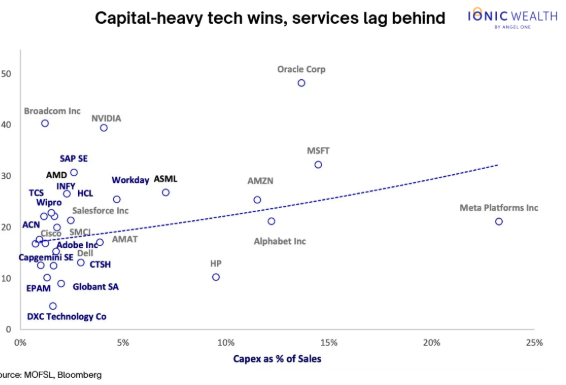
This context makes TCS’s decision more strategic. By entering a capital-intensive business, the company is aligning itself with global technology leaders such as Microsoft, Amazon, and Nvidia, rather than remaining confined to the legacy services model that defined the Indian IT industry for years.
The Automation Shift Reshaping IT
The rise of Generative AI is transforming the very structure of IT services. Within the Application Development and Maintenance (ADM) segment, which makes around 30 percent of the industry’s revenue, AI tools can now automate or accelerate nearly half of all engineering hours.
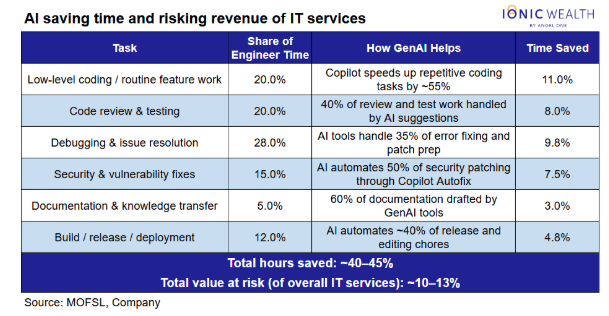
In total, about 40–45 percent of engineer hours in ADM could be automated, putting 10–13 percent of IT-services revenue at risk if firms continue to depend only on human effort.
AI can make delivery faster and cheaper but also less labor-intensive. That is why TCS’s shift toward AI infrastructure is timely; it aligns the company with the next wave of value creation, where compute capacity and proprietary AI platforms replace billable hours as the key growth driver.
TCS Rewiring IT for the AI Era
TCS’s infrastructure investment is part of a broader transformation under its “AI-first” vision. Management has outlined five strategic pillars:
- Make TCS AI-first by embedding AI across its own workforce.
- Redefine every service line using a “human + AI” delivery model.
- Build a future-ready talent base through large-scale reskilling and local hiring.
- Make AI real for clients via AI labs, rapid-build projects, and value-chain solutions.
Strengthen partnerships and acquisitions, including the recent purchase of digital-marketing firm ListEngage, while investing in AI platforms and infrastructure such as the new data centers.
On the supply side, TCS is gradually optimizing its workforce through an AI-augmented delivery model.
TCS’s Scale Advantage
India’s IT load capacity stood at around 1.4 GW as of Q2 2025, according to S&P Global Market Intelligence (451 Research). Another 1.4 GW of capacity is already under construction, which means the total will double within the next two years.
More than 95 percent of this capacity growth is expected to come from leased colocation facilities, while the rest will come from hyperscalers developing dedicated AI infrastructure.
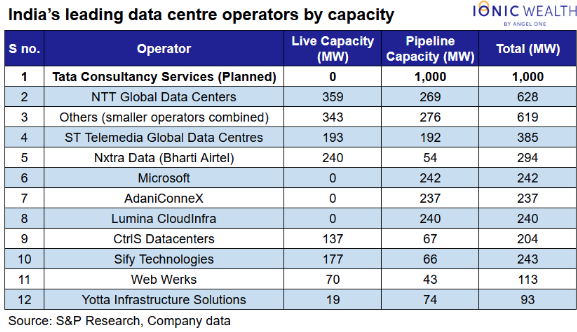
Even as multiple players ramp up their capacity, the scale of TCS’s 1 GW AI Data Centre plan stands out. Most current operators are expanding in smaller increments, typically in the range of 100–300 MW, a fraction of what TCS intends to build.
India’s Data-Center Boom
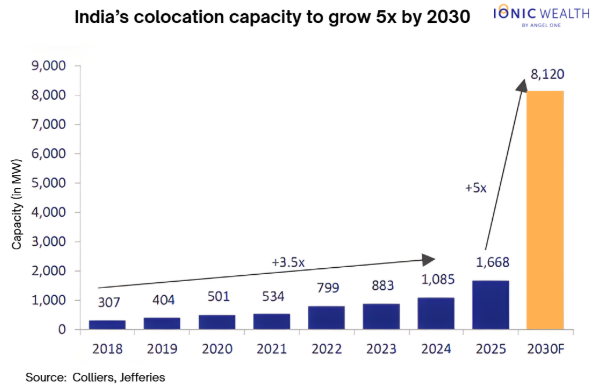
India’s data center market is expanding at an extraordinary pace. According to Jefferies, colocation capacity is expected to rise from 1.7 GW today to more than 8 GW by 2030, an eightfold jump powered by rapid enterprise digitalization, AI-led workloads, and government cloud initiatives.
Proxy Players in India’s Data Center Market
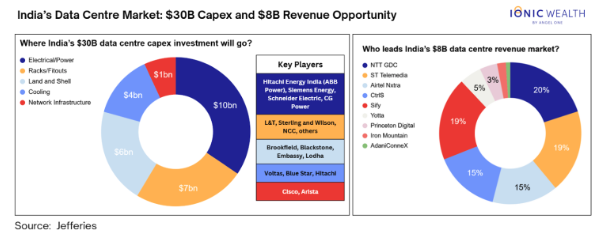
India’s data center ecosystem is evolving into a $38 billion opportunity, and several players are set to benefit indirectly from this wave of investment. According to Jefferies, around $30 billion of capex will flow into areas like power systems ($10B), racks and fitouts ($7B), land and construction ($6B), cooling systems ($4B), and network infrastructure ($1B).
This expansion benefits a wide ecosystem of companies:
- Power: Hitachi Energy India, Siemens Energy, Schneider Electric, CG Power
- Construction: L&T, Sterling and Wilson, NCC
- Cooling: Voltas, Blue Star, Hitachi
- Networking: Cisco, Arista
Within this landscape, Tata Communications stands out as the closest proxy to TCS’s AI data center pivot, given its strength in data center management, cloud connectivity, and digital infrastructure.
On the revenue side, India’s $8 billion data center market is currently led by NTT GDC (20%), ST Telemedia (19%), Airtel Nxtra (15%), and CtrlS (15%), while new players like AdaniConneX and Yotta are rapidly expanding.
The Foundation of India’s AI Revolution
India’s Data Boom
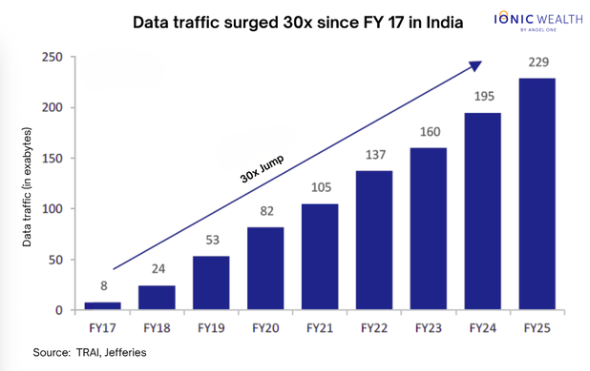
The timing behind this move could not be better. The rollout of 5G and the explosion of internet usage, streaming platforms, and cloud-based applications have multiplied India’s data consumption thirty-fold since FY17. AI, machine learning, and connected devices are fueling a demand for data infrastructure unlike anything seen before fueling
India’s Cost Advantage
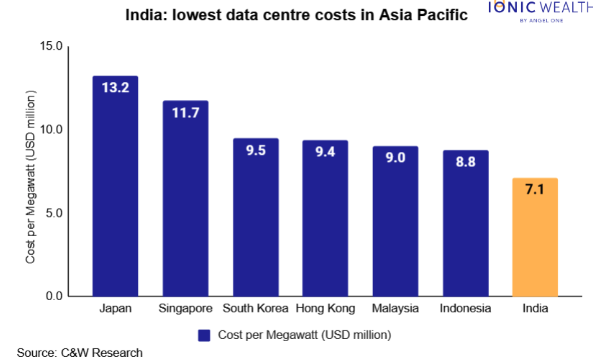
Data center projects are capital-intensive, but India offers a cost advantage few markets can match. Land, labor, and power are significantly cheaper than in other Asia-Pacific economies. The median construction cost in India is about 7.13 USD per watt, the lowest in the region.
Policy Push Behind the Boom
Government initiatives have added further momentum. Policies such as the RBI’s data-localization mandate, MeitY’s Data Centre Policy, and the India AI Mission aim to ensure that critical data is stored within national borders while promoting AI-ready infrastructure.
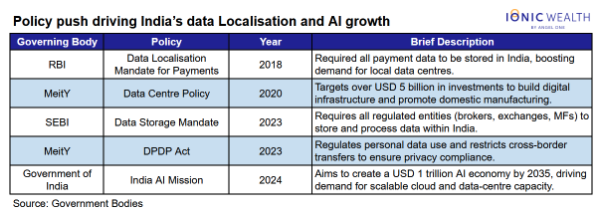
These initiatives have turned digital infrastructure into a national priority, opening the door for long-term private and public investment and creating fertile ground for projects like TCS’s.
Colocation Demand on the Rise
Colocation centres, where companies rent secure space for their IT infrastructure, are running at near-full capacity. Occupancy rates hover around 95–97 percent, reflecting India’s insatiable need for storage and compute power.
This cost edge, supported by government incentives and a growing preference for domestic data storage, makes India one of the most competitive destinations for global data-centre investment.
A Turning Point for Indian IT
TCS’s 7-billion-dollar investment marks a new chapter in how India’s technology ambitions are taking shape. The company is moving from writing code to building the foundations on which the next generation of intelligence will run.
It’s a move that feels both bold and inevitable. As AI becomes central to how economies function, owning the infrastructure behind it gives TCS a place at the heart of that transformation.
For Indian IT, this moment represents maturity, a shift from enabling digital change to creating it. And for TCS, it reaffirms something deeper: that leadership in technology has always come from those willing to think beyond the next quarter and build for the next decade.
Disclaimer
This content is intended for informational purposes only and does not constitute an offer or solicitation for investing in any products distributed by or services made available by Angel One Wealth Limited and Angel One Investment Services Private Limited (collectively referred to as “Ionic Wealth”) or any of their affiliates. It is not intended to be, and should not be construed as, advertising or promotional material. The information provided does not constitute investment advice or a recommendation. You are advised to conduct your own due diligence and consult with your legal, tax, and financial advisors before making any investment decisions.
Angel One Investment Services Private Limited is an AMFI-registered Mutual Fund Distributor (ARN 306165). Note that investments in mutual funds and in the securities market are subject to market risks. Read all the investment-related documents carefully before investing.
Enjoying this article
Share it with the world!
WHAT'S
NEW
Collection of latest reads for you

US Delivers Expected Rate Hike, Reaffirms Focus on Price Sta...
Ionic Wealth Macro Desk on 17 Sept 2026
The Fed raised rates 25 bps to 3.75–4.00% in a unanimous vote, with the dot plot pointing to one more hike in 2026. Growth and jobs stay resilient, but inflation above 3% now isn't seen h...

Macro Headwinds Weigh On Market Sentiment, US Fed Decision I...
Ionic Wealth Macro Desk on 16 Sept 2026
Oil above $100/bbl. US 10Y past 5%. DMs down 1.7%, EMs down 3.4%. INR slips despite RBI support. All eyes now on the Fed's 16th September call — Ionic Wealth holds its 70:20:10 allocation...

What goes inside a AI data center?
Ionic Global Research on 15 Sept 2026
AI is transforming data centres from traditional computing facilities into massive, power-intensive infrastructure. This edition explores the rise of AI data centres, their shift from meg...
Ionic Wealth Newsletter
Investment insights
made simple
Sign up for our newsletter about wealth, markets, and more.




AMFI Registered Mutual Fund Distributor
Angel One Wealth Limited (AOWL)
CIN AOWL - U66190MH2023PLC411784
Angel One Investment Services Private Limited (AOISPL)
ARN AOISPL - 306165
CIN AOISPL - U66190MH2024PTC426203
SEBI Registered Research Analyst Number- INH000020305
Mutual fund investments are subject to market risks, read all scheme related documents carefully.
Registered Office: 601, 6th Floor, Ackruti Star, Central Road, MIDC, Chakala, Andheri (East), Mumbai - 400 093
Copyright © 2025, Ionic Wealth | All rights reserved