
Power of Attorney for NRIs: Managing Indian Investments Remotely
 AI Summary
Key Takeaways
● A Power of Attorney allows NRIs to manage Indian properties and investments remotely through a trusted representative. To be legally valid, a PoA signed abroad must be attested by the Indian Embassy or apostilled and then registered in India within 90 days of arrival.
● While a General PoA provides broad powers, the Special Power of Attorney (SPA) is the safer, preferred choice for specific transactions, such as selling a house. Indian banks and registrars often reject general mandates now to prevent unauthorised transactions and fraud.
● A PoA holder can manage local bills and investments from NRI accounts, but is strictly forbidden from sending money to anyone other than the account holder abroad. In the stock market, the newer DDPI system is replacing PoAs to enhance security for demat accounts.
● To protect assets, NRIs should include "no gift" clauses and specific expiry dates to prevent the representative from misusing their authority. If a relationship ends, the PoA must be formally revoked through a written notice and a registered cancellation deed with the local authorities.
Introduction
NRIs can buy commercial and residential properties in India, invest in Indian capital markets, and have bank accounts. Owning assets is exciting, but managing them requires the physical presence of the asset owner in certain legal and financial matters, which may not always be possible. However, NRIs can manage their investments remotely using a Power of Attorney (PoA). They can grant their trusted person residing in India the power to act as their legal representative to execute financial, legal, and property transactions on their behalf.
A PoA gains legal status upon notarisation and registration. For a POA executed outside India to be legally valid for property or capital market transactions, NRIs must have it attested by the Indian Embassy/Consulate in their country of residence and subsequently registered with the District Registrar in India within 90 days of receipt.
In the current regulatory practice, banks/sub-registrars have an increasing preference for 'Special Power of Attorney' (SPA) over General Power of Attorney (GPA) in property and financial transactions to mitigate fraud and ensure transaction-specific compliance.
What Is the Difference Between a General and Special Power of Attorney for NRIs?
The major difference between a general and special power of attorney is the scope of authority. PoA should be drafted carefully, as you are legally responsible for the transactions your attorney does within the scope of authority you grant them.
General Power of Attorney (GPA): The Broad Mandate
A General PoA grants the representative wide-ranging powers to buy, sell, lease, and manage all assets, creating opportunities to misuse such powers. Hence, the government is discouraging general PoAs by increasing its scrutiny. A state-specific surcharge is applied if a general PoA is granted to someone who is not a blood relative.
In fact, Indian courts have rejected certain transactions (making a will, creating a mortgage on the property) executed under a general PoA to prevent misuse of power. The court requires specific mandates for real estate transactions.
Special Power of Attorney (SPA): The Transaction-Specific Tool
A SPA grants the representative power to act on your behalf for a specific purpose for a specific timeline. A SPA can be granted to handle a particular bank account, the sale/purchase of a specific property, and for specific timelines. For instance, you can issue an SPA for "Executing the sale deed for Flat 402 in Mumbai." The PoA becomes void once the transaction is completed or the timeline expires, restricting the power granted to your representative.
Such detailed, specific, and restricted PoAs are the preferred route for sophisticated NRIs. A registered special PoA ensures the transaction is completed with limited scrutiny by authorities. It reduces the probability of rejection while safeguarding your assets from misuse of power.
How Can an NRI Legally Execute a Power of Attorney From Abroad?
The Indian Contract Act, 1872, and the Powers of Attorney Act, 1882, have laid out laws for PoA. To legally execute a PoA from abroad, NRIs first have to draft the PoA, execute it before an authorised official, and then register it in India by paying stamp duty. Note that Indian law generally does not accept online notarization. You must appear in person before the Notary official.
The Attestation and Apostille Process
NRIs can execute a PoA abroad, either through the Attestation or Apostille Process.
Attestation: Book an appointment with the Indian Embassy for attestation and pay the required fee. On the appointment day, present the drafted PoA with ID proof of both parties. Sign the document in the physical presence of a Consular Officer, not before. The officer will verify the documents and attest the PoA with the Embassy’s seal and signature. You can now courier this attested document to your representative in India.
Apostille: If you are living in a country that is a member of the Hague Apostille Convention (like India, the US, and the UK), you have the option to obtain an apostille. An apostille allows worldwide verification valid in over 125 countries.
First, you have to sign the PoA before a local Notary Public and then get an Apostille Stamp on the reverse of the PoA deed. It is a square computer-generated sticker stamp with a unique proof number. Any member nation of the Hague Apostille Convention can use this number to verify the authenticity of a document online.
In the UK, the Foreign, Commonwealth & Development Office issues apostilles for notarised documents.
The Mandatory 90-Day Adjudication Rule
Once the representative receives the attested or apostilled PoA deed in India, they must submit it to the local adjudication authority. This issue is time sensitive. Under the Indian Stamp Act, the PoA must be adjudicated (paying the local stamp duty) within three months of its arrival in India to be legally "admissible in evidence."
The adjudicators verify the documents for authenticity and compliance with legal requirements. They verify the signatures of the grantor and the grantee, payment of necessary stamp duty, and review the specific powers granted in the deed and its compliance with legal provisions. For instance, property transactions have specific requirements that the PoA must meet to receive adjudication.
If the adjudicator is satisfied, they will issue an adjudication certificate, which confirms the PoA is authentic and compliant.
Can a PoA Holder Operate My NRE/NRO Bank Accounts and Demat Accounts?
So far, we talked about how a PoA can manage property transactions. But you can also authorise your PoA holder to operate your NRE/NRO bank accounts and demat accounts. However, the RBI and SEBI have placed specific restrictions on what a PoA can and can’t do.
RBI Restrictions on NRE/NRO Operations
A PoA holder can make local payments (such as utility bills, taxes, and school fees) and investments in India from your NRI account. They can also send the current Indian income from rent or dividends to the NRI account holder abroad.
What a PoA can’t do is repatriate funds outside India to anyone else other than the account holder. In fact, they cannot transfer funds or gift money to themselves or a third person through the NRI account.
SEBI and Demat Account "Limited PoA"
A demat account is different and regulated by SEBI. Investors usually sign a "Limited Power of Attorney" (LPoA) with their broker, granting them complete access to all their securities in the demat account. However, PoA is being replaced by "DDPI" (Demat Debt and Pledge Instruction) for better security. In a DDPI, the broker can sell and pledge shares from your holdings and execute mutual fund transactions.
Before [6.1]September 1, 2022, you had to sign a Limited PoA to grant your broker access to your demat account. These PoAs still are and will remain valid until you revoke them. However, from September 1, 2022, brokers stopped collecting fresh PoAs from new clients and instead started accepting DDPI for transfer of securities and pledging. From 18 November 2022, the scope of DDPI was widened to also cover mutual fund transactions on exchange platforms and tendering of shares in open offers.
What Are the Key Clauses an NRI Must Include to Prevent Fraud?
A PoA can be a great tool to manage Indian investments remotely, but a disaster if not drafted carefully. Granting broad powers even to your trusted people leaves you vulnerable to misuse. Terms like “full authority” or “general powers” give your representative room to act beyond your instructions.
You can use a PoA template for simple tasks, but where the transactions are complex or of high value, you should put in place "protective" legal clauses. A well-drafted PoA includes the exact powers granted (such as the sale, rental, or management of the property), specific assets or properties, and certain explicit limitations on those powers.
The "No Gift" and "No Sub-Delegation" Clauses
For high-value transactions, especially real estate properties, it is suggested to include the “no gift” and “no sub-delegation” clauses.
The No Gift clause explicitly states that the representative has no authority to gift funds or property to personal accounts or third parties. The No Sub Delegation clause prevents the representative from appointing a sub-agent. The Supreme Court of India allows sub-delegation only if it is specifically permitted in the PoA deed and is for appointing "counsel" or "special attorneys" for specific legal acts.
Specific Expiry and Revocation Provisions
A well-drafted PoA should also have specific provisions for revocation, to protect you if the relationship with the representative sours. Consider adding revocation provisions like expiry date, termination on completion of a transaction, and automatic termination in the event of death or incapacity of the grantor.
In India, there is a formal process for the revocation of a registered PoA. First, the grantor must serve a written notice of revocation of the PoA to the representative stating the reason, effective date, and consequences of the action. Then, publish the notice in the newspaper, and register the cancellation with the same authority that registered the PoA deed. Lastly, the grantor must send copies of the cancellation deed to the representative and people with whom the agent has been interacting on his behalf, and also publish it in the newspaper.
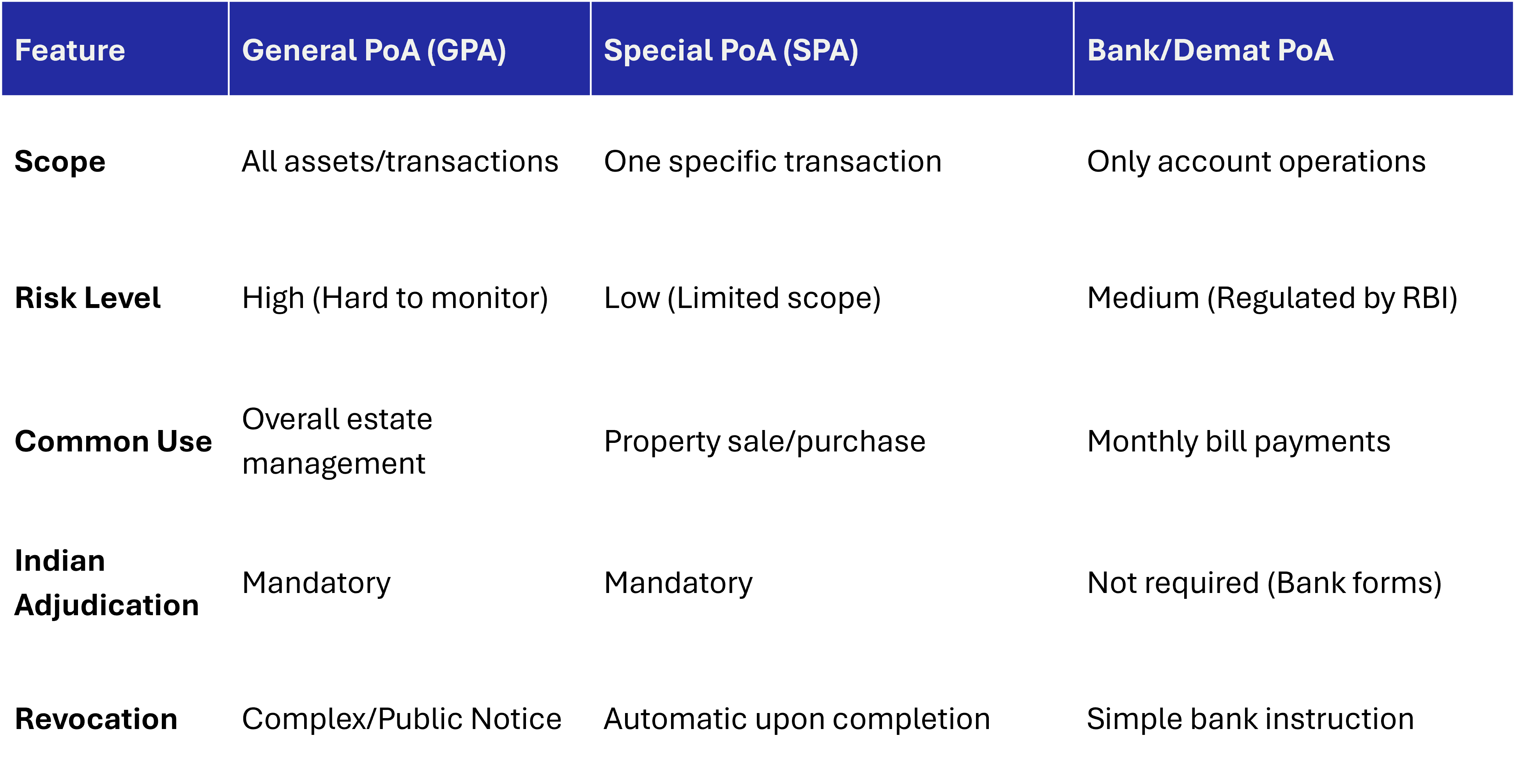
Visual Comparison: GPA vs. SPA vs. Bank PoA
Conclusion
Managing assets in India from abroad no longer requires constant travel, but it does demand a high level of legal diligence. The Power of Attorney is only as safe as the specific clauses you include, so prioritising restricted mandates and "no gift" provisions is vital for protecting your interests. Remember that the legal validity of your document depends on the physical signing before an official and its subsequent registration with the District Registrar. [7.1]Ionic’s NRI service desk supports clients through PoA drafting, attestation/apostille coordination, and adjudication, making PoA a strategic and restricted tool to maintain full control over your remote investments. [
Frequently Asked Questions (FAQs)
Does a Power of Attorney remain valid after the death of the NRI?
No, a PoA stands automatically revoked upon the death of either the grantor (the NRI) or the holder. The assets then fall under the laws of succession or a Will.
Can I have two different PoA holders for two different properties?
Yes, you can execute separate Special PoAs for different cities or different assets to ensure no single person has excessive control over your Indian net worth.
Can I execute a "Digital PoA" using E-Sign from abroad?
While digital signatures are evolving, Indian Sub-Registrars still require physical, wet-ink signatures on a PoA for property transactions, usually attested by the Consulate.
Is a PoA executed in India while on vacation valid after I return abroad?
Yes, a PoA executed and registered in India while you are physically present is perfectly valid. It is often easier to execute as it avoids the consular attestation and adjudication steps.
Enjoying this article
Share it with the world!
WHAT'S
NEW
Collection of latest reads for you

US Delivers Expected Rate Hike, Reaffirms Focus on Price Sta...
Ionic Wealth Macro Desk on 17 Sept 2026
The Fed raised rates 25 bps to 3.75–4.00% in a unanimous vote, with the dot plot pointing to one more hike in 2026. Growth and jobs stay resilient, but inflation above 3% now isn't seen h...

Macro Headwinds Weigh On Market Sentiment, US Fed Decision I...
Ionic Wealth Macro Desk on 16 Sept 2026
Oil above $100/bbl. US 10Y past 5%. DMs down 1.7%, EMs down 3.4%. INR slips despite RBI support. All eyes now on the Fed's 16th September call — Ionic Wealth holds its 70:20:10 allocation...

What goes inside a AI data center?
Ionic Global Research on 15 Sept 2026
AI is transforming data centres from traditional computing facilities into massive, power-intensive infrastructure. This edition explores the rise of AI data centres, their shift from meg...
Ionic Wealth Newsletter
Investment insights
made simple
Sign up for our newsletter about wealth, markets, and more.




AMFI Registered Mutual Fund Distributor
Angel One Wealth Limited (AOWL)
CIN AOWL - U66190MH2023PLC411784
Angel One Investment Services Private Limited (AOISPL)
ARN AOISPL - 306165
CIN AOISPL - U66190MH2024PTC426203
SEBI Registered Research Analyst Number- INH000020305
Mutual fund investments are subject to market risks, read all scheme related documents carefully.
Registered Office: 601, 6th Floor, Ackruti Star, Central Road, MIDC, Chakala, Andheri (East), Mumbai - 400 093
Copyright © 2025, Ionic Wealth | All rights reserved