
India & US Finally Reach A Consensus- US Tariff Lowered From 50% to 18%
 AI Summary
India and the US have finalized a significant trade deal, reducing US tariffs on Indian exports from 50% to 18% and opening India's markets, signaling potential relief and growth for key sectors.
Key Takeaways
- The US has cut tariffs on Indian exports from 50% to 18%, with India reciprocating by lowering tariffs to 0% on US imports and committing to purchase USD 500 billion in US goods over five years.
- Labour-intensive sectors such as textiles, gems & jewellery, and chemicals are poised for significant gains, while India's agricultural sector may experience headwinds due to increased competition from US imports.
- This agreement, coming amid recovering domestic fundamentals and after a period of market underperformance (MSCI India +9.0% vs MSCI ACWI +25% since April 2025), is expected to improve market sentiment and broaden financial market participation towards export-oriented sectors.
In a much-awaited decision, India & US have decided on the terms of trade deal, which have been pending since August 2025, when the Trump Administration levied 25% on all India commodities exported to the US + 25% punitive tariff for buying oil from Russia. The US has reduced tariffs from 50% to 18%, offering significant relief to export-oriented companies and easing pressure on the country’s current account balance. In return India has agreed to lower tariffs and non-tariff barriers on US imports to 0%. India has also agreed to stop buying oil from Russia, which has anyway been falling (down by avg ~10% YoY between April-November 2025). Also, India has committed to buy US goods worth USD 500 Bn over five years in energy, tech and agricultural.
How Have Indian Markets Fared Since Liberation Day?
The domestic equity markets have been under pressure for an extended period, with MSCI India posting a tepid ~9.0% return since April 2025, against MSCI ACWI’s robust performance of 25%. INR has depreciated by ~7% since April 2025, triggered by persistent FPI selling of about USD 10 Bn so far in FY26. The trade deal is sentimentally positive for the markets.
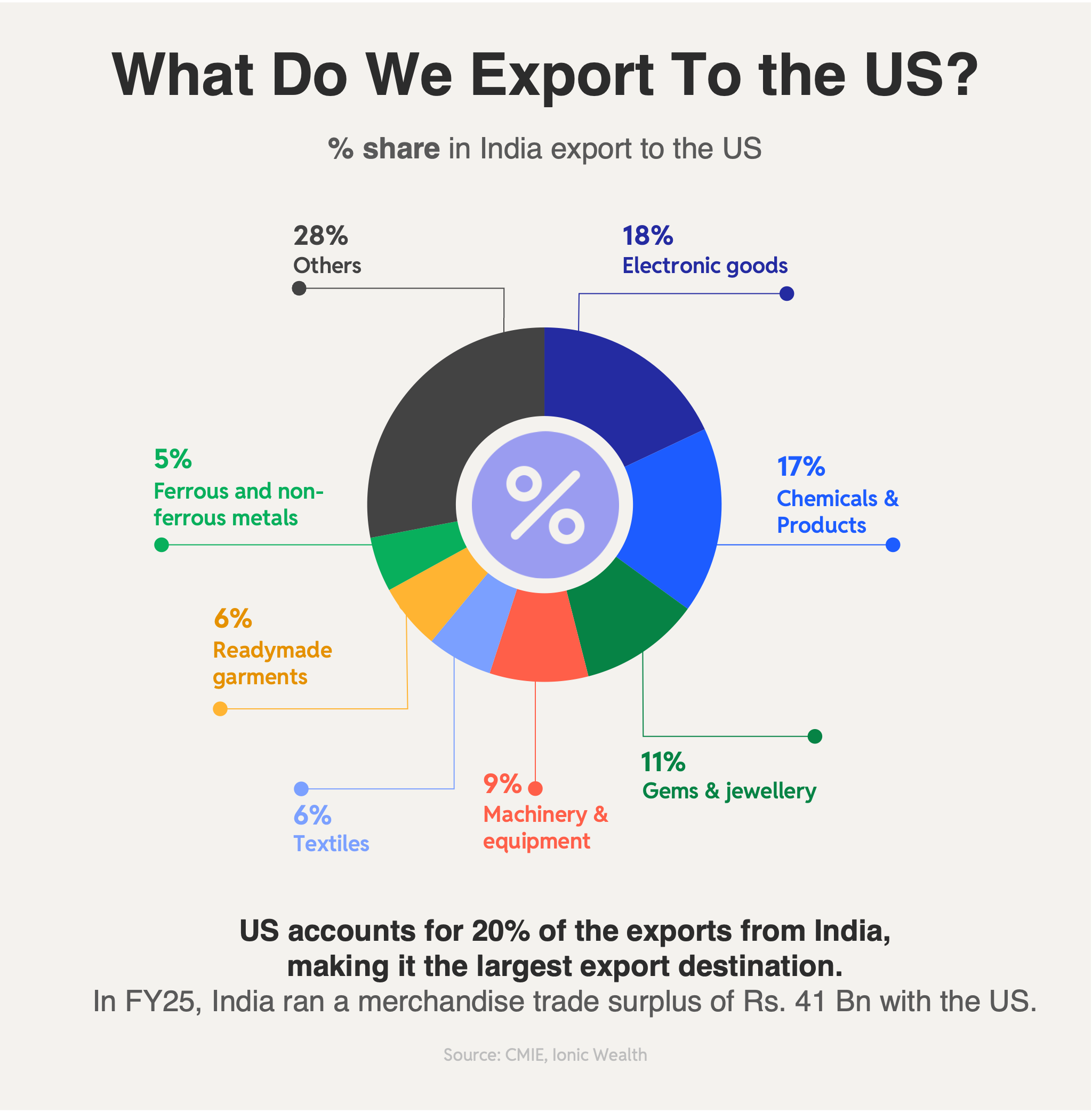
Sectors To be Most Impacted By The Trade Deal
Labour intensive sectors (like textiles, gems & jewellery) could benefit the most, as the 50% tariff primarily targeted these sectors while electronics, pharma etc were already exempted. Push towards India’s manufacturing & labour-intensive sectors in evident as the recent trade deals done with EU, UK and now US are turning out to be most beneficial for these sectors. Also, increasing competitiveness of INR vis-à-vis CNY, could act as a strong tailwind for chemicals sector and could gradually shift US’s heavy reliance on China for chemical imports towards India, supported by lower tariff + weaker INR than CNY.
On the contrary, India opening its agricultural sector to more imports at negligible/zero tariff could be drag on the sector growth and farmers’ income.
Ionic Wealth View
The trade deal with the US has come at an opportune time just as domestic fundamentals including corporate earnings and macros are beginning to recover after a prolonged period of stress. Persistent FPI selling has been a major drag for domestic equities as well as INR. We expect the domestic market sentiment to improve as the trade deal uncertainty is behind us but execution is important- a) India’s corporates should be able to deliver to materialize lower tariffs than China, currency is also favorable and b) Trump should stick to his words. Union Budget and trade deal have been two major clearing events for domestic equities and both have sung the tune favouring real economy, labour intensive sectors and capitalizing on exports opportunity. Consequentially, we’d expect some broadening of the financial markets. This view is for educational and informational purposes only and should not be construed as an investment advice.
Enjoying this article
Share it with the world!
WHAT'S
NEW
Collection of latest reads for you

US Delivers Expected Rate Hike, Reaffirms Focus on Price Sta...
Ionic Wealth Macro Desk on 17 Sept 2026
The Fed raised rates 25 bps to 3.75–4.00% in a unanimous vote, with the dot plot pointing to one more hike in 2026. Growth and jobs stay resilient, but inflation above 3% now isn't seen h...

Macro Headwinds Weigh On Market Sentiment, US Fed Decision I...
Ionic Wealth Macro Desk on 16 Sept 2026
Oil above $100/bbl. US 10Y past 5%. DMs down 1.7%, EMs down 3.4%. INR slips despite RBI support. All eyes now on the Fed's 16th September call — Ionic Wealth holds its 70:20:10 allocation...

What goes inside a AI data center?
Ionic Global Research on 15 Sept 2026
AI is transforming data centres from traditional computing facilities into massive, power-intensive infrastructure. This edition explores the rise of AI data centres, their shift from meg...
Ionic Wealth Newsletter
Investment insights
made simple
Sign up for our newsletter about wealth, markets, and more.




AMFI Registered Mutual Fund Distributor
Angel One Wealth Limited (AOWL)
CIN AOWL - U66190MH2023PLC411784
Angel One Investment Services Private Limited (AOISPL)
ARN AOISPL - 306165
CIN AOISPL - U66190MH2024PTC426203
SEBI Registered Research Analyst Number- INH000020305
Mutual fund investments are subject to market risks, read all scheme related documents carefully.
Registered Office: 601, 6th Floor, Ackruti Star, Central Road, MIDC, Chakala, Andheri (East), Mumbai - 400 093
Copyright © 2025, Ionic Wealth | All rights reserved