
China's Agent Inflection: Why Enterprise Deployment Is the New Cloud Frontier
 AI Summary
From selling compute to selling intelligence: China's hyperscalers are no longer fighting on price
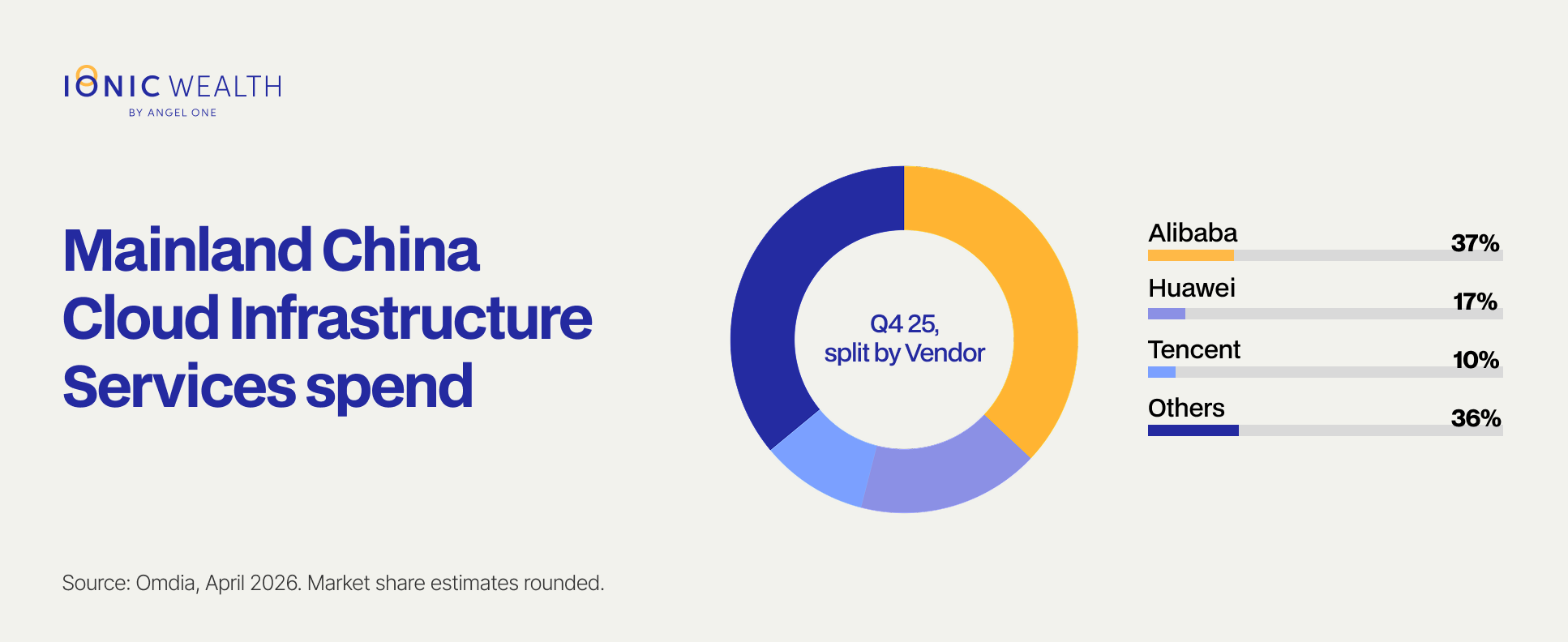
China's cloud market continues to compound — mainland infrastructure services spending reached $14.7 billion in Q4 2025, up 26% YoY, the third consecutive quarter above 20%, with another 26% gain projected for 2026. The just-reported March quarter results extend the trend at the high end: Alibaba Cloud's external revenue accelerated to +40% YoY, while Baidu's AI Cloud Infra surged +79% YoY, with its GPU Cloud business up +184%
AI remains the key driver, but the engine has shifted. Demand is moving decisively beyond raw model usage toward agent-based products that plug into real enterprise workflows. The emergence of OpenClaw in China has accelerated this transition, demonstrating how agents can be delivered in formats that map naturally to how businesses actually operate.
For the first time in years, China's hyperscalers have real pricing power. Alibaba hiked AI compute prices by 5–34%, Baidu raised AI cloud prices by 5–30%, Tencent added 5% between March and May 2026 — synchronized hikes that formally end the multi-year price-war cycle, as agent workloads consume capacity faster than the industry can build it. Additionally, the shift towards Model-as-a-Service — where API-call monetization, which carries structurally higher margins than commodity infrastructure, is driving cloud margin expansion.
Each vendor owns a distinct slice. Tencent Cloud holds the consumer interface — chat-based agent gateways through WeChat and QQ, layered into its gaming and content ecosystems. Alibaba Cloud leads enterprise workflows with Wukong, its DingTalk-native answer to OpenClaw. Baidu is pushing its Ernie models, Qianfan MaaS, and Kunlun chips, while Huawei Cloud continues to win in vertical industry deployments
Ionic View
In our view, China's cloud market is exiting its model-experimentation, price-war phase and entering a structurally healthier growth-and-margin regime, driven by enterprise-scale agent deployment. The key beneficiaries are likely to be platforms with strong enterprise ecosystems, distribution advantages, and integrated deployment capabilities like Tencent and Alibaba. The price hikes suggest that the shift from 'selling compute to selling intelligence' could be structurally lifting cloud margins. These price increases are not driven by rising costs, but by sustained improvements in model performance, and the expanding API gross margins confirm that the market is transitioning from pure commoditization toward performance-based monetization.
Enjoying this article
Share it with the world!
WHAT'S
NEW
Collection of latest reads for you

US Delivers Expected Rate Hike, Reaffirms Focus on Price Sta...
Ionic Wealth Macro Desk on 17 Sept 2026
The Fed raised rates 25 bps to 3.75–4.00% in a unanimous vote, with the dot plot pointing to one more hike in 2026. Growth and jobs stay resilient, but inflation above 3% now isn't seen h...

Macro Headwinds Weigh On Market Sentiment, US Fed Decision I...
Ionic Wealth Macro Desk on 16 Sept 2026
Oil above $100/bbl. US 10Y past 5%. DMs down 1.7%, EMs down 3.4%. INR slips despite RBI support. All eyes now on the Fed's 16th September call — Ionic Wealth holds its 70:20:10 allocation...

What goes inside a AI data center?
Ionic Global Research on 15 Sept 2026
AI is transforming data centres from traditional computing facilities into massive, power-intensive infrastructure. This edition explores the rise of AI data centres, their shift from meg...
Ionic Wealth Newsletter
Investment insights
made simple
Sign up for our newsletter about wealth, markets, and more.




AMFI Registered Mutual Fund Distributor
Angel One Wealth Limited (AOWL)
CIN AOWL - U66190MH2023PLC411784
Angel One Investment Services Private Limited (AOISPL)
ARN AOISPL - 306165
CIN AOISPL - U66190MH2024PTC426203
SEBI Registered Research Analyst Number- INH000020305
Mutual fund investments are subject to market risks, read all scheme related documents carefully.
Registered Office: 601, 6th Floor, Ackruti Star, Central Road, MIDC, Chakala, Andheri (East), Mumbai - 400 093
Copyright © 2025, Ionic Wealth | All rights reserved