
Financial Planning for an IPO Windfall: What to Do Before & After
 AI Summary
Key Takeaways
- Exercising ESOPs while the company is still private allows you to use a lower Merchant Banker valuation for perquisite tax, potentially saving crores compared to the public market price after listing.
- Employees generally face a mandatory six-month lock-in period post-listing, during which they cannot sell or hedge their shares regardless of market volatility.
- You can eliminate long-term capital gains tax by reinvesting the net sale proceeds into a residential house under Section 54F, subject to a ₹10 crore exemption cap.
- To manage the psychological and market risks of a large cash windfall, experts recommend a phased Systematic Transfer Plan (STP) over 6–12 months rather than a single lump-sum investment.
An Initial Public Offering (IPO) converts a company’s unlisted equity (which is generally not very liquid) into tradeable stock. However, financial planning for an IPO windfall is far more complex than simply waiting for shares to vest and sell. A listing creates two distinct financial phases for employees who have equity in the company:
1. A pre-IPO window in which tax and exercise decisions are key.
2. A post-IPO phase in which regulatory lock-ins, single-stock concentration, and behavioral pressure defines how much of the windfall actually translates into long term wealth.
Managing an IPO windfall is fundamentally different from managing ordinary portfolio growth. You need specialised knowledge of private versus public market valuations and the specific tax exemption that exists to absorb very large gains. Once the number become large enough, structures like private family trusts that most salaried professionals have never had a reason to consider come into play.
Also read - How ESOPs and RSUs work: https://ionic.in/blogs/esop-vs-rsu-india
Let’s look at Kabir. He is a senior engineering leader at a fintech company preparing for its IPO in the next twelve months. He holds 10,000 vested stock options, each with a strike price of ₹100, granted over his seven years at the firm. The company's internally approved Fair Market Value (determined by a SEBI-registered Category I merchant banker) currently stands at ₹1,000 per share. The investment banker discussions around the IPO suggest a listing price in the ₹3,500–4,500 band for the company. On paper, Kabir is looking at somewhere between 3.5 to 4.5 crore of wealth. What he does in the next six months will determine how much of that actually ends up in his account.
Should I Exercise My Vested ESOPs Before the IPO Listing Date?
The most consequential decision Kabir will make this year is whether to exercise his options before the company lists, or wait until after. For most employees, the answer is pre-IPO, while individual circumstances may vary.
Here is why. When a company is unlisted, the perquisite tax on an ESOP exercise is calculated using the Category I Merchant Banker's FMV. This private valuation embeds an illiquidity discount and is typically well below the eventual IPO issue price. Once the company lists, however, the Income Tax Act requires the perquisite to be calculated using the public market price (specifically, the average of the opening and closing price on the recognised stock exchange on the date of exercise).
For Kabir, that distinction is worth over a crore in preventable tax. Exercising now, while the FMV is ₹1,000, generates a perquisite of (₹1,000 − ₹100) × 10,000 = ₹90 lakh, taxed at his slab rate. Assuming his income is already above ₹2 crore, he sits at the highest tax bracket under the new tax regime. With the maximum surcharge capped at 25% (plus cess), his effective tax rate is 39%. That results in a tax hit of approximately ₹35 lakh.
Exercising after the stock lists at, say, ₹4,000 turns those same 10,000 options into a ballooned perquisite of ₹3.9 crore. While his effective tax rate remains capped at 39% under the new regime, the sheer size of the inflated public valuation pushes his tax liability to approximately ₹1.52 crore.
Same number of shares. Same underlying value creation. Over ₹1.17 crore extra in tax, paid purely because the exercise happened on the wrong side of the listing date.
The catch, of course, is that Kabir needs the cash. Exercising 10,000 options at a ₹100 strike means writing a cheque of ₹10 lakh to the company, plus ₹35 lakh to the tax department, on shares he cannot yet sell. Most employees who choose to exercise pre-IPO options have planned the cash outlay 12 to 24 months in advance.
If your base income is below ₹2 crore and you plan to exercise post-listing, you should strongly consider a partial exercise to avoid surcharge bracket risk. A massive single-year vest can easily push your total income past the ₹2 crore threshold, triggering the peak 25% surcharge for that financial year. By staggering your exercise across multiple years, you can manage your effective tax rate, stay below the threshold for the highest surcharge, and maximize your net take-home gains.
How Does the SEBI 6-Month Lock-In Period Threaten My Net Worth?
Suppose Kabir exercises early, the company lists, and the stock opens at ₹4,000. He is now sitting on shares worth ₹4 crore. He cannot sell a single one on listing day.
Under SEBI's ICDR Regulations, the entire pre-issue capital held by non-promoters (which, in most IPOs, includes shares held by employees, pre-IPO investors, and ESOP-holders) is subject to a six-month lock-in period from the date of allotment in the IPO. Recent ICDR amendments have carved out exemptions for specific ESOP allotments, but in practice, most employees face either a SEBI-mandated or a company-imposed lock-in period of around 6 months. There are additional restrictions from insider-trading regulations and the company's closed trading windows around quarterly results.
For Kabir, this means his net worth will fluctuate wildly on paper for roughly half a year, with no ability to intervene. He cannot set stop-loss orders. He cannot liquidate to capture early gains if the stock spikes. He cannot hedge. If the broader market has a bad quarter, he watches his ₹4 crore become ₹2.8 crore and waits. Financial planning before the IPO has to account for this enforced illiquidity. He needs enough cash outside the locked-up stock to pay his perquisite tax bill without being forced into any distressed borrowing.
Can I Use Section 54F to Wipe Out My IPO Capital Gains Tax?
Six months later, Kabir's lock-up expires. He is now free to sell. Assume the stock has settled at around ₹3,500. Let’s assume he sells 7,000 shares at ₹3,500 each, generating ₹2.45 crore in sale proceeds. His cost of acquisition for capital gains purposes is the FMV on the date of exercise (₹1,000), so his long-term capital gain on those shares is (₹3,500 − ₹1,000) × 7,000 = ₹1.75 crore. At the current LTCG rate of 12.5% for listed equity held over twelve months, the tax on that gain would be approximately ₹22 lakh.
However, Kabir can utilise Section 54F of the Income Tax Act. Under it, if he reinvests the net sale consideration from his share sale into the purchase or construction of a residential house in India, he can claim an exemption on the associated long-term capital gain. This is the same provision that allows HNIs to effectively convert a large equity windfall into a primary or upgraded residence without paying capital gains tax on the intermediate step.
There are three prerequisite conditions that need to be satisfied in order to avail Section 54F benefits:
1) The investment must be of the net sale consideration, not merely the capital gain. If Kabir invests only part of the proceeds, the exemption is prorated.
2) Kabir can own only one residential house in his name (other than the new one being planned for purchase) on the date of the share sale as per Section 54F(1).
3) The purchase must happen within one year before or two years after the sale, or the construction must be completed within three years from the sale.
The crucial recent change, introduced in Budget 2023 and effective from AY 2024-25, is that the maximum exemption under Section 54F is now capped at ₹10 crore. For IPO millionaires looking at gains in the hundreds of crores, this cap materially limits the strategy. But for someone in Kabir's bracket, with a capital gain of ₹1–3 crore, Section 54F remains an intact, powerful tool.
The Cost of Exercising Post-IPO
The pre-IPO versus post-IPO exercise decision is worth revisiting in plain numbers, because the asymmetry is what makes it actionable.
Strategy A: Kabir exercises before listing. He needs to pay roughly ₹35 lakh in taxes.
Strategy B: Kabir waits. The stock lists at ₹4,000, and he gets a tax bill of roughly ₹1.5 crore.
The capital gains picture gets worse too. In Strategy B, Kabir's cost basis for any subsequent sale is now ₹4,000 per share rather than ₹1,000. So, while his perquisite tax is dramatically higher, he has less room for the capital-gains step of the tax arbitrage. For context, tax on long term capital gains of stocks at 12.5% is generally lower than slab-based tax rates.
The only reason to choose Strategy B is cash flow. For employees who genuinely cannot arrange the ₹35 lakh exercise-plus-tax outlay in advance, waiting may be the only option but it is an expensive one, and worth exploring every alternative (structured loans, staggered exercise, etc) before accepting it as the default.
How Do I Deploy a Massive Lump Sum Without Market Timing Risk?
Assume Kabir has navigated the exercise, the lock-in, and the tax planning. A year after listing, he has about ₹3 crore of post-tax liquid cash sitting in his account. What happens next is where most people quietly lose the gains they worked a decade for. Through behavioural mistakes, not market ones.
The central psychological problem of sudden liquidity is that moving ₹3 crore into the market in a single click feels terrifying. If the market falls 10% the following week, Kabir will feel that he personally caused the loss. If he holds it in cash and the market rallies 15%, he will feel like he missed his chance. Both paths are psychologically expensive. Most wealth managers recommend a structured deployment rather than a single decision.
There are three broad approaches:
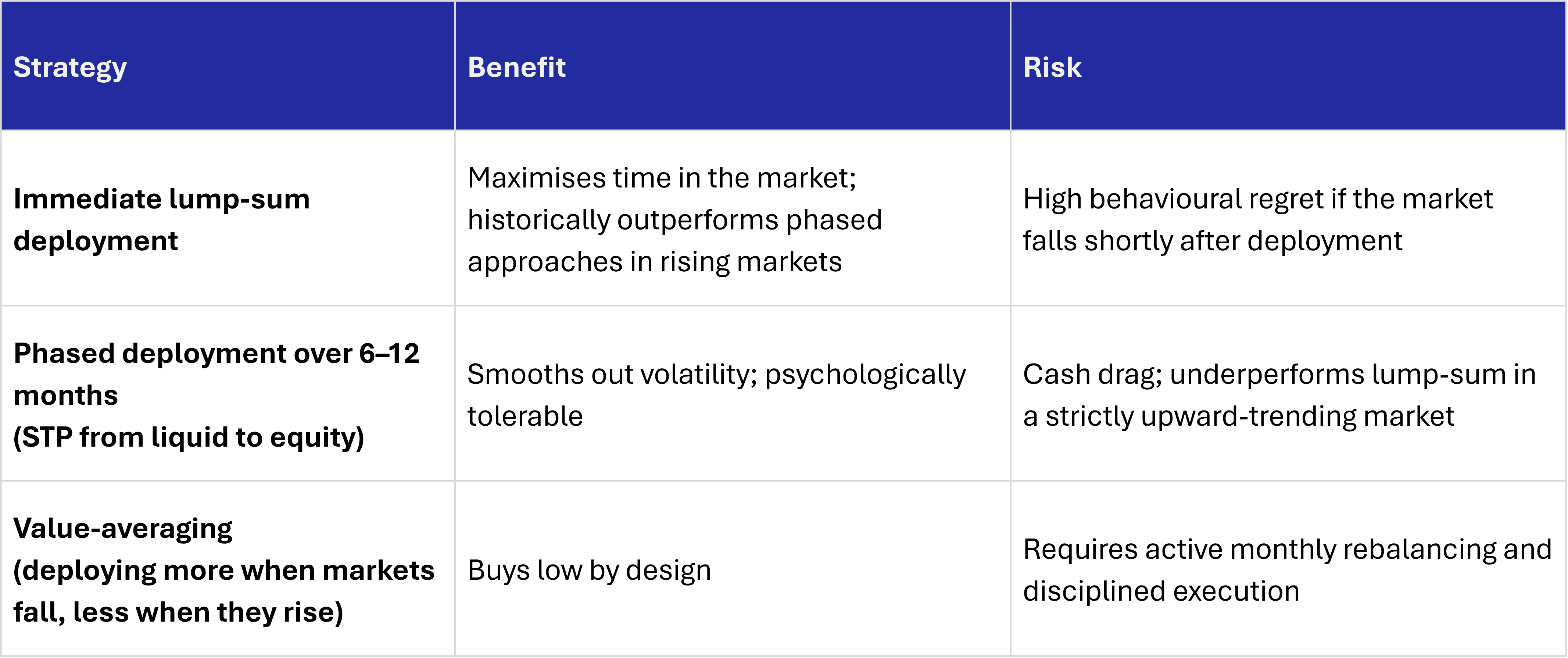
For life-changing windfalls, most wealth managers advise the middle path: A structured tranche deployment over six to twelve months, typically through a Systematic Transfer Plan from a liquid fund to the target equity allocation.
This neutralises the fear of buying at a market top while moving the capital steadily out of cash and into productive assets. The historical data on whether lump-sum beats phased deployment is genuinely mixed. In rising markets, lump-sum wins, but the behavioural cost of a bad month after a lump-sum deployment can be severe enough to derail the entire long-term plan.
Should I Setup a Private Family Trust for My IPO Wealth?
Once Kabir's post-tax liquid net worth ranges from ₹20–50 crore, holding assets solely in his individual name becomes inefficient. He has to worry about succession, asset protection, and centralised management. A private family trust is a vehicle into which Kabir can transfer assets, to be held for the benefit of named family members under terms he lays down in the trust deed.
Revocable vs. Irrevocable: What Changes?
There are two broad varieties of trusts, distinguished primarily by their flexibility and tax impact. In a revocable trust, the income is generally taxed in the hands of the settlor (Kabir), whereas in an irrevocable discretionary trust, the trustee is taxed in representative capacity, potentially offering better asset protection.
For asset ring-fencing against future liabilities and genuine intergenerational wealth transfer, many wealth advisors suggest setting up an irrevocable discretionary trust. However, the right structure depends entirely on individual goals.
The Practical Benefits of Scale
The advantages of a trust become meaningful as wealth grows. Assets held in trust can be governed by a clear set of rules that survive the settlor. A trust also centralizes the management of newly acquired capital, which is vital when a windfall is deployed across multiple asset classes, managers, and geographies.
Setting up a family trust is not a DIY exercise. The trust deed shapes tax treatment, succession outcomes, and family governance for decades. For someone at Kabir's wealth level, this is a conversation with a specialist tax lawyer and a wealth advisor, not a template downloaded off the internet.
Frequently Asked Questions (FAQs)
Is the perquisite tax calculated on the IPO issue price or the listing day closing price?
If you exercise your options after the company has gone public, the Fair Market Value for perquisite purposes is the average of the opening and closing price of the shares on the recognized stock exchange on the date of exercise — not the issue price, and not the listing day closing price specifically.
Can I use derivatives to hedge against my company stock crashing during the lock-up period?
No. Listed companies enforce strict insider-trading and anti-hedging policies that prohibit employees from buying put options, shorting their employer's stock, or entering into equivalent derivative positions to bypass lock-up risk. Attempting to do so is a violation of SEBI's PIT Regulations and the company's code of conduct.
Are my unvested ESOPs automatically vested when the company IPOs?
Typically, no. An IPO is a financing event, not a change-of-control event like an acquisition, so unvested shares usually continue to vest on their original schedule — converting, after listing, from rights in a private company into RSUs or stock options in the listed entity. Specific acceleration terms will be detailed in your individual grant agreement.
Do I need to pay advance tax on the day my shares are sold post-lock-in?
The cleanest compliance path is to pay the advance tax on the realized capital gain in the very next quarterly installment after the sale — 15 June, 15 September, 15 December, or 15 March. The provision to Section 234C specifically recognizes that capital gains cannot always be estimated in advance, so no interest is charged on a shortfall in earlier installments provided the tax is paid in the remaining installments after the gain arises, or by 31 March if the gain falls after 15 March.
Disclaimer: The content of this article is intended solely for educational and informational purposes. It does not constitute personalised tax, legal, or financial advice. Readers are advised to consult a qualified professional or a certified tax advisor regarding their specific financial circumstances before making any decisions.
Enjoying this article
Share it with the world!
WHAT'S
NEW
Collection of latest reads for you

Macro Headwinds Weigh On Market Sentiment, US Fed Decision I...
Ionic Wealth Macro Desk on 16 Sept 2026
Oil above $100/bbl. US 10Y past 5%. DMs down 1.7%, EMs down 3.4%. INR slips despite RBI support. All eyes now on the Fed's 16th September call — Ionic Wealth holds its 70:20:10 allocation...

What goes inside a AI data center?
Ionic Global Research on 15 Sept 2026
AI is transforming data centres from traditional computing facilities into massive, power-intensive infrastructure. This edition explores the rise of AI data centres, their shift from meg...

US CPI Inflation Stays Elevated At 3.4%, Driven By Higher En...
Ionic Wealth Macro Desk on 15 Sept 2026
US CPI held at 3.4% in August 2026, matching forecasts as gasoline prices drove the monthly uptick. Core inflation eased to 2.4% y-o-y even as shelter and core services stayed sticky. Fed...
Ionic Wealth Newsletter
Investment insights
made simple
Sign up for our newsletter about wealth, markets, and more.




AMFI Registered Mutual Fund Distributor
Angel One Wealth Limited (AOWL)
CIN AOWL - U66190MH2023PLC411784
Angel One Investment Services Private Limited (AOISPL)
ARN AOISPL - 306165
CIN AOISPL - U66190MH2024PTC426203
SEBI Registered Research Analyst Number- INH000020305
Mutual fund investments are subject to market risks, read all scheme related documents carefully.
Registered Office: 601, 6th Floor, Ackruti Star, Central Road, MIDC, Chakala, Andheri (East), Mumbai - 400 093
Copyright © 2025, Ionic Wealth | All rights reserved