
What goes inside a AI data center?
 AI Summary
Launch of a new series. Today, we start a new series where we decompose the important parts that go into the making of an AI data center, which we estimate costs ~50bn for a 1GW center in the US.
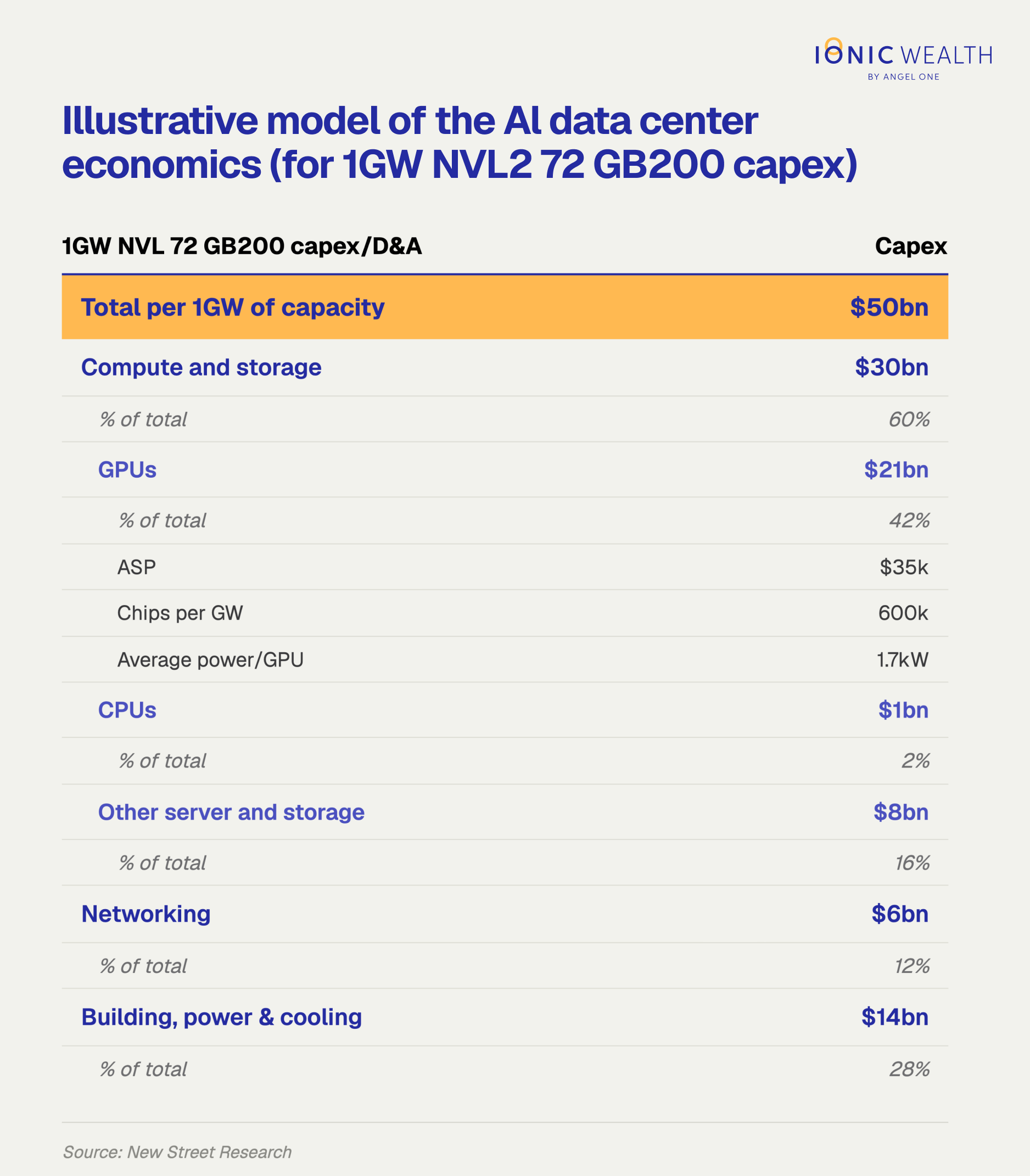
What is a data center? In simple words, a data center is just a building full of computers/servers. It is the physical back-end to the digital world. They are not an AI invention – banks, telecom companies, governments, etc. have run them for decades. With the advent of AI, what's changed is the composition of what goes inside the data center and the power they draw.
History of data centers. Data centers aren't new; for decades they were just "the computer room," where big organizations kept their own powerful computers to run day-to-day operations. If you needed computing, you bought the hardware and ran it yourself; most of it sat idle, and you paid for all of it regardless.
That changed in 2006, when Amazon's AWS let anyone rent computing by the hour instead of owning it. Microsoft and Google followed, and computing consolidated out of thousands of corporate server rooms into a handful of giant facilities run by "hyperscalers“. For nearly two decades the job was steady: storing data, serving web pages and running business software on general-purpose CPUs.
Then AI arrived. Where a traditional data center juggles many small & independent tasks, an AI data center behaves like one enormous computer - thousands of chips (GPUs) working as a single machine, performing simple arithmetic billions of times. Everything else follows from that: denser power, heavier cooling, and ever-larger campuses.
The pace, not the idea, is what's new. Data centers have existed for decades, but the current rate of investment has no precedent. Large US hyperscalers spent a combined ~$410bn on capex in 2025 and have guided to roughly $800bn for 2026, nearly double in a single year, with analyst estimates pointing to c.$1.3trn in 2027. The bulk of it is AI data centers, chips and power.
The unit of measurement has changed from megawatts to gigawatts. For most of the cloud era, a large data center was measured in tens of megawatts. AI campuses are now measured in gigawatts. For instance, Microsoft has added roughly a gigawatt of capacity in each of its recent quarters and says it is on track to roughly double its total footprint within two years. Amazon added ~3.8 GW of power in the twelve months to Q3-25, twice its entire 2022 capacity, and is on track to double again by end-2027.
Why should investors care? AI infrastructure is emerging as one of the largest capital investment themes globally. Understanding where capital is spent is critical to identifying the key beneficiaries of the AI buildout. The relevance extends well beyond just tech investors. Commodity exposure is directly implicated - copper demand, for instance, is tied to data center construction through power distribution, cabling, and cooling systems. So is emerging-market equity exposure: large portions of the Taiwanese and South Korean indices are composed of companies that sit in the data center supply chain, from chip fabrication to components and assembly. For fund managers, then, mapping the moving parts of the data center ecosystem is not a niche exercise but a prerequisite for understanding both direct and indirect portfolio exposure.
Components covered. Over the coming weeks we will work through the AI data center build-out layer by layer, dedicating a separate note to each of the five components that absorb the bulk of incremental spend: (1) GPUs, (2) CPUs, (3) Memory, (4) Optical networking, and (5) Power & Cooling.
Framework. For each component, our discussions will primarily revolve around a few questions.
- What purpose does it serve within the build?
- How is thecurrentdemand-supply environment?
- Who are the dominant industry players?
- What are the current key debates driving the relevant stocks?
Ionic View
We believe each layer of the AI infrastructure stack has its own distinct investment narrative. Each of these components occupy a unique position in the value chain, and the corresponding companies compete within a variety of market structures.
With this series, our goal is to help readers understand not only where the dollars are spent, but also understand where value is ultimately accruing, and which companies are best positioned to capture it.
Enjoying this article
Share it with the world!
WHAT'S
NEW
Collection of latest reads for you

Macro Headwinds Weigh On Market Sentiment, US Fed Decision I...
Ionic Wealth Macro Desk on 16 Sept 2026
Oil above $100/bbl. US 10Y past 5%. DMs down 1.7%, EMs down 3.4%. INR slips despite RBI support. All eyes now on the Fed's 16th September call — Ionic Wealth holds its 70:20:10 allocation...

US CPI Inflation Stays Elevated At 3.4%, Driven By Higher En...
Ionic Wealth Macro Desk on 15 Sept 2026
US CPI held at 3.4% in August 2026, matching forecasts as gasoline prices drove the monthly uptick. Core inflation eased to 2.4% y-o-y even as shelter and core services stayed sticky. Fed...

Resilience Amid Uncertainty: Global Markets Regained Some St...
Ionic Global Research on 11 Sept 2026
Emerging markets led a broad August rebound as resilient earnings offset AI-return jitters and Fed rate-hike risk, with large caps and defensives outperforming small caps. The Pantheon re...
Ionic Wealth Newsletter
Investment insights
made simple
Sign up for our newsletter about wealth, markets, and more.




AMFI Registered Mutual Fund Distributor
Angel One Wealth Limited (AOWL)
CIN AOWL - U66190MH2023PLC411784
Angel One Investment Services Private Limited (AOISPL)
ARN AOISPL - 306165
CIN AOISPL - U66190MH2024PTC426203
SEBI Registered Research Analyst Number- INH000020305
Mutual fund investments are subject to market risks, read all scheme related documents carefully.
Registered Office: 601, 6th Floor, Ackruti Star, Central Road, MIDC, Chakala, Andheri (East), Mumbai - 400 093
Copyright © 2025, Ionic Wealth | All rights reserved