
Role of CPUs in the data center buildout
 AI Summary
We continue our data center series with CPUs which for most of the AI boom were treated as the boring part of the server until companies started running out of them. In January Intel said demand for its server chips had come in far above what it expected and that it simply could not make enough. AMD (Advanced Micro Devices, the US company that designs server CPUs under the EPYC brand and is also Nvidia's closest rival in GPUs) has since said supply will stay tight through the rest of this year.
What is a CPU? CPU stands for Central Processing Unit and it is basically the brain of the computer that decides what needs to be done and in what order. A GPU has thousands of small units doing the same simple sum at the same time. A server CPU has far fewer cores (Intel's largest now has 288) but each one can handle much more complicated work. Last week we called the CPU the head chef and the GPUs the kitchen staff, and that still is the perfect analogy to think about it. With chatbots the chef was only taking the order and passing it on to the staff which is why for the last three years all the attention and money went to GPUs.
How AI agents changed this. A chatbot takes a question and gives back an answer and the GPU does most of that work. An AI agent is given a task instead. To finish it the agent has to plan, search the web, run code, open other software and check its own answer before going again and most of this happens on the CPU. AMD tested this and found that seven out of eight steps in a typical agent workflow run entirely on the CPU. So, if there are not enough CPUs, the GPUs just sit there waiting still drawing power and still being paid for while doing no actual work.
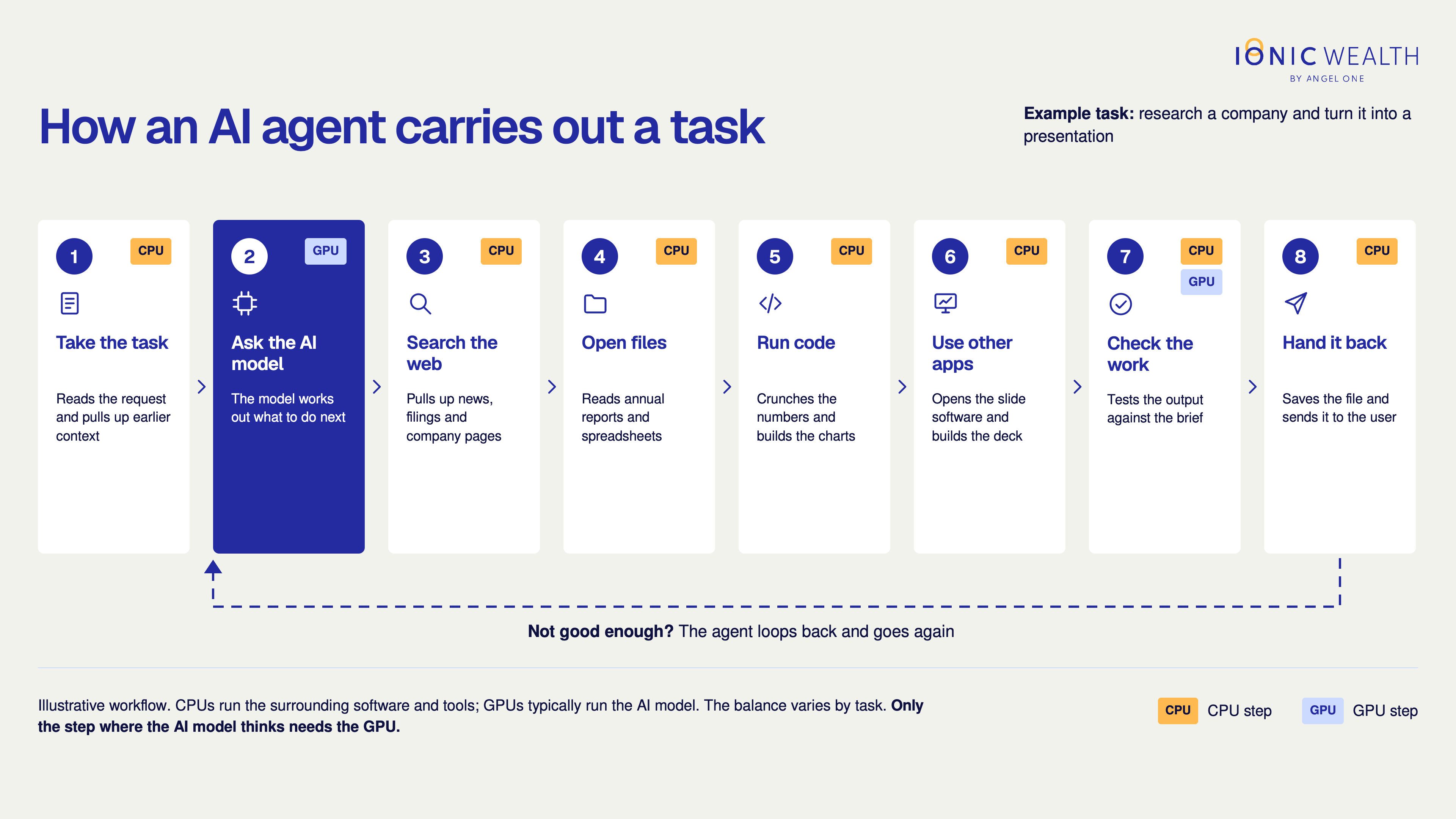
Where the extra demand shows up. This extra CPU work lands in two places. The first is the CPUs sitting inside the GPU servers themselves. The second, which is newer, is entire racks of CPU-only servers placed next to the GPU racks where the agents actually run their tools. AMD calls these "agentic sandboxes" and now sizes them as their own part of the server CPU market separate from the CPUs in GPU servers and regular servers. So the opportunity is bigger than just adding one more CPU next to each GPU.
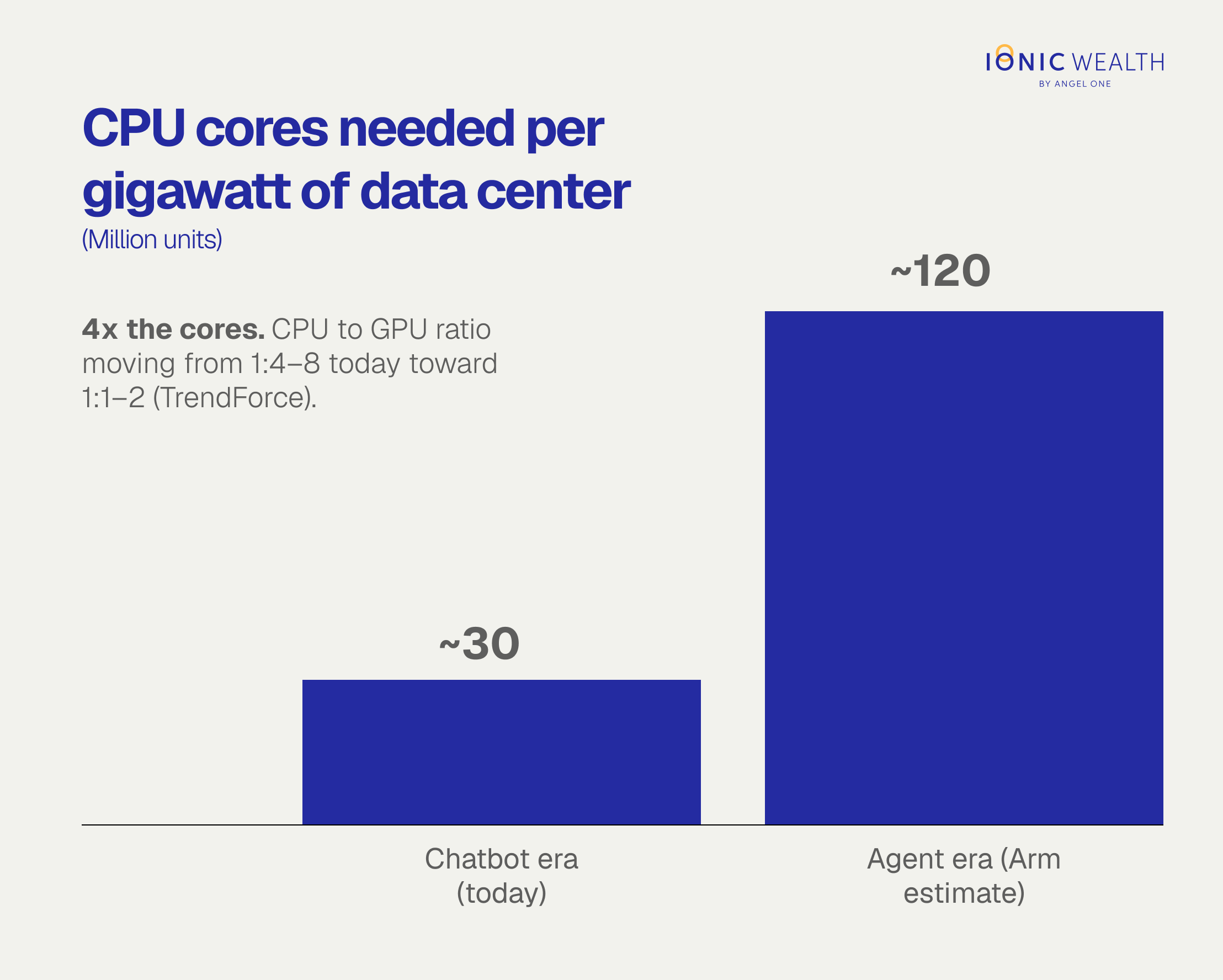
What to watch. Data centers built for chatbots have roughly one CPU for every four to eight GPUs. TrendForce expects this to move toward one CPU for every one or two GPUs as agents become more common. Arm estimates the CPU cores needed per gigawatt of data center going from about 30 million today to 120 million, that is four times as many.
x86 and Arm. Server CPUs broadly come in two types and the easiest way to think about them is as two languages. x86 is the language Intel and AMD chips speak and it has run the world's servers for decades which is why most business software is written for it. Arm started in smartphones where saving battery mattered more so its designs use less power. Arm mostly does not make chips and instead licenses its designs and collects a royalty on every chip sold. The big cloud companies have taken to it in a big way, with Amazon, Google and Microsoft all designing their own Arm CPUs (Graviton, Axion and Cobalt respectively) and Nvidia doing the same for its AI servers. Arm server shipments nearly doubled in a year mostly because of the Arm-based CPUs that now ship inside Nvidia's AI servers.
Who makes them? Intel is the only big CPU company that still makes its own chips in its own factories, which you would think gives it an edge in a shortage, but Intel has been building extra capacity all year just to keep up with orders. AMD and the cloud companies on the other hand, only design their CPUs and get them made at TSMC. So the CPUs and GPUs going into AI data centers are now coming out of the same factories and competing for the same space.
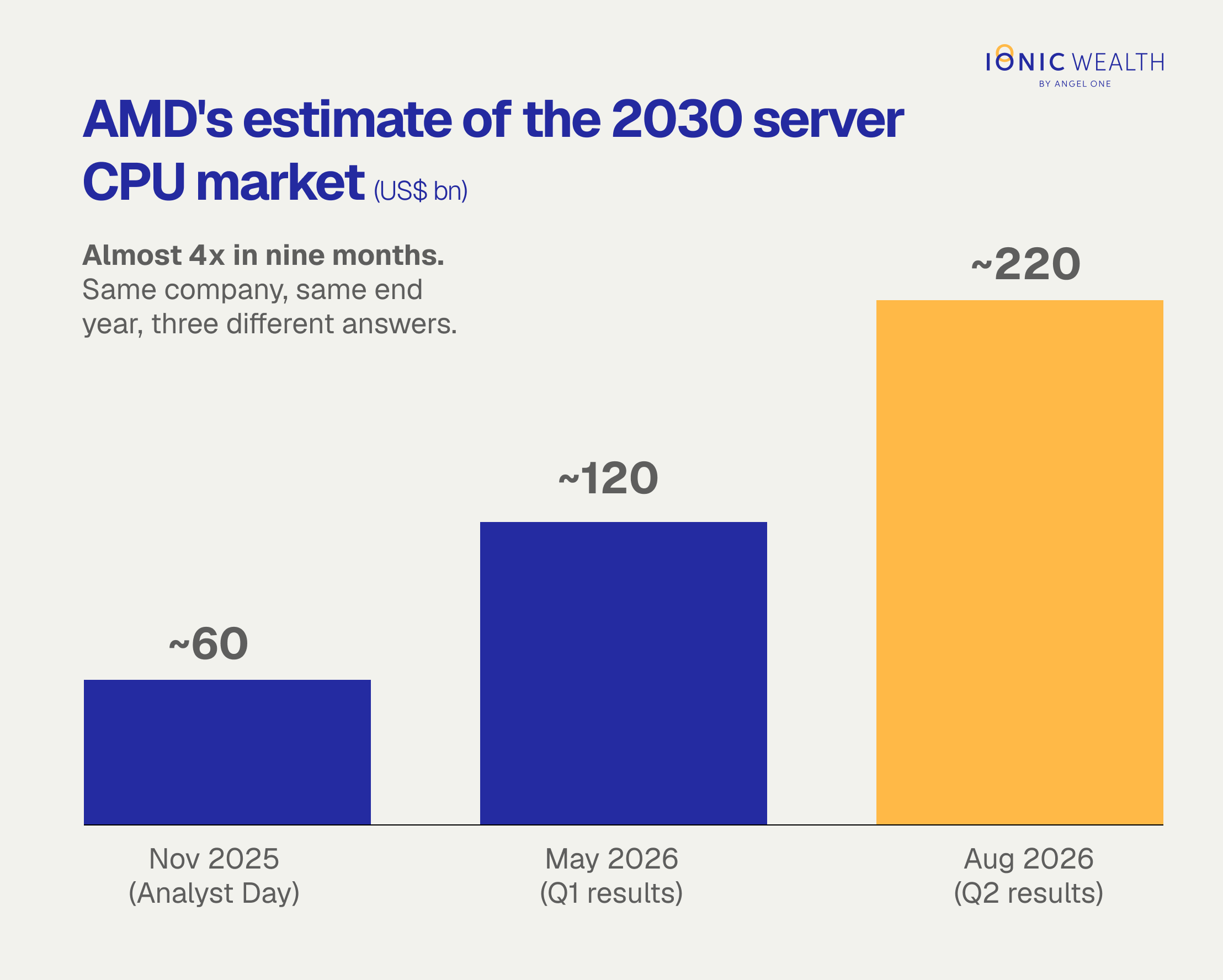
The numbers so far. AMD's server CPU sales grew more than 70% y/y in Q2 2026 and it expects more than 80% growth in the second half of this year. AMD also thinks the server CPU market will be worth around $220bn by 2030, up from its own estimate of about $60bn only last November. The first set of numbers is what AMD has sold and the second is AMD's own forecast so it is worth keeping the two apart.
Demand-supply environment: sold out and getting more expensive. Buyers are now waiting months for servers, with Lenovo warning some customers of six-month delays on data center hardware and AWS reportedly facing much longer queues for CPU capacity. In the April to June quarter this year, Intel had more orders than chips to fill them and its average server chip price was 48% higher than a year ago, mostly because it sold more of its expensive chips with price increases making up the rest. Intel's data center revenue came in at $6.26bn for the quarter against $5.37bn expected, which shows how much the shortage is helping even the company that is losing share.
The competition: three camps fighting for the same market.
Intel. Still the biggest seller but losing share. UBS estimates Intel went from 64.4% of server CPUs in Q1 2025 to 54.9% in Q1 2026. Nvidia agreed to invest $5bn in Intel last September and as part of that deal Intel will build custom CPUs for Nvidia's AI systems.
AMD. The biggest winner so far, with 27.4% of units, up from 24.1%. According to Mercury Research it earns 46.2% of x86 server revenue because it sells more of the high-end chips.
The Arm camp. Arm's share went from 11.5% to 17.7%. In March Nvidia started selling its Vera CPU on its own for the first time and Arm launched the AGI CPU, the first chip it has ever sold itself, which puts it in competition with some of the same companies paying it royalties.
Current key debates.
Does the ratio really get to 1 CPU per GPU? Most of the aggressive forecasts come from companies that sell CPUs. Better software,or chips with more cores doing the same work could mean demand grows slower than expected.
x86 or ArM? If most new AI capacity goes to Arm, Intel and AMD could be left fighting over traditional corporate servers.
Pricing. Some of this year's price increase is down to shortage, so what happens to margins once supply catches up?
How much is already priced in? A company can keep growing fast and still disappoint if its share price was expecting even more.
Ionic View
While the exact ratio is hard to call we believe CPU demand has moved to a higher level and could remain there because as AI goes from answering questions to actually doing tasks, it needs a lot more CPU work around it, both inside GPU servers and in the new CPU-only racks the agents run on. We would take the 1:1 number with some caution since it mostly comes from the people selling CPUs. But even getting partway there from today's 1:4 to 1:8 on a GPU base that is itself growing this fast would still mean a lot more CPUs.
On competition, AMD appears well placed among the companies that sell chips to everyone. Arm could benefit irrespective of which Arm chip gains share, since it gets paid by the cloud companies by Nvidia and now on its own chips. Intel benefits from the shortage for now but continued share loss is the bigger trend and we expect part of this year's pricing gains to fade once supply catches up.
***
Missed our deep dive into GPUs? We covered the powerhouse behind the AI boom in our previous #TuesdayTechTrivia edition 77.
Read More: Here
Enjoying this article
Share it with the world!
WHAT'S
NEW
Collection of latest reads for you

Role of GPUs in the data center buildout
Ionic Global Research on 22 Sept 2026
The AI boom is driving unprecedented demand for GPUs, putting chipmakers and data-center infrastructure at the centre of a rapidly evolving market. This edition of TTT explores the forces...

BOJ Raises Rates To 1.25%, Further Hikes Face A More Divided...
Ionic Wealth Macro Desk on 18 Sept 2026
BOJ raised rates 25bps to 1.25% (7-2 vote), the highest level since 1995, as yen weakness and sticky inflation near 2% persisted. The US-Japan yield gap continues pressuring JPY despite r...

US Delivers Expected Rate Hike, Reaffirms Focus on Price Sta...
Ionic Wealth Macro Desk on 17 Sept 2026
The Fed raised rates 25 bps to 3.75–4.00% in a unanimous vote, with the dot plot pointing to one more hike in 2026. Growth and jobs stay resilient, but inflation above 3% now isn't seen h...
Ionic Wealth Newsletter
Investment insights
made simple
Sign up for our newsletter about wealth, markets, and more.


Experience Ionic Wealth AI
and much more on the app



Disclaimer: Mutual fund investments are subject to market risks, read all scheme related documents carefully.
Co - founder
in your journey of wealth creation.