
Role of GPUs in the data center buildout
 AI Summary
We begin the component series of the AI data center buildout with GPUs, the single largest line item of any data center today.
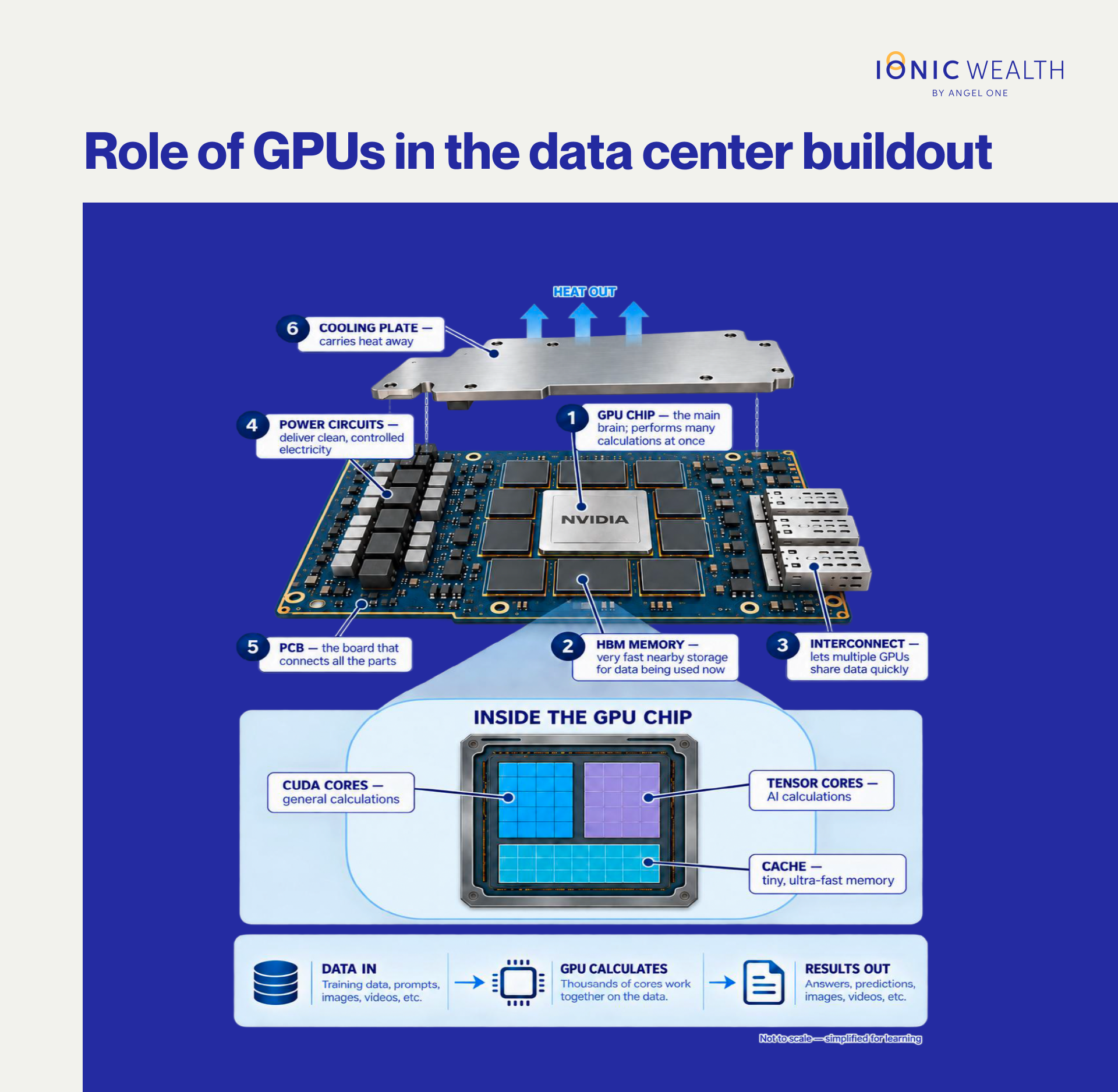
What is a GPU, and why does AI need one? GPU stands for Graphics Processing Unit. Before AI, almost all computing ran on CPUs (Central Processing Units) - chips built to handle a few complicated jobs, one after another. AI warrants for a different kind of work: training and running a model (like Claude or ChatGPT) is billions of simple jobs, and nearly all of them need to be done at the same time. A GPU is built for exactly that- thousands of small calculating units working side by side.
A simple analogy. Picture a restaurant kitchen. The CPU is the head chef who takes the order, works out what needs to be done and in what sequence, and hands the job out to the kitchen staff (GPUs). GPUs are the group of thousands of kitchen staff on the other side of the pass: each does one simple thing, but all of them do it at the same time. The chef could cook the whole dish alone, just far too slowly. In AI, the chef still runs the kitchen - but almost all the actual cooking is done by the GPUs.
What is inside a GPU? A GPU is a slice of silicon (think of a small disk) printed with billions of microscopic switches called transistors, each doing nothing more than being on or off - a 1 or a 0. Grouped together they add and multiply numbers; wire hundreds of billions of them together and you get a chip that performs the arithmetic behind an AI answer. Each chip is sold with high-bandwidth memory attached to hold the data it works on, which we cover in a later note.
From video games to AI. GPUs were invented to render video games. Drawing a moving 3D scene means recalculating millions of pixels for every frame, many small, identical sums, all at once. That turned out to be the same shape of arithmetic AI needs. In 2016 it launched the DGX-1 system built purely for AI, and by Jensen Huang's own account received not a single purchase order - the only taker was a nonprofit research lab called OpenAI, to whom Huang personally drove the first unit. That machine helped produce the work that became ChatGPT. Six years of no demand were followed by the fastest demand ramp in corporate history.
The moat is software, not just silicon. Nvidia is not the only firm capable of designing a fast parallel chip. What set it apart was CUDA, released in 2006: free software that let researchers program a GPU for general mathematics rather than graphics. Almost every AI paper, tool and framework since has been built on it, and a whole generation of developers learned to write code needed to develop AI models on CUDA. Moving to a rival chip means rewriting all that work, which is not a simple task. That lock-in is why Nvidia commands premium pricing for its chips and earns roughly 70-75% gross margin.
The growth has no precedent at this size. Revenue went from $61bn in FY24, to $130bn in FY25 (+114% y/y) and $216bn in FY26 (+65% y/y). For FY27 and FY28, management has guided for roughly 90% and 70% increase in sales, respectively. At a c.$5trn market capitalisation, no company of this size has compounded at this rate.
Nvidia designs the chips; TSMC makes them. Nvidia owns no factory. Its chips are designed in house and manufactured by TSMC (Taiwan Semiconductor Manufacturing Company) in Taiwan. TSMC is a “foundry”; it builds chips for other companies and sells none of its own. It reportedly holds c.73% of the advanced global foundry market share (Q2-26), effectively most of the leading-edge capacity AI chips require. Note that TSMC also manufactures the custom chips built to compete with Nvidia (covered in the next section). So irrespective of who wins the design war, the wafers are ordered from the same place.
Demand-supply environment: still short, but the bottleneck has moved. Chips remain sold out, and the primary reason for hold up in shipments is not just the GPU itself. It is the two steps around it.
(1) Packaging (CoWos): The process that mounts the chip and its memory onto a single base so they can talk to each other at speed.
(2) Memory: Memory gets attached to every GPU unit sold, and supply here far lags the demand.
During Q2 26, Nvidia guided next year's revenue growth to c.70% and called it "a supply-constrained outlook“.
The competition: AMD/Intel and custom chips (ASICs). Nvidia’s chips currently have 2 different categories of competitors:
- AMD. AMD is currently the largest alternative to Nvidia. Third-party estimates put AMD at c.5-7% market share, with signed agreements to supply GPUs to OpenAI and Meta.
- Qualcomm. Qualcomm currently has a very small share of the data-center AI accelerator market, but importantly, Qualcomm has an agreement with Amazon to supply chips.
- ASICs. Another prominent source of competition has now emerged directly from its largest customers making their own custom chips (called ASICs), notably Google’s TPU, Amazon’s Trainium, and OpenAI’s Jalapeno (recently announced), among others. These chips are developed in partnership with major chip-designers like Broadcom, Marvell and MediaTek, and almost all manufactured at TSMC. An ASIC is narrower than a GPU: cheap at one company’s specific workloads rather than being capable at everything. They primarily target inference workloads (running a trained model), while bulk of training today still stays on Nvidia’s GPUs.
Current key debates. We highlight below the current key debates surrounding GPUs (and by extension Nvidia)
- Duration of capex. Hyperscaler capex went from c.$410bn in 2025 to c.$800bn guided for 2026 (with estimates pointing to c.$1.3 trillion in 2027); when does this capex ramp peak, what does Nvidia look like when that growth stops compounding?
- Pricing. Can Nvidia hold 70-75% gross margin as input costs rise and credible alternatives appear?
- Market Share dynamics. How much do custom chips take, and does it primarily stay confined to inference?
Ionic View
While nobody has a crystal ball on how long the capex cycle runs, we believe GPUs will remain the key enabler of AI even after the buildout is over. While growth might slow down as the cycle peaks, replacement of existing installed base of chips with newer generations of chips can drive future durable growth (partly also driven by higher ASP on newer chips).
On competition, while we expect custom chips to take a growing share of Hyperscaler inference work, we do not expect that to unseat general purpose GPUs as the industry standard. These GPUs currently still win on raw performance, versatility and design against custom ASICs, and hence we expect them to continue to hold the lion’s share of the market.
Enjoying this article
Share it with the world!
WHAT'S
NEW
Collection of latest reads for you

BOJ Raises Rates To 1.25%, Further Hikes Face A More Divided...
Ionic Wealth Macro Desk on 18 Sept 2026
BOJ raised rates 25bps to 1.25% (7-2 vote), the highest level since 1995, as yen weakness and sticky inflation near 2% persisted. The US-Japan yield gap continues pressuring JPY despite r...

US Delivers Expected Rate Hike, Reaffirms Focus on Price Sta...
Ionic Wealth Macro Desk on 17 Sept 2026
The Fed raised rates 25 bps to 3.75–4.00% in a unanimous vote, with the dot plot pointing to one more hike in 2026. Growth and jobs stay resilient, but inflation above 3% now isn't seen h...

Macro Headwinds Weigh On Market Sentiment, US Fed Decision I...
Ionic Wealth Macro Desk on 16 Sept 2026
Oil above $100/bbl. US 10Y past 5%. DMs down 1.7%, EMs down 3.4%. INR slips despite RBI support. All eyes now on the Fed's 16th September call — Ionic Wealth holds its 70:20:10 allocation...
Ionic Wealth Newsletter
Investment insights
made simple
Sign up for our newsletter about wealth, markets, and more.




AMFI Registered Mutual Fund Distributor
Angel One Wealth Limited (AOWL)
CIN AOWL - U66190MH2023PLC411784
Angel One Investment Services Private Limited (AOISPL)
ARN AOISPL - 306165
CIN AOISPL - U66190MH2024PTC426203
SEBI Registered Research Analyst Number- INH000020305
Mutual fund investments are subject to market risks, read all scheme related documents carefully.
Registered Office: 601, 6th Floor, Ackruti Star, Central Road, MIDC, Chakala, Andheri (East), Mumbai - 400 093
Copyright © 2025, Ionic Wealth | All rights reserved