
Tesla TeraFab: Ambitions to Scale 2nm AI Chip Manufacturing
 AI Summary
.png&w=3840&q=75)
Tesla's TeraFab Ambition: $20-25 billion initial push; but TSMC's moat remains.
Tesla has unveiled its TeraFab initiative, targeting the build-out of a vertically integrated semiconductor ecosystem capable of producing ~1TW/year of AI chips (logic, memory, and advanced packaging) in the US.
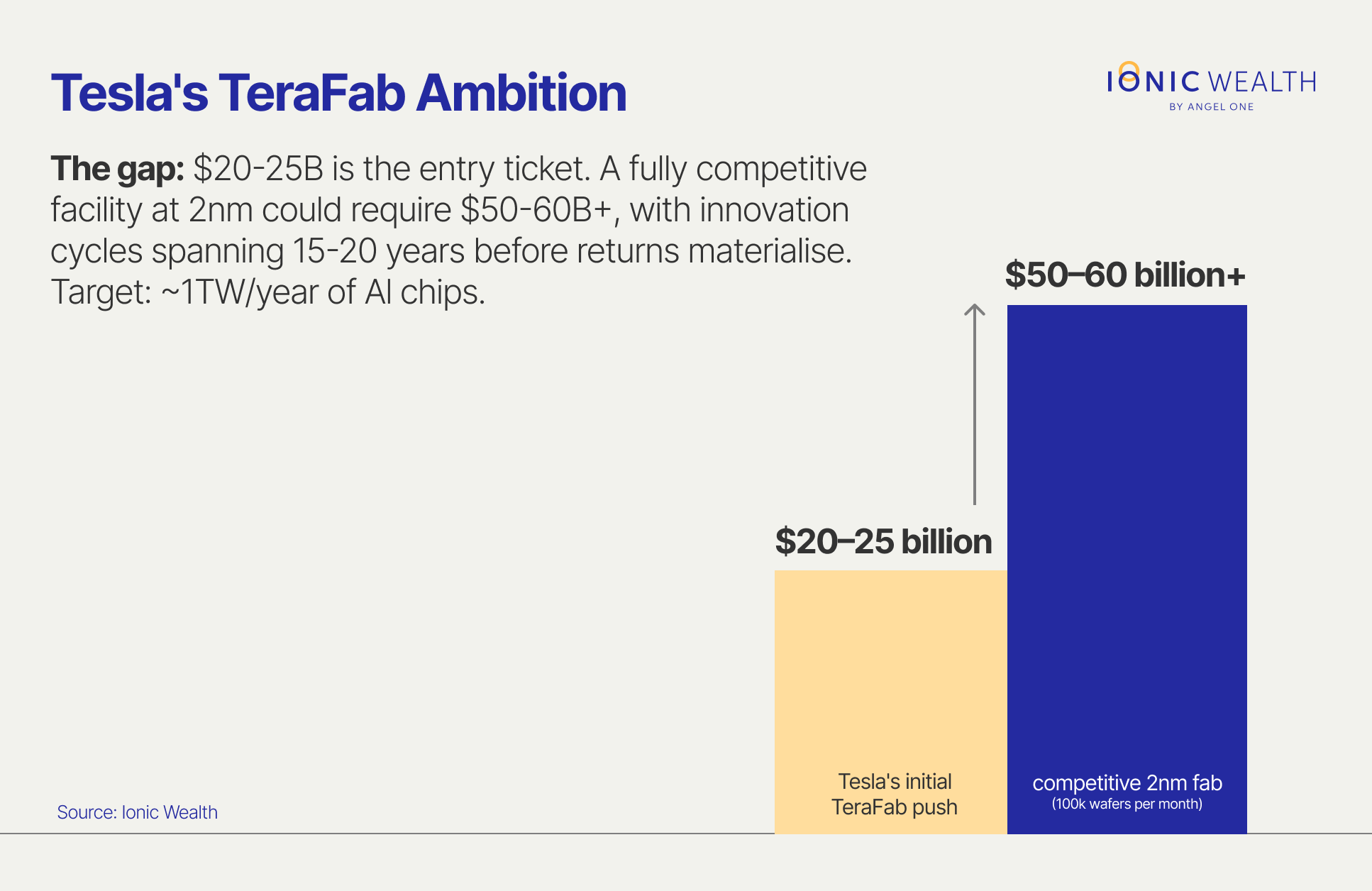
The effort reportedly involves a $20–25bn initial push into 2nm-class manufacturing, alongside aggressive hiring in Taiwan focused on process integration engineers, a critical function responsible for yield optimization and end-to-end production control. The targeted expertise spans advanced technologies such as FinFET, Gate-All-Around, and Backside
Power Delivery Network, indicating Tesla’s intent to move beyond chip design into leading-edge manufacturing capabilities.
Key takeaways:
• Full-Stack Ambition: Tesla is exploring control across design → fabrication → packaging, targeting next-gen AI compute infrastructure.
• Talent-Led Entry: Hiring of senior process integration engineers suggests a focus on solving yield + scaling challenges at advanced nodes.
• Technology Complexity: Mastery across FEOL–BEOL, transistor architecture, and process optimization is required to compete at 2nm.
• Massive Capital Intensity: A competitive leading-edge fab (100k wfpm) could require $50–60bn+ investment, with ongoing R&D commitments.
• Ecosystem Dependence: Success depends on tight integration with equipment, EDA, materials, and chemical supply chains.
Ionic View
While TeraFab is ambitious, its near-to-medium-term risk to TSMC is low. Leading-edge manufacturing is highly concentrated among TSMC, Samsung, and Intel; transitioning from research to high-volume production requires managing hundreds of complex steps and deep supplier dependencies—a challenge far exceeding Tesla’s experience in automotive or batteries.
Furthermore, the economics are unforgiving, with $50–60 billion upfront costs for a 2nm facility raising serious questions about returns on a captive demand model. Given that semiconductor innovation cycles typically span 15–20 years, TeraFab remains a long-term vertical integration play that reinforces, rather than disrupts, TSMC’s structural leadership.
Enjoying this article
Share it with the world!
WHAT'S
NEW
Collection of latest reads for you

Semis: 9 turns of de-rating, c.20 points of EPS accretion
Ionic Global Research on 8 Sept 2026
Semiconductor stocks just went through their sharpest valuation reset of the year, the SOXX index's forward P/E fell from roughly 29x in late June to 19.6x now, even as forward earnings e...

Asset X | September 2026: Key Signals Across Asset Classes
Ionic Wealth Macro Desk on 8 Sept 2026
Domestic equities stay resilient on strong earnings and attractive valuations, while global markets remain volatile on rate uncertainty and AI capex concerns. Fixed income holds firm on R...

Gold ETFs vs. EGR vs. Physical Gold: Best Way to Invest in G...
Ionic Wealth Tax Team on 7 Sept 2026
Physical gold's non-refundable GST, elevated customs duty and storage costs quietly erode HNI portfolios — while EGRs offer a SEBI-regulated middle path: exchange-traded liquidity with th...
Ionic Wealth Newsletter
Investment insights
made simple
Sign up for our newsletter about wealth, markets, and more.




AMFI Registered Mutual Fund Distributor
Angel One Wealth Limited (AOWL)
CIN AOWL - U66190MH2023PLC411784
Angel One Investment Services Private Limited (AOISPL)
ARN AOISPL - 306165
CIN AOISPL - U66190MH2024PTC426203
SEBI Registered Research Analyst Number- INH000020305
Mutual fund investments are subject to market risks, read all scheme related documents carefully.
Registered Office: 601, 6th Floor, Ackruti Star, Central Road, MIDC, Chakala, Andheri (East), Mumbai - 400 093
Copyright © 2025, Ionic Wealth | All rights reserved