
Gold ETFs vs. EGR vs. Physical Gold: Best Way to Invest in Gold
 AI Summary
Key Takeaways
- SEBI-regulated Electronic Gold Receipts (EGRs) combine the digital trading liquidity of securities with the option to seamlessly redeem them for physical gold.
- Unlike Gold ETFs that have a continuous Total Expense Ratio (TER), EGRs minimize tracking errors and charge only transparent vaultage fees without any upfront GST.
- Holding physical gold acts as an operational wealth drag due to a non-refundable 3% GST, high carrying costs, making charges, and an elevated 15% customs duty.
- Both EGRs and Gold ETFs offer superior tax efficiency by qualifying for the 12.5% Long-Term Capital Gains (LTCG) rate after just a 12-month holding period, whereas physical gold requires a 24-month holding period to get the same benefit.
Introduction
In 2022, a 10-gram bar of 24 Karat gold cost Rs 52,670. By 2026, it costs Rs 1,59,500, nearly tripling in four years as central banks stockpiled gold to hedge against geopolitical shocks and stubborn inflation.
Gold hasn't always moved like this. Its modern volatility traces back to 1971, when the gold standard collapsed and paper currencies stopped being tied to bullion. Ever since, gold has been the default safe haven whenever fiat money wavers, whether the trigger is inflation, war, or a financial crisis. That shift also turned gold from something people hoarded into something institutions trade: a liquid, digitally integrated financial asset held by central banks and large allocators alike.
Institutional allocators hold gold as a hedge against systemic risk and reduce portfolio volatility, and that hedge only works if the gold itself is cheap to hold. Physical gold carries real, ongoing costs. that quietly undermine it. The arrival of SEBI-regulated Electronic Gold Receipts (EGRs), alongside the now-familiar Gold ETF, has changed that calculation for anyone deciding how to hold this asset.
This article breaks down where physical gold, Gold ETFs, and EGRs each win and lose on cost, liquidity, and tax, so you can decide which one should actually be holding your capital.
Why Has the Introduction of Electronic Gold Receipts (EGR) Altered the Gold Landscape for Indian Investors?
It is no secret that India is the second-largest purchaser of gold in the world, and imports most of it. But buying physical gold bars and coins at a retailer is not operationally efficient because of the high purchase and carrying costs. Digital frameworks and paper gold (such as Gold ETFs) were used to make gold operationally efficient. However, regulated paper gold only paid the price difference. You could not redeem them for physical gold. Many fintech apps tried to address this problem with digital gold that provided the convenience of digital buying with the option to redeem it with physical gold. But digital gold was not regulated by SEBI or RBI, giving zero investor protection.
EGRs bridges the gap between Gold ETFs and physical gold, giving investors an option to get the liquidity of the securities market as well as the safety of physical gold. The SEBI-regulated EGR framework allows investors to purchase, hold, and trade gold digitally through their demat accounts while providing investor protection.
EGR transaction has three layers to it:
- First Layer: The depositor deposits physical gold with the SEBI-registered Vault Manager, who then creates an electronic gold receipt against it. The gold stored in the vault must comply with either the LBMA Good Delivery Standard or the India Good Delivery Standard (IGDS), maintaining a 999 purity rating. To eliminate counterparty risk, SEBI mandates that Vault Managers maintain a minimum net worth of Rs 50 Crore and legally ring-fence the bullion, ensuring that in the event of corporate insolvency, the underlying physical gold remains entirely protected from creditors.
- Second Layer: The EGR enters the stock exchange ecosystem, where depositories, stock exchanges, and clearing houses make it tradable. EGRs have the same trading features as “securities” defined under the Securities Contracts (Regulation) Act, 1956. Investors can buy EGRs in small denominations (like 1g or 10g units), making them accessible for retail investors. They pay vaulting charges, brokerage fees, and depository charges when buying the EGR.
- Third Layer: Holders of EGRs have the option to convert their EGRs into physical gold by placing a request with the Depository. However, investors have to pay withdrawal charges, other applicable fees, and taxes to convert EGR into physical gold.
Even today, India’s gold market remains unorganized and fragmented, plagued by purity concerns, opaque pricing, high transaction costs, and the absence of a regulated spot exchange. The price you pay for gold in Delhi is different from that in Mumbai because of retail markups by local jewellers. Hence, retail physical gold buyers pay more than what is visible on the commodity markets.
The EGR framework makes gold trade organized, transparent, and regulated. Here’s how.
The Fungibility Breakthrough: EGRs makes the physical delivery of gold operationally efficient through fungibility. EGRs are not linked with a unique gold bar in a particular vault. This means that physical gold deposited in one location can be withdrawn from any designated vault delivery center across India, depending on the availability of physical gold. This reduces the withdrawal and logistics costs of transmitting physical gold.
The Pan-India Price Discovery Engine: The EGR structure puts gold on nationwide electronic trading, where live demand and supply determine real-time gold rates, instead of local jewellers’ associations. The price at which you buy or sell EGRs is reflected in your Demat account, bringing transparency in pricing and eliminating localized premiums and discounts. There is a single wholesale market price for 995 and 999 purity gold that bypasses the retail markups of local jewellers.
How Do Gold ETFs and EGRs Stack up Against Each Other in Execution Friction and Carrying Costs?
As is evident from the EGR framework, these instruments operate very similar to how Gold ETFs work. Like ETFs, you can buy and sell EGRs on exchanges via a standard demat account and pay the necessary brokerage. However, EGRs allow investors to redeem them for actual gold bars or coins. This element brings a fundamental difference in the execution and internal cost structure of the two securities, which could significantly alter their net returns.
The Total Expense Ratio (TER) of ETFs: Gold ETFs pool investors’ capital to buy physical gold with 99.5% purity and store it in vaults. They charge annual built-in management fees ranging from 0.30% to 0.60% on the net asset value (NAV). These fees include the fee paid to the fund manager for executing trades, marketing, and record-keeping, custodial and vaulting charges, insurance premiums, and regulatory and compliance fees. This TER is automatically deducted from NAV and thus acts as a slow, continuous drag on the asset’s multi-year returns.
The Transaction and Vaultage Architecture of EGRs: Unlike ETFs, EGRs do not have fund managers as there is no pooling of money to buy gold. Instead, the already existing gold is made tradeable. The investor faces minimal upfront exchange transaction costs (brokerage and security transaction tax, and no GST). However, EGRs charge a specific, transparent "vaultage fee" (storage and insurance charge) that goes directly to the vault manager.
The Tracking Error Diagnostic: Gold ETFs occasionally deviate from local physical spot prices as the fund sells some gold or uses cash reserves to pay its TER. Gold ETFs do not set the price of the underlying gold. They simply provide exposure to price volatility arising from demand and supply and are therefore influenced by domestic premiums or impact costs. EGRs, by contrast, are tied directly to a vault receipt for underlying physical bars, which minimizes tracking distortion.
When Does Physical Bullion Cross the Line From a Safe-Haven Asset to an Operational Wealth Drag?
Despite the trading efficiency of gold ETFs, people still prefer buying physical gold bars and coins for a premium. It is because physical possession of gold eliminates systemic counterparty risk. This safety net makes gold a safe-haven asset. However, this safe haven could be an operational wealth drag when the gold storage costs, making charges, and taxes erode your returns.
Note that physical gold sits idle in storage, without generating any income (dividends or interest). In a high-interest environment, you miss out on the opportunity to earn compounding interest from yield-bearing assets. In fact, buying and storing physical gold is expensive.
- The Making Charge and Premium Leakage: It’s not just the jewellery that has making charges. Even plain investment-grade bars and coins are subject to making charges and the retail premiums triggered by local demand, dealer margins, and other regional factors. These costs erode capital efficiency from day one. The government has elevated the cost of buying physical gold by increasing the customs duty on gold from 6% to 15% in 2026. This further increases the retail premium as the jeweller passes on this cost to the customer.
- The 3% GST Sunk Cost: In addition to charges, physical gold purchases are subject to 3% Goods and Services Tax (GST), and this cost is not recoverable by an individual investor. This increases the cost of buying physical gold, widening the gap to breakeven upon liquidation.
- The Logistics and Custody Drag: The cost doesn’t stop at purchase. There is a carrying cost of physical gold. You spend on high-security vaulting systems if you keep gold at home, annual rental fees if kept in a bank locker, and private insurance overlays.
When you eventually liquidate the asset back into the physical market, buyers require mandatory physical assaying to check the purity of gold. These costs could turn a higher allocation in physical gold into a wealth destroyer rather than a wealth preserver. EGR helps improve the operational efficiency of holding gold in your portfolio.
How Does the Tax Framework Differentiate Between Paper Gold, Electronic Receipts, and Physical Storage?
EGRs not only improve operational efficiency, but also tax efficiency. The tax code treats listed financial securities and non-financial physical assets differently, altering the after-tax realized returns.
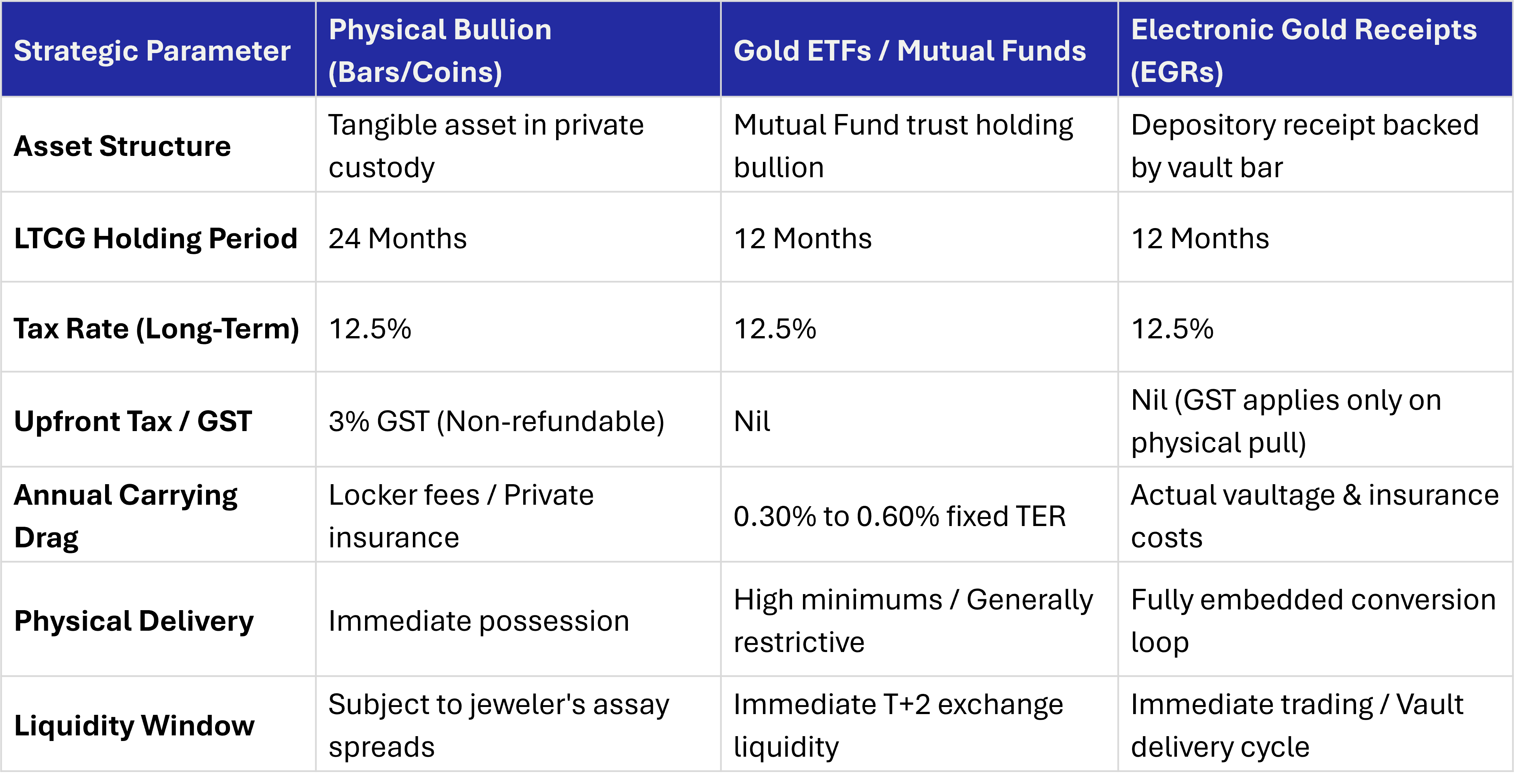
Both physical gold and paper gold are taxed at a flat 12.5% Long-Term Capital Gains (LTCG) rate if held long enough, or at the individual's slab rate (up to 30%) as Short-Term Capital Gains (STCG) if sold earlier. However, both have different holding period requirements to determine which tax rate applies.
- The 12-Month Listed Asset Advantage: As listed exchange-traded instruments, Gold ETFs and EGRs have a 12-month holding period to qualify for the 12.5% LTCG tax rate, making portfolio rebalancing tax-efficient.
- The 24-Month Physical Asset Constraint: As physical assets, gold bars, coins, or jewelry require a 24-month holding period to qualify for the identical 12.5% LTCG rate. Any exit before 24 months triggers STCG.
This gives EGRs a "holding period arbitrage" over physical gold.
- The Wealth Transition Protocol: When you redeem your EGR for physical gold, it does not trigger capital gains tax under Section 70 of the Income Tax Act. The original cost of buying the EGR and its holding period are carried through even after you redeem EGR for physical gold. The capital gain tax is triggered when you sell the physical gold. However, you do pay a 3% GST levied on gold purchases at the time of EGR redemption.
Take Rahul, who puts Rs 1 lakh into EGRs. Twelve months later they’re worth Rs 1.5 lakh, and he redeems it for physical gold, a move that triggers no capital gains tax at all, just a 3% GST on the gold's value. A year on, he then sells the physical gold for Rs 2.1 lakh. Because Section 70 carries his original purchase date forward, his holding period reads as 24 months, qualifying him for the 12.5% LTCG rate on a gain of Rs 1.1 lakh (Rs 2.1 lakh, less his original Rs 1 lakh cost).
Visual Comparison: Operational Matrix of the Core Gold Instruments
Conclusion
At Ionic Wealth, our philosophy for wealth creation is rooted in unbiased, data-driven, and tax-efficient portfolio construction. When evaluating gold not just as a traditional safe haven, but as a strategic hedge against systemic risk, the vehicle you choose to hold this asset dictates its actual effectiveness.
For the modern HNI, physical bullion has crossed the line from a reliable store of value to an operational wealth drag. The non-refundable 3% upfront GST, the recently elevated 15% customs duty, retail markups, and ongoing storage costs relentlessly erode your capital efficiency from day one. Additionally, being locked into a 24-month holding period just to qualify for the 12.5% Long-Term Capital Gains (LTCG) tax rate significantly restricts your portfolio's agility.
For future-proofing portfolios, the aim should be to maximise net-of-fee, post-tax returns while eliminating systemic risk. By allocating capital to EGRs, gold holdings get upgrade into a liquid, secure, and cost-optimised financial asset, ensuring the portfolio remains resilient without carrying the dead weight of physical market inefficiencies.
Enjoying this article
Share it with the world!
WHAT'S
NEW
Collection of latest reads for you

Is Nvidia Buying the Doorway to AI Demand?
Ionic Global Research on 1 Sept 2026
Nvidia is reportedly planning to buy Hugging Face, the open-model repository used by over 30% of Fortune 500 companies, at a steep ~86x price-to-sales multiple. The deal would give Nvidia...

How to Invest in US Stocks from India: Platforms, Tax & LRS ...
Ionic Wealth Tax Team on 1 Sept 2026
Investing in US stocks lets Indian investors ride global tech themes and pocket rupee depreciation as "currency alpha" — but LRS limits, 20% TCS, and a 40% US estate tax bite hard on dire...

Jackson Hole: Hawkish Fed, What Lies Ahead For Markets?
Ionic Wealth Macro Desk on 31 Aug 2026
Fed Chair Kevin Warsh signals a pivot away from forward guidance, urging markets to send unfiltered signals as the FOMC holds firm on its 2% inflation target. With over half the PCE baske...
Ionic Wealth Newsletter
Investment insights
made simple
Sign up for our newsletter about wealth, markets, and more.




AMFI Registered Mutual Fund Distributor
Angel One Wealth Limited (AOWL)
CIN AOWL - U66190MH2023PLC411784
Angel One Investment Services Private Limited (AOISPL)
ARN AOISPL - 306165
CIN AOISPL - U66190MH2024PTC426203
SEBI Registered Research Analyst Number- INH000020305
Mutual fund investments are subject to market risks, read all scheme related documents carefully.
Registered Office: 601, 6th Floor, Ackruti Star, Central Road, MIDC, Chakala, Andheri (East), Mumbai - 400 093
Copyright © 2025, Ionic Wealth | All rights reserved