
NRI Tax Filing in India: When, How and Common Mistakes to Avoid
 AI Summary
Key Takeaways
- NRI status depends on days spent in India, not your passport. Under 182 days typically means non-resident, but that drops to 120 days once Indian income exceeds ₹15 lakh.
- Under Section 6(1A), an Indian citizen earning over ₹15 lakh from Indian sources and not taxed elsewhere can be deemed resident (RNOR) even with zero days spent in India in the Financial Year.
- India taxes NRIs only on Indian-source income; NRE and FCNR deposit interest stays fully tax-free and does not count toward the ₹15 lakh deemed-resident threshold.
- The Section 87A rebate that makes ₹12 lakh tax-free applies only to residents; NRIs get no rebate and a flat ₹2.5 lakh exemption regardless of age.
- On NRO interest, don't accept the flat 30% TDS: a Tax Residency Certificate plus an electronically filed Form 10F can cut it to 10–15% under a DTAA.
For the global Indian, filing a tax return in India is no longer a quiet, once-a-year formality. The tax department now matches bank statements, property records, and foreign remittances almost as soon as they happen.
One mismatch and an automated notice can land within weeks. For a high-net-worth NRI, compliance stops being about avoiding penalties. It becomes the mechanism that protects wealth built across decades and countries.
This guide covers certain critical aspects of NRI tax filing - the return most global Indians are working through now, for income earned in financial year 2025 to 2026 (FY26), assessed in 2026.
It is written for tech executives, entrepreneurs abroad, and NRIs who have recently returned to India and are unsure which rules apply to them.
The 2026 Residency Test: Are You Legally an NRI?
Your tax residence status in India has nothing to do with your passport or how long you have lived abroad. Whether or not you qualify as a Non Resident Indian (NRI) comes down to the days physically spent in India, and in some cases, to your Indian income, even with zero days.
What is the 182 Day vs 120 Day Rule for tax residency?
Spend fewer than 182 days in India during the financial year, and you qualify as a non-resident. But there is a catch for wealthier NRIs.
If your Indian-sourced income crosses ₹15 lakh, the 182-day window shrinks to 120 days, provided you were also in India for 365 days or more in the preceding four years.
This rule can become tricky for NRIs who plan longer home visits without first checking their income.
How does one become a Deemed Resident?
According to Section 6(1A), an Indian citizen earning more than ₹15 lakh from Indian sources, who is not liable to pay tax anywhere else (common for those based in the UAE or similar zero tax jurisdictions), can be treated as a deemed resident automatically, without a single day spent in India.
This pulls them into Resident but Not Ordinarily Resident status, changing how part of their income is taxed.
The Tax Perimeter: What Income Does India Actually Tax?
For a non-resident, Indian authorities generally tax any income that is received in India, deemed to be received in India, or that accrues, arises, or is deemed to accrue or arise in India. So, usually, the question is not where you currently live, but whether the income has an Indian source or sufficient Indian tax nexus.
What counts as Indian Sourced Income?
Capital gains from Indian shares or property, rent from a flat you still own, dividends from Indian companies, and interest on your NRO account sit inside India's tax net, regardless of residency.
The NRE and FCNR Shield
Interest on NRE (Non-Resident External) and FCNR (Foreign Currency Non-Resident) deposits remains completely tax-free in India and does not count toward the income threshold that can trigger deemed resident status.
This is one reason that wealth managers generally recommend that NRI clients should route surplus cash through NRE structures rather than NRO accounts, wherever the source of funds allows.
The Filing Mechanics: Forms, Deadlines and Advance Tax
NRIs may not use the simplest tax form, and AY 2026-27 deadlines carry a wrinkle worth knowing.
Why can NRIs not file ITR1?
No matter how simple your Indian income is, an NRI can never use ITR 1 (Sahaj), the form most resident salaried employees rely on. You need ITR 2 if your income includes capital gains, rent, or dividends, etc or ITR 3 for business or professional income.
Deadlines and the Advance Tax Trap
The deadline for AY 2026-27 is July 31, for ITR-1 or ITR-2 filers. Audit and transfer-pricing cases follow later due dates.
If estimated tax after TDS exceeds ₹10,000, advance tax is also due in quarterly installments. Miss one and interest compounds under Sections 234B and 234C, roughly 1% a month on the shortfall.
Old Regime or New Regime? And Why It Matters More for NRIs
NRIs can and should compare the old and new regimes before filing, but the flexibility is not identical for every taxpayer. The new regime for FY26 looks generous: no tax up to ₹4 lakh, a standard deduction of ₹75,000 against salary, and slabs topping out at 30% only above ₹24 lakh.
Residents also get a rebate, making income up to ₹12 lakh (₹12.75 lakh for the salaried) effectively tax-free.
Here is one detail that gets consistently missed.
That rebate under Section 87A is for residents only, in both regimes. An NRI running numbers on a generic online calculator built for residents will see a misleadingly low figure, since the calculator assumes a rebate that does not apply.
A related trap catches older NRIs specifically: the higher exemption limits for resident senior citizens under the old regime, ₹3 lakh for ages 60 to 80 and ₹5 lakh beyond, do not extend to NRIs, who use the standard ₹2.5 lakh floor regardless of age.
The old regime still allows 80C, 80D and 80G deductions, almost none of which survive under the new regime, aside from employer NPS contributions under Section 80CCD(2).
That section was recently sweetened: private-sector employees can now claim a deduction for employer NPS contributions up to 14% of salary under the new regime, up from 10%, matching government employees.
With income spread across salary, rent, and capital gains, an NRI needs both regimes to be run side by side before filing.
One note for planning: FY26 is the last full year assessed entirely under the Income Tax Act, 1961.
The Income Tax Act, 2025, takes over from April 1, 2026, governing tax year 2026-27 onward. This return is unaffected, but the forms and terminology will look different next year.
Double Taxation Avoidance Agreement Optimization
Do not accept a flat 30% TDS on NRO interest if a treaty offers a better rate.
Form 10F and the TRC Requirement
To claim a reduced withholding rate under a DTAA, typically 10-15% instead of 30%, you need a Tax Residency Certificate from your home country, plus an electronically filed Form 10F on the Indian tax portal.
Skip either step and the bank defaults to the higher domestic rate.
Claiming Foreign Tax Credit
Form 67 runs in one direction, and it is easy to get backwards. It is filed with your Indian return to claim credit for foreign tax you have already paid, set against the Indian tax on that same income. That makes it a resident's tool — useful to an NRI who has returned to India and now reports foreign income here, but not to a non-resident whose Indian income is simply also taxed abroad. In that case, the credit for the Indian tax is claimed on your US, UK, or local return, under that country's rules and the treaty — not through Form 67. The relief is real either way; the trap is claiming it in the wrong country. FYI, under Income Tax Act 2025, Form 67 has been replaced with Form 44 . Both serve the same purpose.
Resident vs NRI Filing at a Glance
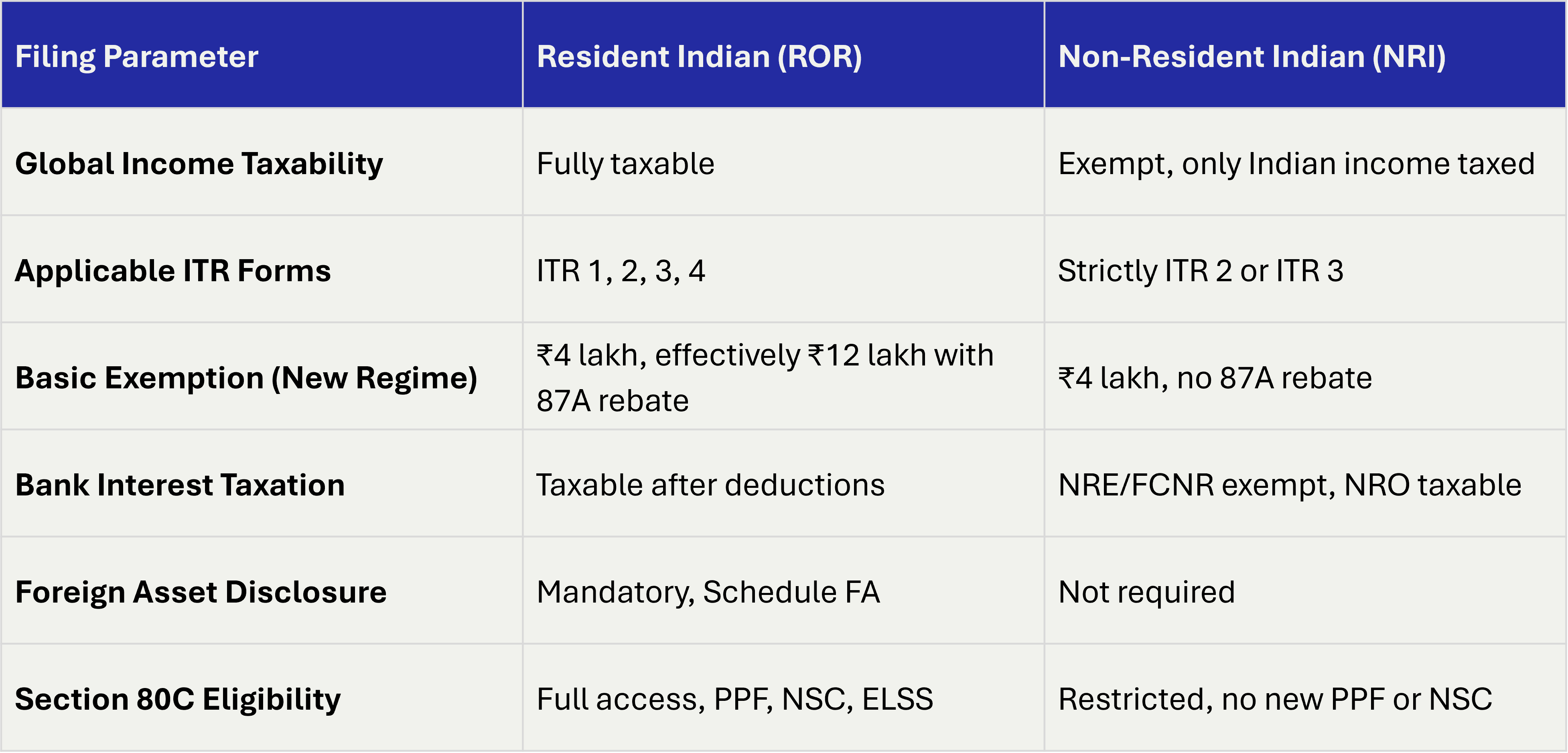
Five Costly Mistakes NRIs Keep Making
The tax department rarely questions intent. Instead, it questions data that does not match.
1. Keeping a Resident Savings Account Open
Continuing to operate a regular resident savings account after your status changes is a FEMA violation, not just a tax slip, and it carries real penalties.
2. Underestimating TDS on Property Sales
When an NRI sells property, the buyer must deduct TDS on the gross sale price, not the profit. Since the Budget 2024 changes, long-term property gains are taxed at 12.5%, but with surcharge and cess added, the actual TDS can exceed the real liability.
A lower TDS certificate under Form 13, applied for before the sale closes, is the only way to avoid proceeds sitting locked up until refund season.
3. Ignoring the AIS Mismatch
Every rupee of NRO interest, dividend or rent shows up in your Annual Information Statement (AIS) whether you report it or not. Leave it off your return and expect an automatic mismatch and a notice under Section 143(1) within weeks.
4. Assuming TDS Paid Means Filing Done
Banks deduct 30% TDS on NRO fixed deposit interest by default. That is not the end of the obligation. A return is still required to claim back the excess, especially if the actual bracket sits below 30%.
5. Missing the Verification Window
Filing is step one. There are then 30 days to verify it through Aadhaar OTP, net banking, or a physical ITR V. Miss that window and the return counts as though it was never filed.
Frequently Asked Questions (FAQs)
Do I need to file if my Indian income is below the exemption limit?
Not legally, but generally it’s a good practice to file if any TDS was deducted that needs refunding, or if asset or expenditure triggers make filing compulsory regardless of income level.
Can I claim deductions under 80C and 80D as an NRI?
Yes, under the old regime: ELSS, life insurance premiums, home loan principal and health insurance for parents in India all qualify. A new PPF or NSC account cannot be opened once NRI status is in effect.
How does the new regime change things for FY26?
It is the default unless you opt out. Slabs are lower, but most Chapter VI A deductions disappear, so run the comparison against your specific income mix before deciding.
Are gifts from resident relatives taxable?
No. Gifts from parents, siblings, or a spouse are fully exempt, regardless of the amount. Gifts above ₹50,000 from anyone outside that relative list count as income from other sources.
Conclusion
At Ionic Wealth, we do not treat NRI tax filing as a once-a-year form-filling exercise. We treat it as an annual checkup on how money moves across borders.
The Indian tax system is efficient at collecting first and refunding later, whether through a flat 30% TDS on NRO interest or an oversized deduction on a property sale.
Money sitting in an unclaimed refund or taxed twice because a Form 10F was never filed, is a portfolio drag that has nothing to do with markets and everything to do with paperwork.
The prudent approach is to stay consistent: reconcile global income against the AIS every year, keep tax-free capital in NRE structures rather than NRO wherever possible, and use the DTAA network proactively rather than reactively.
For clients near the surcharge thresholds, it is also important to model both regimes and factor in charitable planning under 80G, since a well-timed donation under the old regime can pull total income back below a surcharge slab and meaningfully change the effective rate.
Filed correctly, Indian exposure should behave like any other well-managed asset in the portfolio: productive, transparent and free of avoidable friction.
Enjoying this article
Share it with the world!
WHAT'S
NEW
Collection of latest reads for you

US CPI Inflation Eases To 3.4%, As Energy Prices Fall
Ionic Wealth Macro Desk on 14 Aug 2026
US CPI eased to 3.4% YoY in July 2026, with core inflation moderating to 2.5% even as shelter stayed sticky at 3.2% and energy remained elevated at 14.7%. AI-driven demand is filtering in...

From Froth to Fundamentals: The market’s shift toward qualit...
Ionic Global Research on 13 Aug 2026
Markets favoured quality and defensives in July as AI capex worries and leveraged unwinds weighed on sentiment, even as inflation stayed sticky across energy, food, tariffs and housing. W...

Cloud Just Made the AI Spending Argument Easier
Ionic Global Research on 11 Aug 2026
For months, investors have worried that Big Tech was spending vast sums on AI with no clear path to a return. Reporting within a day of each other in late July, Microsoft and Amazon put t...
Ionic Wealth Newsletter
Investment insights
made simple
Sign up for our newsletter about wealth, markets, and more.




AMFI Registered Mutual Fund Distributor
Angel One Wealth Limited (AOWL)
CIN AOWL - U66190MH2023PLC411784
Angel One Investment Services Private Limited (AOISPL)
ARN AOISPL - 306165
CIN AOISPL - U66190MH2024PTC426203
SEBI Registered Research Analyst Number- INH000020305
Mutual fund investments are subject to market risks, read all scheme related documents carefully.
Registered Office: 601, 6th Floor, Ackruti Star, Central Road, MIDC, Chakala, Andheri (East), Mumbai - 400 093
Copyright © 2025, Ionic Wealth | All rights reserved