
Returning NRI Guide: Tax Residency, RNOR Status & Portfolio Restructuring
 AI Summary
Key Takeaways
- Returning to India isn't just about taking a flight — it's a time-sensitive tax operation. The date on your boarding pass determines whether your global income becomes taxable in India for that entire financial year.
- Time your return carefully: arriving on or after October 2nd keeps you under 182 days, but if your Indian income exceeds ₹15 lakh, the 120-day rule pushes your deadline to early December.
- RNOR status is the returning NRI's key advantage. You qualify by meeting just one of two conditions — NRI in 9 of the last 10 years, or under 730 days in India over 7 years.
- During the 2-to-3-year RNOR window, foreign income received abroad stays fully tax-free in India — use it to liquidate appreciated global assets, reset cost basis, and repatriate capital without Indian tax.
- FEMA status changes immediately on return: re-designate NRE and NRO accounts, shift funds to an RFC account for tax-free interest during RNOR, and let FCNR(B) deposits run to maturity at their contracted rate.
Introduction
After years of working abroad, deciding to return to India permanently shows you have thought it through. While booking the flight is the easy part, a bigger challenge is transitioning the tax status. It is probably one of the most complex financial decisions you will ever make. How and when you transfer foreign income and assets will determine your tax liability and wealth in India for years to come. When you return, you are changing your residential status from Non-Resident Indian (NRI) to Resident and Ordinarily Resident (ROR). As a resident of India, your global income, right from the property rental in Dubai to capital gains shares in the S&P 500 to the bank account, retirement account, and any other income earned in Silicon Valley, becomes taxable in India.
While changing tax residency, NRIs must follow two main laws:
- Income Tax Act – for tax liabilities
- Foreign Exchange and Management Act (FEMA) – for all transactions and investments, the opening of bank accounts, etc.
Thankfully, the Indian Income Tax Act creates a temporary Resident but not an Ordinarily Resident (RNOR) status to give returning Indians time to settle down and adjust their foreign assets to domestic needs.
For all high-net-worth professionals, returning global executives, and entrepreneurs who are returning to India, this guide seeks to help repatriate wealth without triggering massive capital gains taxes.
The Tax Mathematics of the Return: When Do You Lose Your NRI Status?
While booking your flight tickets is straightforward, the date stamped on your boarding pass will dictate your tax liabilities for the entire Indian financial year (April 1 to March 31). The Indian Income Tax Act evaluates your residential status using an uncompromising calendar-based formula. When calculating your days in India, remember that both the day you land and the day you take off count as full days spent within Indian borders.
Cross any of the statutory thresholds detailed below, and you instantly forfeit your NRI status, pulling your global income into the sightlines of the Indian tax authorities. For ultra-high-net-worth individuals, navigating these boundaries requires precise timing.
The 182-Day vs. 120-Day Threshold
Under the standard provisions of Section 6(1), you are classified as a resident of India for tax purposes if your stay totals 182 days or more during the current financial year.
However, for affluent global Indians, the tax code features a tighter trap. The residency threshold drops drastically from 182 days to 120 days if you meet all of the following conditions simultaneously:
- Your total income originating from Indian sources (excluding foreign income) exceeds ₹15 Lakhs in that financial year.
- Your physical presence in India totals 365 days or more across the 4 preceding financial years.
Tracking your entry and exit dates is non-negotiable. Exceeding these limits by even a single weekend can prematurely end your NRI status and upend your cross-border wealth strategy.
The Strategic October Flight
To neutralise this risk, high-earning professionals and entrepreneurs must plan the physical date of their permanent return by working backwards from the tax calendar.
If you are not caught by the 120-day rule, the target is to stay under 182 days for the transitional financial year. Assuming there were no earlier visits to India during the financial year and then arriving on or after October 2nd (in a non-leap year) keeps your stay at 181 days through March 31 and cleanly locks in your NRI status. In a leap year, that date shifts by a day to October 3rd. However, the tax residency will depend on the exact dates of your stay in India.
If your Indian-sourced income crosses ₹15 Lakhs (and you have 365+ days of presence over the prior 4 years), the tighter 120-day trap applies, and October is far too late. To remain under 120 days, you need to arrive around early December — roughly December 3rd gives you 119 days to March 31.
The RNOR "Golden Window": How Long Can You Shield Global Wealth?
Uprooting a life abroad involves significant logistical friction, from shifting capital to re-establishing a domestic base. Recognizing that a sudden shift to global taxation could cause severe financial disruption, the tax code offers a temporary buffer: the Resident But Not Ordinarily Resident (RNOR) status.
Think of the RNOR phase as a statutory tax holiday on the global income. It grants arriving HNIs a temporary window to restructure global assets, liquidate highly appreciated offshore holdings, and repatriate capital completely free from Indian tax drag before transitioning to full Resident and Ordinarily Resident (ROR) status.
The 9-of-10 and 729-Day Rules
Qualifying for the RNOR shield is a strict mathematical exercise. Section 6(6) grants you RNOR status if you satisfy either one of the following two conditions:
- You have been classified as an NRI in 9 out of the 10 financial years immediately preceding the current year, or
- Your physical presence in India totals 729 days or fewer across the 7 preceding financial years.
Meeting just one of these is enough. You only lose the RNOR shield and become a full Resident and Ordinarily Resident (ROR) if you fail both tests at once — that is, you were a resident in 2 or more of the last 10 years and you were present in India for 730 days or more over the last 7 years.
Assume you are a frequent traveller. Suppose business trips and family visits pushed your aggregate stay over the last 7 years to 735 days, breaching the second test. You are not thrown into ROR. As long as you were an NRI in 9 of the last 10 years, the first condition is still met, and you retain RNOR status. For most professionals returning after a long stint abroad, at least one of these two conditions is comfortably satisfied — which is precisely why the RNOR window is available to most of the returning HNI.
The 120-Day Automatic Shield: There is a further statutory safety net. If you are classified as an Indian resident solely because you triggered the shortened 120-day rule (Indian income above ₹15 Lakhs plus 365 days of presence over the prior 4 years), the law automatically grants you RNOR status for that financial year — completely independent of the 9-of-10 and 729-day tests above.
The 3-Year Planning Horizon
Depending on the exact month you land and how your previous travel logs look, you can systematically maintain RNOR status for two or three financial years.
During this transition window, the tax code treats you as a hybrid entity: a resident for your domestic Indian investments, but an NRI for your foreign-sourced wealth. This creates a highly advantageous, time-delimited runway. You have up to 36 tax months to unwind or rebalance complex global portfolios, including vested RSUs, foreign real estate, and offshore corporate equity, before the aggressive, worldwide taxation of the ROR regime takes effect.
Once your residency status changes from RNOR to Resident, your worldwide income will be taxed in India.
What Assets and Incomes Are Legally Protected Under RNOR?
The RNOR framework protects the geography of the income generation, not the asset class itself. For an asset's yield to remain untaxed by India, the income must be generated and received outside Indian borders. For instance, if your foreign employer routes your consultancy fees or corporate salary directly into a domestic Indian bank account, it is legally deemed as income received in India and becomes immediately taxable.
The Offshore Exemption
For individuals holding valid RNOR status, offshore income is generally 100% exempt from Indian income tax, provided it is received outside India. This protective umbrella covers:
- Rental yields from foreign real estate (e.g., UK or UAE properties).
- Dividends from foreign corporate equities (e.g., US stocks).
- Capital gains from the liquidation of offshore mutual funds, equities, or properties.
- Interest compounding within overseas bank accounts.
Note on Global Exposure: While India will not tax these offshore inflows during your RNOR phase, you may still face withholding taxes or tax liabilities within the country where the income originated based on their local domestic tax laws.
The Indian Liability & The ROR Transition
The RNOR status provides zero immunity for domestic, Indian-sourced income. Real estate rentals within India, capital gains on Indian equities, and interest generated via Non-Resident Ordinary (NRO) accounts are fully taxable from day one.
The moment your RNOR window expires and you cross into full ROR status, your global sanctuary dissolves. You will be legally required to disclose every single foreign bank account, retirement pool, real estate asset, or foreign-held Restricted Stock Unit (RSU) under Schedule FA (Foreign Assets) of your Indian ITR.
Once you are an ROR, double taxation must be mitigated via treaty network mechanisms. If you earn US dividends subject to a 25% US withholding tax, you must leverage the Double Taxation Avoidance Agreement (DTAA) by filing Form 67 to claim a Foreign Tax Credit (FTC) against your Indian tax liabilities, preventing the same dollar from being taxed twice.
The Banking Transition: Converting NRE, NRO, and Demat Accounts
While the Income Tax Act gradually changes the residency status from NRI to RNOR and then ROR, FEMA changes the status immediately to Resident if you return to India with the intention to stay. You have to comply with FEMA requirements for domestic accounts immediately.
The Resident Foreign Currency (RFC) Strategy
As an NRI, you open various international bank accounts and Indian bank accounts - Non-Resident Ordinary (NRO), Non-Resident External (NRE), Foreign Currency Non-Resident Bank (FCNR(B)). Operating an NRE or NRO account as a permanent resident is a direct FEMA violation. What happens to them?
When you relocate to India:
- Your NRE accounts’ interest, which was tax-free when you were an NRI, becomes taxable when you become a resident. You can transfer the NRE funds into a Resident Foreign Currency (RFC) account. You can hold capital in foreign currency inside an RFC and enjoy tax-free interest under Section 10(15)(iv)(fa) during the RNOR period.
- NRO accounts must be re-designated as regular Resident Savings accounts (RSA), where interest earned is fully taxable at applicable slab rates.
- A common misconception is that returning NRIs must immediately break their FCNR(B) fixed deposits to comply with FEMA. This is incorrect. Under RBI guidelines, returning NRIs are legally permitted to let their existing FCNR(B) deposits run until maturity at the original contracted interest rate. The interest earned during this period remains completely tax-free. Converting an FCNR(B) to an RFC account before maturity is considered a premature withdrawal, which sacrifices your contracted FCNR(B) rate and subjects the funds to the newly prevailing RFC deposit rate. The optimal maneuver is to hold the FCNR(B) until maturity to preserve your locked-in yield, and upon maturity, seamlessly transfer the proceeds into an RFC account to maintain your currency hedge.
Migrating the Demat
For your demat account, you have to inform your Depository Participant and Portfolio Investment Scheme (PIS) bank about your change in residential status. They will update your KYC to reflect the new domestic address to avoid frozen portfolios, close the NRE/NRO trading account, open a new Resident Trading account, and transfer your securities to the new account without triggering any capital gain tax. Your original cost of acquiring the securities will be retained for tax purposes.
Visual Comparison: The NRI to ROR Transition Matrix
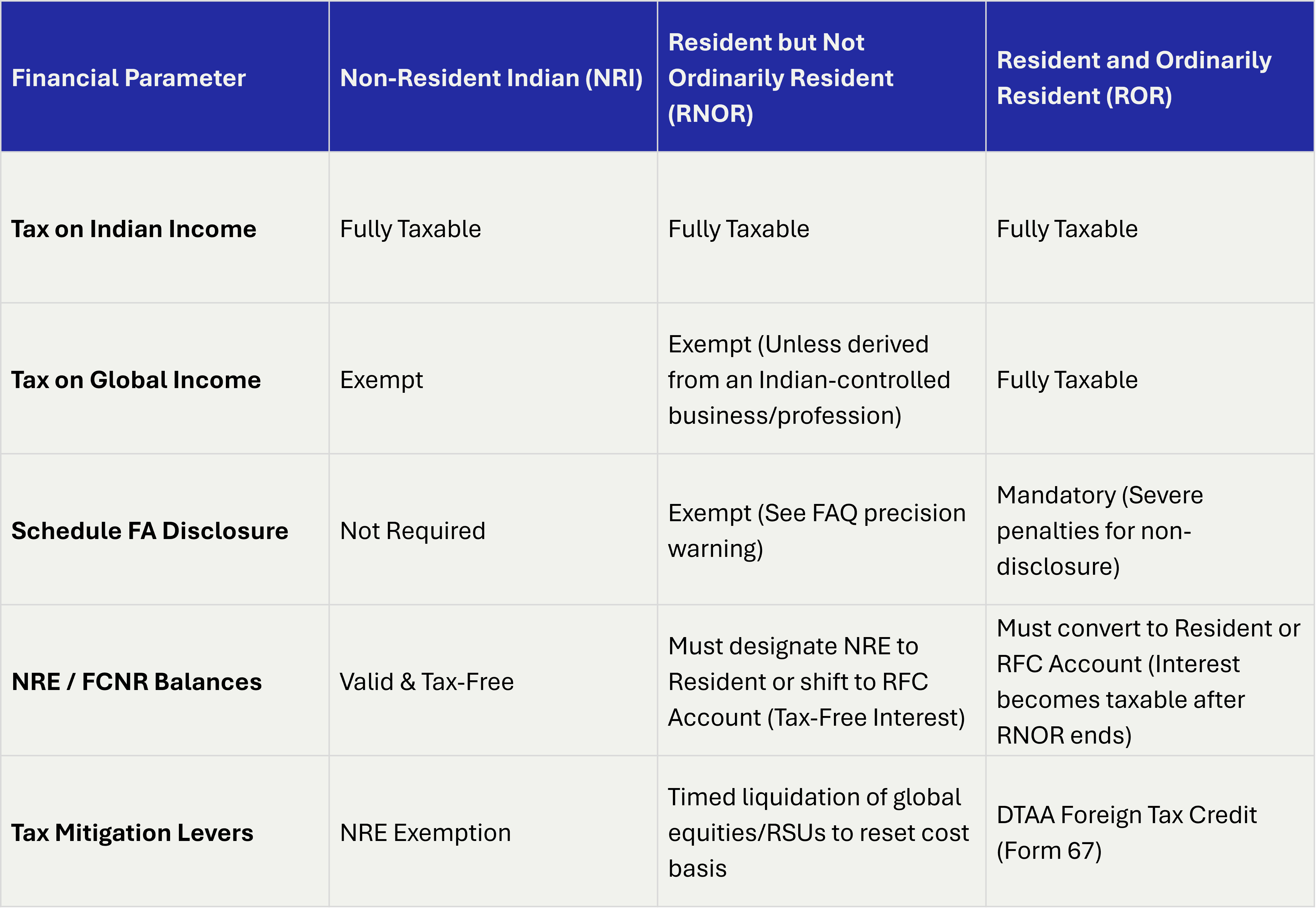
How to Execute Portfolio Restructuring During the RNOR Phase?
The Income Tax Act gives returning NRIs a 2-3 year window to restructure their foreign portfolio while retaining their NRI tax status. Use this window wisely to sell certain foreign assets without incurring any tax in India.
Liquidating High-Tax Global Assets
The RNOR window is a golden opportunity for HNIs to sell their highly appreciated global equities, RSUs, and foreign real estate without triggering a capital gains tax in India. This way, you can reset your cost basis entirely tax-free.
Remitting Capital to India
The RNOR phase is also an opportunity to repatriate capital from foreign bank accounts to India without paying any tax on foreign income. You can bring in all the USD and GBP to India and set up family trusts or buy domestic property.
Conclusion
The Master Strategy: A permanent return to India is not as an endpoint, but a critical, time-sensitive financial transition. The Indian tax framework encompasses global income under the full ROR status, which can introduce a substantial tax drag for unprepared global families. The RNOR window provides a highly strategic buffer within the tax code, but optimizing it requires precise execution. By timing your return flight, seamlessly migrating NRE capital to RFC accounts to retain currency hedges, and systematically liquidating or restructuring global RSUs and real estate during this transitional period, an returning HNI can protect significant capital. Failing to plan this transition means exposing globally compounded wealth to immediate domestic taxation on day one of your ROR status.
Frequently Asked Questions (FAQs)
If I earn a salary in the US but remit it to India during my RNOR period, is it taxable?
Foreign salary is tax-free even if you remit it to India later, as long as it was received abroad in the first place.
Do I need to declare my foreign assets under Schedule FA while I am an RNOR?
Legally, your foreign assets are exempt from disclosure during your RNOR years. However, because you file your returns on a Resident tax form (ITR-2 or ITR-3), we advise ultra-high-net-worth individuals to work with a cross-border strategist. Ensuring your ITR disclosure pages perfectly align with your statutory RNOR disclosure exemptions is critical to preventing automated system flags under the Black Money Act.
What happens to my 401(k) or foreign pension when I return?
You can continue to hold your 401(k) or foreign pension even after you return to India and defer taxation until actual withdrawals. You can claim a foreign tax credit on the tax withheld on these withdrawals when filing returns in India as a ROR.
Can I keep my foreign bank accounts open after returning?
Yes, you can legally keep your foreign bank accounts open after returning to India. However, you must notify your overseas bank of your return so they can update your account profile to non-resident status. As a ROR, you must also disclose all your foreign bank accounts in Schedule FA of your Income Tax Return under the Black Money Act.
Enjoying this article
Share it with the world!
WHAT'S
NEW
Collection of latest reads for you

NRI Tax Filing in India: When, How and Common Mistakes to Av...
Ionic Wealth Tax Team on 14 Aug 2026
NRI status hinges on days spent in India — under 182 days, or 120 days once Indian income exceeds ₹15 lakh — with Section 6(1A) allowing deemed residency even at zero days. This FY26 fili...

US CPI Inflation Eases To 3.4%, As Energy Prices Fall
Ionic Wealth Macro Desk on 14 Aug 2026
US CPI eased to 3.4% YoY in July 2026, with core inflation moderating to 2.5% even as shelter stayed sticky at 3.2% and energy remained elevated at 14.7%. AI-driven demand is filtering in...

From Froth to Fundamentals: The market’s shift toward qualit...
Ionic Global Research on 13 Aug 2026
Markets favoured quality and defensives in July as AI capex worries and leveraged unwinds weighed on sentiment, even as inflation stayed sticky across energy, food, tariffs and housing. W...
Ionic Wealth Newsletter
Investment insights
made simple
Sign up for our newsletter about wealth, markets, and more.




AMFI Registered Mutual Fund Distributor
Angel One Wealth Limited (AOWL)
CIN AOWL - U66190MH2023PLC411784
Angel One Investment Services Private Limited (AOISPL)
ARN AOISPL - 306165
CIN AOISPL - U66190MH2024PTC426203
SEBI Registered Research Analyst Number- INH000020305
Mutual fund investments are subject to market risks, read all scheme related documents carefully.
Registered Office: 601, 6th Floor, Ackruti Star, Central Road, MIDC, Chakala, Andheri (East), Mumbai - 400 093
Copyright © 2025, Ionic Wealth | All rights reserved