
ESOP Taxation in India: Perquisite Tax, Capital Gains & Related IT Act Sections
 AI Summary
Key Takeaways
- ESOP taxation in India is triggered by two distinct taxable events: a perquisite tax levied at the time of exercise and a capital gains tax applied when the shares are eventually sold.
- The taxable perquisite value is the difference between the Fair Market Value (FMV) and the strike price. For unlisted startups, this FMV must be certified by a Category I Merchant Banker within 180 days of the exercise.
- Employees of DPIIT-recognised startups incorporated by March 31, 2030, with a a valid Section 80-IAC (section 140 as per ITA 2025) certification from the Inter Ministerial Board (IMB) can defer their perquisite tax liability for up to 60 months or until they sell their shares or terminate their employment.
- Gains from unlisted shares held for less than 24 months are taxed at your individual slab rate, whereas holdings exceeding 24 months qualify for a reduced flat tax rate of 12.5%.
- Investors must annually declare their unlisted shareholdings in full within their ITR-2 or ITR-3 filings to avoid penalties and ensure their returns match company-reported data.
Most executives holding ESOPs view the tax bill as something they need to address in the future, when the shares are eventually sold.
That assumption is not always correct, and failing to act on this can be costly.
In India, the Income Tax Act creates two separate tax events: one when you exercise your options, and another when you finally sell the shares.
Underestimating that first tax bill is how executives with significant equity end up cash-strapped.
This guide takes you through how both charges are calculated, what the compliance trail looks like, and where the real planning decisions sit.
How is the Perquisite Tax Calculated When I Exercise My ESOPs?
The timing of a perquisite tax event often surprises people since you are not taxed on the grant date, nor when the ESOPs vest.
You can have options in your account for years, watch them vest quarter by quarter, and owe nothing to the government during that entire period.
The tax clock actually starts only when you exercise or when you hand over the strike price and take actual ownership of the shares.
Here’s when Section 17(1)(d) of the new Income Tax Act 2025 comes into play.
Section 17(1)(d) of the new ITA 2025 is the one that defines perquisite tax.
The substantive rule, that the gap between FMV on exercise date and strike price is a taxable perquisite, is unchanged, but the sub-clause is now moved to Section 17(4)(h).
The tax law treats the gap between what the shares are worth on exercise day (the Fair Market Value) and what you paid for them (the strike price) as a perquisite.
Say the FMV is ₹2,000 and your strike price is ₹500. That ₹1,500 difference, multiplied across every share you exercise, gets added to your salary.
Your employer then deducts TDS (Tax Deducted at Source) on that combined figure at your applicable slab rate.
Under ITA 1961, this employer's TDS obligation on salary (including ESOP perquisites) is governed by Section 192.
Under ITA 2025, the equivalent provision is Section 392. The obligation, the mechanics, and the deduction timing are all identical; only the section number changes.
For anyone in the highest income tax bracket, that amounts to 30% plus surcharge and cess.
This number can cost you several lakhs before you've sold a single share or seen a rupee of actual cash.
How Do You Determine the Fair Market Value (FMV) of Unlisted Startup Shares?
For employees at a listed company, FMV is easy: it's whatever the stock traded at on the day you exercised.
Unlisted startups are a different situation entirely.
As there's no exchange traded price for reference, the rules require the company to get a valuation certificate from a Category I Merchant Banker, a SEBI-registered (Securities and Exchange Board of India) intermediary authorised to certify share valuations for regulatory purposes.
That certificate has a shelf life. Under Rule 3(8)(iii) of the Income Tax Rules, 1962, which applies under both ITA 1961 and ITA 2025, the certificate must be dated within 180 days of the exercise date.
Before you submit an exercise request, it's worth checking with your HR or finance team to confirm that a current, compliant certificate already exists. If it doesn't, you are already delayed and sitting with a financial ambiguity that the tax department won't overlook.
How Can I Manage the Severe Liquidity Crunch When Exercising Unlisted ESOPs?
This is where ESOP planning either works or falls apart. Exercising unlisted ESOPs involves two simultaneous payments. You need the strike price to buy the shares, and you need to cover the TDS on the perquisite value at the same time.
Let’s run the numbers on a hypothetical illustration.
Assume 1,000 options at at a strike price of ₹500 a share with an FMV of ₹2,000:
That means ₹5,00,000 in strike price and roughly ₹4,50,000 to ₹ 5,85,000 (including surcharge and cess as applicable) in TDS. That’s close to ₹10-11 lakhs out the door on the same day, just for exercising the option. The shares may not be sold for years, and the final gains (or losses) will be subject to market performance over time.
In our experience advising senior executives across India's startup ecosystem, this dual payment at exercise is the single most underestimated financial obligation we encounter.
Executives frequently arrive having already committed to an exercise date without mapping the full cash requirement, at which point the options available to them narrow considerably.
A pre-exercise liquidity review, ideally three to six months ahead of the intended exercise, is the single most effective step you can take.
What makes the process uncomfortable is the asset you're acquiring. Unlisted shares don't trade on an exchange. There's no quick exit if you need cash.
Executives who haven't mapped out this dual liability in advance sometimes end up borrowing and paying interest on loans to fund a tax bill on illiquid equity.
The smarter move, if your liquidity is constrained, is to wait for a company-organised secondary sale or buyback where you can exercise and exit in the same transaction.
Can I Use a "Cashless Exercise" to Avoid the Upfront Capital Outlay?
The cashless exercise sounds like an elegant solution. Here, a broker fronts the strike price and the TDS, sells just enough shares to recover what it's owed, and deposits the remaining shares in your account.
You end up with the net quantity of equity shares, and no cash outflow. It works well in theory and in practice for employees at listed companies, because the broker can sell into an active market immediately.
For unlisted startup employees, the practical reality is much narrower. There's no exchange, no ready buyer, no mechanism to sell shares on the spot.
A cashless exercise for unlisted company employee is generally possible when the company itself organises a formal liquidity window, such as a secondary sale or a buyback, in which buyers are lined up in advance.
Do I Qualify for the Tax Deferral on ESOPs Granted by DPIIT-Recognized Startups?
For employees at startups formally recognised by the DPIIT (Department for Promotion of Industry and Internal Trade), there's meaningful relief available.
Rather than paying the perquisite tax immediately upon exercise, eligible employees can defer it, essentially postponing the liability until cash is realised.
The deferral runs until whichever of the three events happens first: you sell the shares, your employment ends, or, under ITA 2025, 60 months pass from the end of the tax year in which you exercised.
The 60-month exemption is valid for shares allotted after 1st April 2026.
There is an additional condition for the exemption. A valid Section 80-IAC (section 140 as per ITA 2025) certification from the Inter Ministerial Board (IMB).
The tax doesn't disappear. You'll still owe the same amount, but the timing shifts in your favour if you're holding illiquid stock.
One thing to check before counting on this is whether a deferral flows through your employer's TDS system under Section 192 of the ITA 1961 or Section 392 of the ITA 2025, which means your company has to be set up to process it.
So it’s important to confirm that your company holds both a valid DPIIT recognition and an IMB certification u/s 80-IAC. Section 80-IAC of the ITA 1961 retains the same designation in the ITA 2025.
However, the eligibility window has been extended. Startups incorporated up to 31 March 2030 are now eligible (via the Finance Act 2025), compared to the earlier cut-off of 31 March 2024 under the previous framework.
If your company was incorporated after the prior cut-off but before 2030, it may now qualify for the first time, worth confirming with your finance team.
A structural issue we frequently encounter is that the deferral fails not for lack of eligibility, but because the employer's payroll team was unaware they needed to configure their TDS system differently.
If you are counting on the deferral, verify the mechanics with both your finance team and your CA before your exercise date, not after.
Make sure your finance team understands the mechanics before you exercise, and confirm that the deferral is available before proceeding.
Can I Transfer My ESOPs to an HUF or Spouse to Lower the Tax Burden?
The idea of transferring options or shares to a spouse or Hindu Undivided Family (HUF), splitting income, and reducing the effective rate often arises. However, this is generally tax-inefficient and rarely worth the operational cost.
Before exercise, the question is almost always moot. Startup ESOP plan documents nearly universally prohibit transferring unexercised options to anyone, including a spouse, family member, HUF, or trust. Trying to do so could also forfeit the options.
Once you hold shares, you can’t gift them to your spouse and lower the tax burden. Section 64 of the Income Tax Act, 1961 contains clubbing rules specifically designed for this scenario.
Under ITA 1961, Section 64 contains the clubbing rules specifically designed for this scenario. Under ITA 2025, the equivalent provision is Section 99. Income earned by a spouse on assets transferred without adequate consideration is clubbed back into the transferor's income.
The ITA 2025 makes one refinement. The exception for income attributable to a spouse's "technical or professional knowledge and experience" now explicitly includes "qualifications" as an additional qualifying criterion. This has no practical impact on ESOP scenarios, where no professional services relationship exists.
Any capital gains your spouse earns when those shares are sold get added back to your taxable income, not theirs.
The tax position is the same as if you'd sold the shares yourself. The paperwork is more complex, the compliance risk is higher, and you've gained nothing on the tax front.
How Much Tax Will I Actually Pay on a ₹50 Lakh ESOP Exercise?
The following is a hypothetical scenario for illustrative purposes only and does not constitute tax advice.
Take an executive exercising 1,000 options at a strike price of ₹500. The Category I Merchant Banker valuation has set the FMV at ₹2,000 per share.
Step 1 — Exercise (Perquisite Tax): The ₹1,500 spread per share creates a total perquisite of ₹15,00,000. This amount is added to the executive's salary income and taxed at the 30 percent slab rate, resulting in an approximate base tax liability of ₹ 4,50,000, exclusive of surcharge and cess.
Critically, the acquisition cost for future capital gains computation resets to the ₹2,000 FMV, not the ₹500 strike price, because the spread has already been taxed as income at exercise.
Step 2 — Sale (Capital Gains Tax): The executive subsequently sells the shares at ₹3,000 per share.
The capital gain per share is ₹1,000 (the sale price of ₹ 3,000 minus the ₹2,000 FMV-based acquisition cost), resulting in a total capital gain of ₹10,00,000. The applicable tax rate on this gain depends entirely on the holding period from the exercise date.
What Are the Capital Gains Tax Rates on Selling Unlisted ESOP Shares?
The rates below apply under both the ITA 1961 (as amended by the Finance Act 2024) and the ITA 2025. The flat 12.5% LTCG rate on unlisted shares held over 24 months, without indexation, was introduced by the Finance Act 2024 and carried forward unchanged into the ITA 2025.
If you are filing for Tax Year 2025-26 or earlier, cite the Finance Act 2024 amendment to the ITA 1961. From Tax Year 2026-27 onwards, the same rates apply under the ITA 2025.
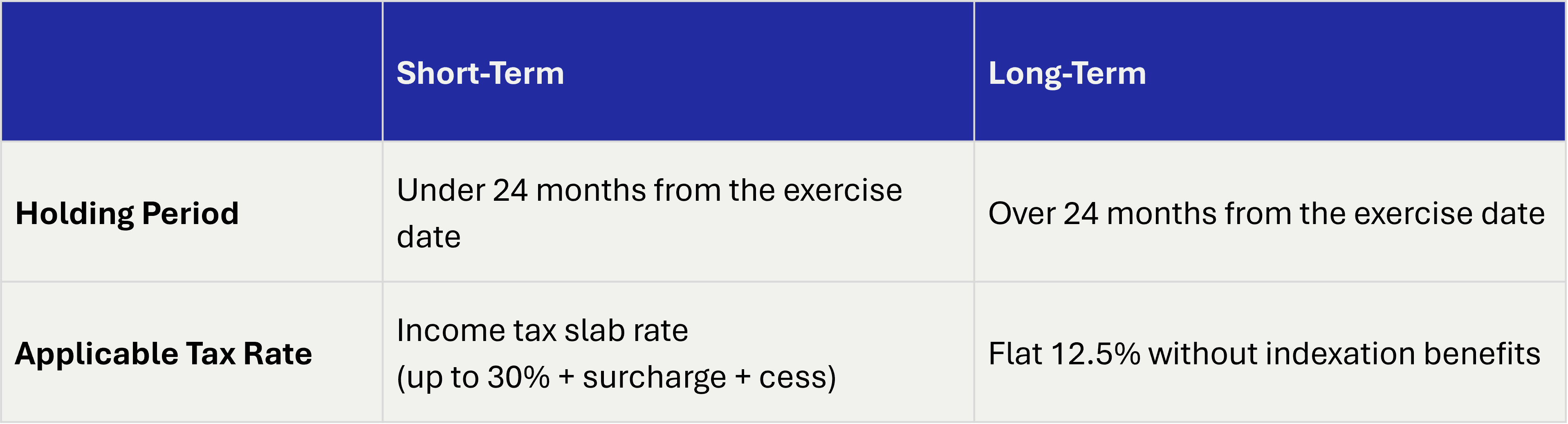
The 24-month threshold is measured from the date of exercise, not the date of grant or vesting. Achieving long-term status at a flat 12.5% rate represents a materially lower tax burden for patient holders.
For an executive sitting on a ₹10 lakh gain, the difference between short-term and long-term treatment can be upwards of ₹1.75 lakh in tax.
Deliberately planning exit timing around this threshold, particularly ahead of a secondary sale or IPO, is one of the highest-leverage optimisations available to ESOP holders.
How Do I Declare Unlisted ESOP Shares in My ITR-2 to Avoid Penalties?
Paying tax deducted at source (TDS) at exercise doesn't satisfy your obligations and only covers the immediate charge. Unlisted shares come with an annual reporting requirement that is separate from the tax payment itself, and many executives overlook it.
Every year, you must file taxes using ITR-2 (Income Tax Return form for individuals without business income) or ITR-3 (Income Tax Return form for individuals with business income). You must declare your unlisted shareholdings in full: opening balance, acquired shares, sold shares, and closing balance.
The Income Tax Department is increasingly cross-referencing these disclosures against company-level data.
If your return doesn't match the company's records, you may receive a notice from the Income Tax Department. In years when you've exercised options or sold shares, the schedule must be filled in correctly and completely.
A qualified CA who understands unlisted equity filings is worth the cost, as the penalties for getting this wrong are a lot steeper than the filing fee.
For income earned up to and including March 2026 (Tax Year 2025-26), your return will still be filed under the ITA 1961. From Tax Year 2026-27 (income from April 2026), the ITA 2025 governs, and returns should reference its provisions.
The ITR-2/ITR-3 form structure and the unlisted shareholding disclosure schedule are not expected to change materially, but confirm with your CA that they are using updated forms for the applicable year.
Conclusion
ESOPs are one of the most powerful tools for executive wealth creation, but they are not a "get-and-forget" asset. As we’ve explored, the immediate liquidity crunch caused by the perquisite tax under Section 17(2)(vi) as per ITA 2025, which often occurs years before a sale is even possible, demands proactive financial planning and a clear understanding of your FMV liabilities.
The significant tax advantage of waiting until the 24-month threshold is met to qualify for the 12.5% LTCG rate makes timing one of your most valuable strategic levers. The key is to match your tax payments with meticulous annual reporting in your ITR-2 or ITR-3. Ultimately, managing ESOPs successfully means looking beyond the grant date and treating your tax and disclosure obligations with the same precision you apply to your professional role.
Frequently Asked Questions (FAQs)
Are unexercised ESOPs subject to taxation?
Unexercised options remain completely untaxed. The tax liability arises only when you exercise the right to purchase the shares.
Can capital losses from ESOPs offset salary income?
Capital losses cannot be set off against salary income. You can only set off these losses against other capital gains and carry them forward for eight assessment years.
How does a company buyback affect ESOP taxation?
Unlisted companies occasionally conduct buybacks to provide liquidity to employees. This does not change the tax incidence; the standard capital gains tax rules apply to an employee who tendered shares during a buyback event.
Does the Section 112A exemption apply to unlisted ESOPs?
The ₹1.25 Lakh long-term capital gains exemption strictly applies to listed equity shares subject to Securities Transaction Tax. Unlisted shares do not qualify for this specific exemption.
Enjoying this article
Share it with the world!
WHAT'S
NEW
Collection of latest reads for you

US CPI Inflation Eases To 3.4%, As Energy Prices Fall
Ionic Wealth Macro Desk on 14 Aug 2026
US CPI eased to 3.4% YoY in July 2026, with core inflation moderating to 2.5% even as shelter stayed sticky at 3.2% and energy remained elevated at 14.7%. AI-driven demand is filtering in...

From Froth to Fundamentals: The market’s shift toward qualit...
Ionic Global Research on 13 Aug 2026
Markets favoured quality and defensives in July as AI capex worries and leveraged unwinds weighed on sentiment, even as inflation stayed sticky across energy, food, tariffs and housing. W...

Cloud Just Made the AI Spending Argument Easier
Ionic Global Research on 11 Aug 2026
For months, investors have worried that Big Tech was spending vast sums on AI with no clear path to a return. Reporting within a day of each other in late July, Microsoft and Amazon put t...
Ionic Wealth Newsletter
Investment insights
made simple
Sign up for our newsletter about wealth, markets, and more.




AMFI Registered Mutual Fund Distributor
Angel One Wealth Limited (AOWL)
CIN AOWL - U66190MH2023PLC411784
Angel One Investment Services Private Limited (AOISPL)
ARN AOISPL - 306165
CIN AOISPL - U66190MH2024PTC426203
SEBI Registered Research Analyst Number- INH000020305
Mutual fund investments are subject to market risks, read all scheme related documents carefully.
Registered Office: 601, 6th Floor, Ackruti Star, Central Road, MIDC, Chakala, Andheri (East), Mumbai - 400 093
Copyright © 2025, Ionic Wealth | All rights reserved