
How to Invest in US Stocks from India: Platforms, Tax & LRS Limits
 AI Summary
Key Takeaways
- Investing in US stocks provides Indian investors with exposure to global themes and serves as a portfolio diversifier, while offering an automatic "currency alpha" due to the historical depreciation of the rupee against the dollar.
- Navigating the Liberalised Remittance Scheme (LRS) requires managing an annual individual limit of $250,000 and a 20% Tax Collected at Source (TCS) on remittances exceeding ₹10 lakhs (the threshold raised from ₹7 lakhs under Budget 2025), though the TCS can be strategically offset against domestic advance tax liabilities.
- Investors can choose among direct brokerage platforms, domestic Funds of Funds (FoFs) that bypass LRS limits, or the emerging GIFT City route. Each route comes with distinct implications for costs, taxation, and regulatory compliance.
- International investing involves navigating complex tax regulations, including a 12.5% Long-Term Capital Gains tax after 24 months, a 25% US dividend withholding tax mitigated by the Foreign Tax Credit, and a steep 40% US Estate Tax on direct holdings exceeding $60,000.
For the high-net-worth individual, "Home Bias" is a silent destroyer of global purchasing power. While the Indian equity market offers participation in the domestic growth story, failing to allocate capital to US markets means missing out on key innovative themes including technological monopolies, from AI architecture to global SaaS, that define the modern economic era. US equity also acts as a powerful structural hedge. Historical data shows the INR depreciating by 3% to 4% annually against the USD, adding an automatic "currency alpha" to dollar-denominated assets.
The mechanics of investing in US stocks have grown more complicated in recent years, thanks to the 20% Tax Collected at Source (TCS) on foreign remittances and the lingering threat of US Estate Taxes. This guide lays out a practical 2026 framework for navigating the Liberalised Remittance Scheme (LRS), making sense of double taxation treaties, and choosing the right structural tool, whether that's Direct Equity, Domestic Funds of Funds, or the GIFT City route, to maximise your net-of-friction global return.
This is written with corporate executives and business owners in mind, those who need a systematic way to move INR liquidity into USD assets for portfolio stability and legacy planning.
The Macro Play: Why the USD-INR Exchange Rate is Your "Hidden Alpha"
When you invest in US markets as an Indian resident, in addition to stock appreciation, you also stand to earn the currency differential between the rupee and the dollar.
The Dual-Compounding Effect
The math is simple. If the S&P 500 returns 8% in a given year, and the USD appreciates by 3% against the INR over the same period, your effective return in rupee terms comes to roughly 11%. This currency depreciation effectively works as an automatic yield enhancer for Indian investors holding dollar assets. Over a multi-year horizon, this compounding effect can meaningfully widen the gap between domestic and international portfolio performance.
Hedging Against Domestic Systemic Risk
US equities, particularly large-cap technology and healthcare names, often display a low or even negative correlation to emerging market volatility. This means that when Indian markets face a localised political or economic shock, a well-allocated US portfolio can act as a kind of "portfolio parachute," cushioning the overall blow to your net worth.
Navigating the LRS and the 20% TCS Cash Flow Shock
Before any of this currency math can play out, investors need to get past the RBI's capital controls and one particularly painful tax mandate.
The $250,000 LRS Limit
The Liberalised Remittance Scheme allows every resident individual, including minors, to remit up to $250,000 USD per financial year for overseas investments. For a family of four, that adds up to a $1 million USD annual capital flight corridor, assuming each member's limit is used. Remittances for foreign securities must use RBI Purpose Code S0001. The RBI strictly prohibits using LRS funds for leveraged trading, margin trading, or foreign financial derivatives (F&O); all transactions must be pure delivery-based equity purchases.
Surviving the 20% TCS Liquidity Drag
Effective under Section 394(1) of the Income Tax Act, 2025 (transitioned from Section 206C(1G)), any LRS investment remittance exceeding ₹10 lakhs in an aggregate financial year across all authorised bank accounts is subject to a 20% Tax Collected at Source on the amount above that threshold. .
If you remit ₹1 crore to buy Apple shares, the first ₹10 lakhs is exempt, and 20% applies to the remaining ₹90 lakhs, meaning ₹18 lakhs is being collected upfront, creating a significant cash flow drag even though the amount is available as tax credit.
TCS is not a sunk cost; it is an advance tax credit. To neutralize this cash flow drag, these steps can be followed:
- Advance Tax Adjustment: Immediately offset the 20% TCS against your quarterly domestic Advance Tax liabilities. If remitting in Q1, reduce your June 15 Advance Tax payment by the exact quantum of TCS collected.
- Salary TDS Reduction: Salaried corporate executives can submit Form 12BB to their employer, detailing the TCS collected. Employers are legally mandated to reduce monthly salary TDS accordingly.
- AIS Reconciliation: Ensure the TCS reported in your Annual Information Statement (AIS) matches Form 26AS data to prevent automated mismatch notices during ITR processing.
Direct Brokerage vs. Domestic FoFs vs. GIFT City
The vehicle you choose to invest through has a direct bearing on your tax code, compliance burden, and estate-planning exposure.
Direct Brokers
These platforms give you direct fractional ownership of US stocks and ETFs, often with the lowest available expense ratios. The tradeoff is that you remain subject to LRS limits, the 20% TCS hit, wire transfer fees through SWIFT, and direct exposure to US tax laws, including the estate tax issue discussed below.
Domestic Fund of Funds (FoFs)
Indian mutual funds that invest in US markets allow you to invest in USD using INR, with the asset management company handling the USD conversion. This means a total elimination of LRS reporting and no TCS implication.
The downside is that these funds are treated as “debt” or “unlisted assets” for tax purposes in India, which can affect how gains are taxed. They're also subject to industry-wide RBI limits, which have occasionally forced AMCs to pause fresh inflows altogether.
The Emerging GIFT City Route
The International Financial Services Centre at GIFT City is becoming an increasingly viable third option. It allows HNIs to invest in US stocks through Indian-regulated international exchanges, often with a more streamlined remittance and tax environment for high-ticket allocations. This route is still maturing, but it's worth keeping on your radar as infrastructure and product offerings expand.
The Tax Math: Capital Gains, Dividends, and the DTAA
Once you're invested, two tax authorities have a claim on your returns: the IRS taxes your income at source, and the Indian Income Tax Act taxes your capital gains.
Unlisted Foreign Equity Taxation (LTCG)
Foreign stocks aren't treated the same way as Indian listed shares for tax purposes. Under the 2024/25 tax rationalisation, US stocks need to be held for 24 months to qualify for Long-Term Capital Gains treatment, which is taxed at 12.5% without indexation benefit. Anything sold before that 24-month mark is treated as Short-Term Capital Gains and taxed at your highest applicable slab rate, which can go as high as 39%.
The 25% Dividend Withholding
Dividends paid by US companies to Indian residents are subject to a 25% withholding tax at source under Article 10 of the India-US DTAA. (The 15% DTAA rate applies exclusively to corporate shareholders holding 10%+ voting stock; retail individual investors pay 25%).
Crucial Requirement: To secure the 25% treaty rate instead of the default 30% IRS rate, investors must file Form W-8BEN with their broker/custodian upon account opening and renew it every three years.
Utilising the Foreign Tax Credit (FTC)
To prevent double taxation on dividend income, you can claim credit for the 25% tax paid in the US against your Indian tax liability:
- Legislative Form Update: Effective under the Income Tax Act, 2025 (Sections 159/160), Foreign Tax Credit is claimed by filing Form 44 (which replaces the legacy Form 67).
- Procedural Execution: You must obtain IRS Form 1042-S from your US broker as documentary proof of tax withheld. Dividend income and tax paid must be converted into INR using the State Bank of India (SBI) Telegraphic Transfer Buying Rate (TTBR) from the last day of the month preceding the payment date.
- Filing Deadline: Form 44 MUST be submitted on the e-filing portal BEFORE submitting your ITR (i.e – within 12 months from the end of the relevant tax year). Submitting the ITR prior to Form 44 causes automated CPC rejection of the credit, triggering tax notices.
The Silent Wealth Killer: US Estate Tax
This is perhaps the most overlooked risk in direct US stock ownership, and it can be devastating for multi-generational wealth planning.
The 40% Confiscation
Non-US citizens, including resident Indians, only get a $60,000 exemption on US situs assets, which include stocks, ETFs, and real estate. Any value above that threshold is subject to US Estate Tax upon the holder's death, with rates that can reach a staggering 40%. For HNIs holding even a moderately sized direct US portfolio, this is a real and significant exposure for heirs.
Estate Tax Mitigation Strategies
There are several ways to sidestep this risk. One option is using Ireland-domiciled ETFs, often referred to as UCITS funds, which are not classified as US situs assets. Accumulating UCITS ETFs automatically reinvest dividend proceeds internally into the fund's NAV. Because no cash dividend is paid to the Indian investor, you experience no current dividend tax in India, eliminate the need to file Form 44, bypass Schedule FSI complexity, and convert current income into long-term capital gains (taxed at 12.5% after 24 months upon final sale).
Another is investing through domestic FoFs, in which the Indian AMC is the legal owner of the underlying assets, thereby removing the issue entirely for the individual investor. For very large allocations, setting up offshore corporate entities or trusts may also be worth exploring with proper legal counsel.
Direct Routing vs. Mutual Fund (FoF) Wrapper
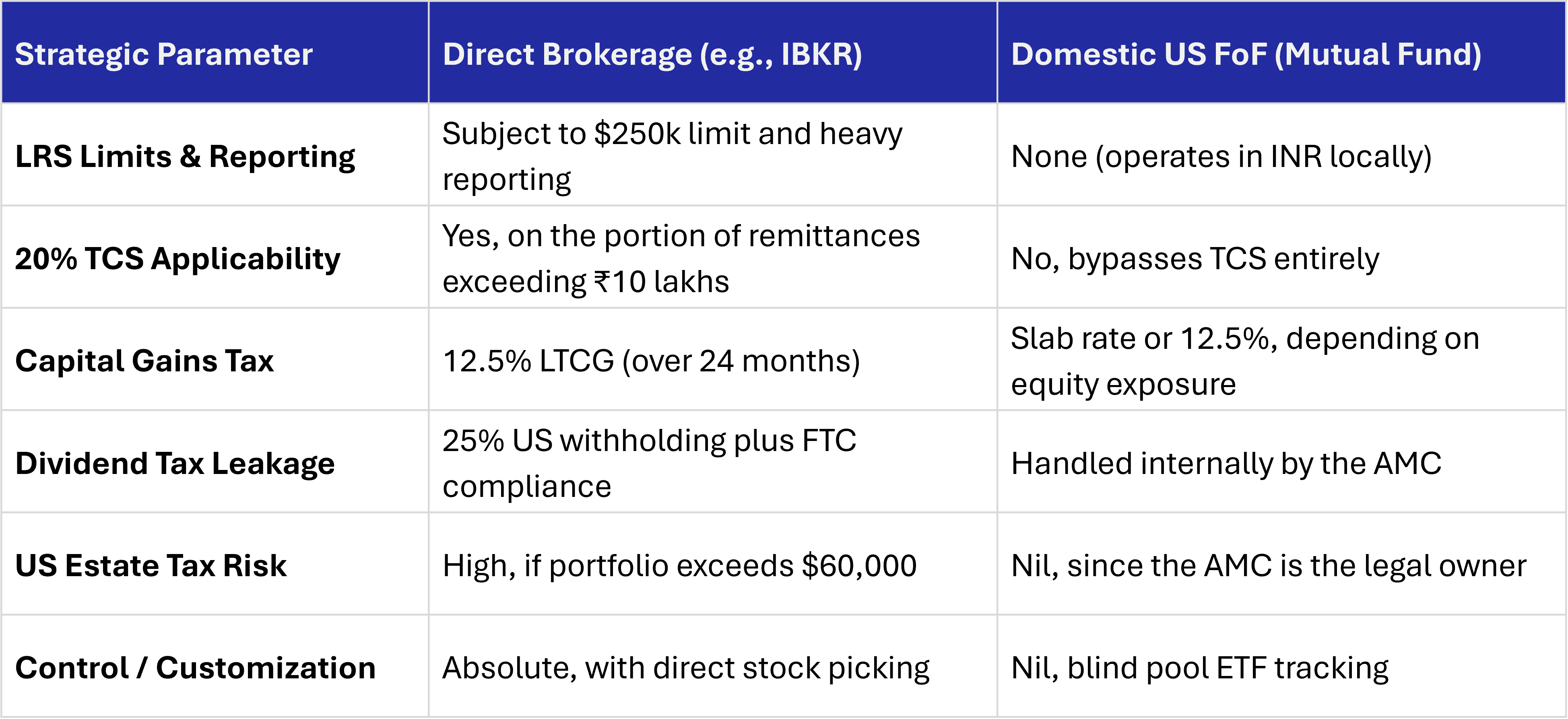
Conclusion
At Ionic Wealth, a global equity allocation is a core part of how we think about future-proofing a portfolio. But the decision to diversify globally is only half the job. How you execute this allocation matters just as much as the decision to make it.
Since the RBI limits for domestic mutual funds’ FoF structures are currently full, alternatives need to be considered from a practical point of view.
For the core allocation, like a broad exposure to something like the S&P 500 or the Nasdaq, the first choice could be a platform route, i.e. Ireland-domiciled UCITs funds or ETFs. Alternatively, one can look at various professionally managed strategies offered via GIFT City AIFs. Both structures keep the holding out of US-situs classification, which addresses the US estate tax exposure that comes with holding US-listed shares directly in a US brokerage account.
Direct equity exposure via LRS may form the secondary option, positioned as the satellite, not the core. It suits high-conviction, single-stock decisions, a concentrated bet in an AI or biotech name, for instance, where the investor is willing to carry the heavier load that comes with it: annual reporting under Schedule FA, TCS on the remittance, and offsetting that TCS credit against advance tax at filing time.
Intelligent global investing was never just about picking the right index or the right stock. It is also about choosing a structure that lets those gains compound without leaking out through TCS, FX costs, or a cross-border estate tax bill your heirs never signed up for.
Enjoying this article
Share it with the world!
WHAT'S
NEW
Collection of latest reads for you

Jackson Hole: Hawkish Fed, What Lies Ahead For Markets?
Ionic Wealth Macro Desk on 31 Aug 2026
Fed Chair Kevin Warsh signals a pivot away from forward guidance, urging markets to send unfiltered signals as the FOMC holds firm on its 2% inflation target. With over half the PCE baske...

Nvidia Raises AI Server Prices Above 15% as Memory Costs Bit...
Ionic Global Research on 25 Aug 2026
Nvidia has told major customers that AI server prices are rising more than 15% on early-2027 shipments, adding roughly $800,000 to a GB300 NVL72 rack. The increase is framed as a memory-c...
.png&w=3840&q=75)
Anthropic Hits Its First Operating Profit Ahead of Landmark ...
Ionic Global Research on 18 Aug 2026
Anthropic posted its first-ever operating profit alongside a 14x year-on-year revenue jump in Q2 2026, turning two years of losses into the strongest argument yet for its targeted $2 tril...
Ionic Wealth Newsletter
Investment insights
made simple
Sign up for our newsletter about wealth, markets, and more.




AMFI Registered Mutual Fund Distributor
Angel One Wealth Limited (AOWL)
CIN AOWL - U66190MH2023PLC411784
Angel One Investment Services Private Limited (AOISPL)
ARN AOISPL - 306165
CIN AOISPL - U66190MH2024PTC426203
SEBI Registered Research Analyst Number- INH000020305
Mutual fund investments are subject to market risks, read all scheme related documents carefully.
Registered Office: 601, 6th Floor, Ackruti Star, Central Road, MIDC, Chakala, Andheri (East), Mumbai - 400 093
Copyright © 2025, Ionic Wealth | All rights reserved