
Managing Concentration Risk: What to Do When Your Net Worth Is Tied to One Stock
 AI Summary
Key Takeaways
- A concentrated position is generally defined as holding more than 20% of your total liquid net worth in a single stock. Wealth managers typically recommend diversifying the risks associated with concentration.
- Holding a concentrated position, exponentially increases the "recovery return" needed to break even after a price dip. For instance, as a 40% drawdown requires a 66.7% gain just to return to the original portfolio value.
- Loan Against Securities (LAS) allows investors to unlock the value of wealth tied up in a single security, without triggering capital gains tax.
- A structured tranche sale strategy helps investors systematically diversify their wealth, spreading out capital gains tax liabilities over multiple years while reducing the risk associated with holding large positions in volatile shares.
Introduction
Most tech employees and startup founders build wealth by accumulating equity through equity stock grants, i.e. Employee Stock Options (ESOPs) and Restricted Stock Units (RSUs).
While senior executives often receive 40–60% of their compensation in equity, and founders may have 80–90% of their net worth tied to a single ticker. While these grants have been known to act as a great way of creating wealth, preserving that wealth requires a transition from a builder's loyalty to an investor's discipline.
Some people think diversifying means you don't believe in your company, but that's not the case. It’s the process of protecting yourself from the unpredictable swings of one company's stock price.
What Percentage of Your Net Worth in a Single Stock is Mathematically Unsafe?
Many wealth managers define a concentrated position as holding more than 20% of your total liquid net worth in a single stock.
The math behind this threshold is driven by the "recovery return" required to offset a dip. If you have 50% of a ₹1 Crore portfolio allocated to a single stock that falls by 50%, your total portfolio value drops by 25%. To return to your original ₹1 Crore value, that single stock must then deliver a 100% return or the entire portfolio should give an overall return of 33%.
Let us illustrate the benefits of reducing concentration risk with the help of numbers
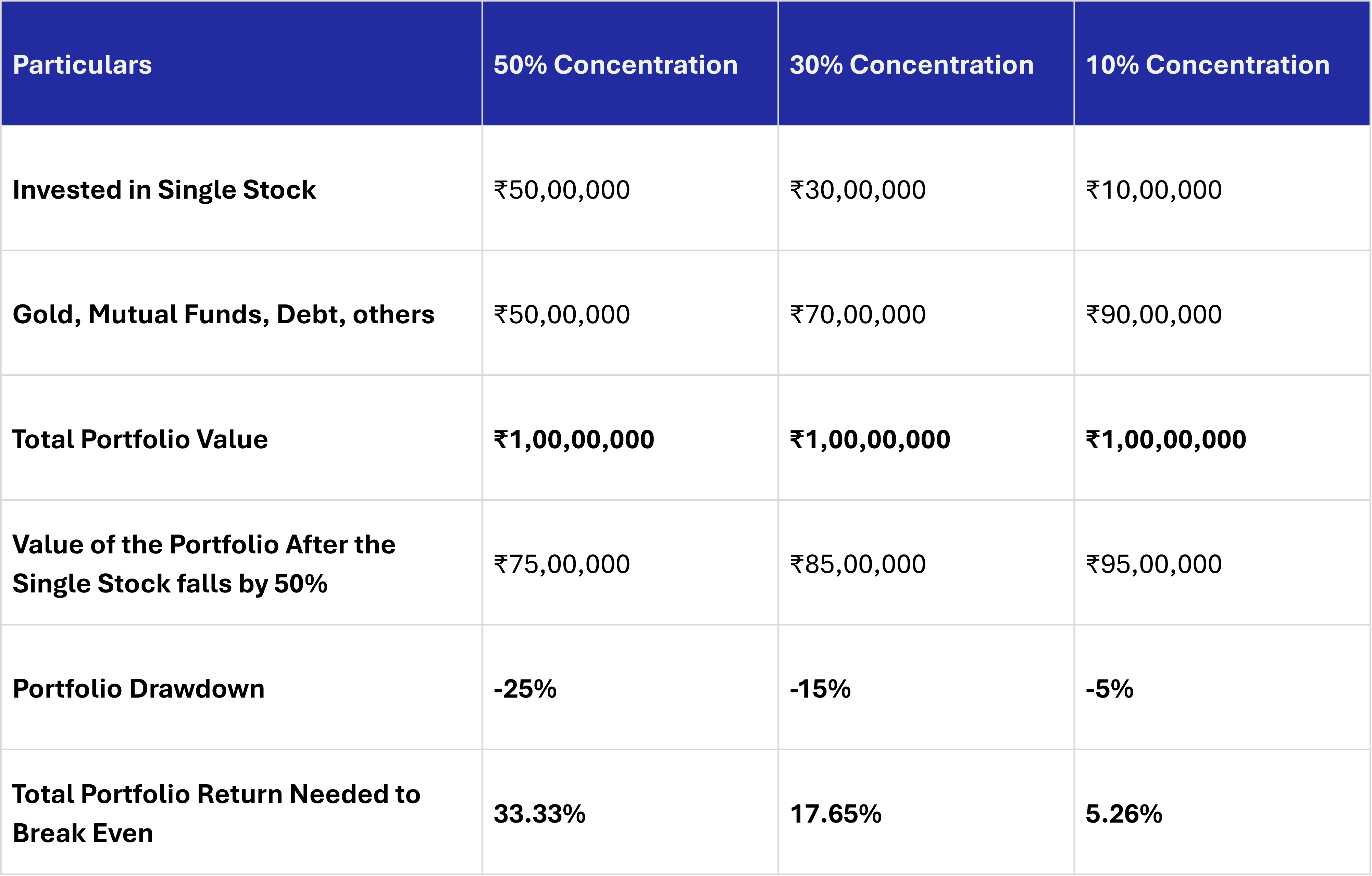
The same math applies to single-stock holdings accumulated through RSUs and ESOPs. No one can predict the future with accuracy, but one can make a rational analysis and decide on what percentage of the holdings should be kept in a single stock to avoid drastic drawdown in your overall portfolio.
How Does the "Endowment Effect" Blind You to Portfolio Risk?
For those accumulating RSUs and ESOPs, the feeling of being "safe" and familiar with the company creates a cognitive bias called the Endowment Effect. This leads individuals to overvalue an asset simply because they already own it, regardless of its intrinsic value or market outlook.
To assess your own bias, try this exercise: Imagine your entire net worth was in cash today. Would you invest 80% of that cash into your employer's stock at its current price? If the answer is no, you are likely holding a position based on emotion rather than a rational exit strategy.
This is often compounded by the Sunk Cost Fallacy, where investors hold onto a losing position because they have already committed years of labor to the company.
What is the Hidden Cost Of Recovery In Your Stock Value?
Most investors assume "breaking even" means returning to their initial price. However, in a concentrated position, time is a hidden tax. When your capital is stuck recovering from a dip, it isn't just stagnant; it is losing value against inflation and safer alternatives.
Consider the following example that illustrates the asymmetry of recovery.
Imagine your ₹1 Crore tech stock position suffers a 40% drawdown and takes two years to return to its original price. Here is why "getting back to zero" is actually a loss:
The Recovery Gap
A 40% drop turns ₹1 Crore into ₹60 Lakhs. To return to ₹1 Crore, the stock must gain 66.7%.
(Recovery Return) = (40,00,000)/(60,00,000) * 100 = 66.67%
The Opportunity Cost (The Risk-Free Miss)
If you had diversified into a simple Fixed Deposit (FD) at 7% p.a., your ₹1 Crore would have grown while your stock was struggling to recover.
Future Value (FD) = 1,00,00,000 * (1 + 0.07)^2 = ₹1,14,49,000
The Inflation Effect
With 6% annual inflation, your original ₹1 Crore has lost purchasing power. To buy the same lifestyle two years later, you actually need ₹1,12,36,000.
The "True" Break-Even
To truly be "even" with a conservative investor, your stock doesn't just need a 66.7% gain, it needs to outperform the risk-free benchmark.
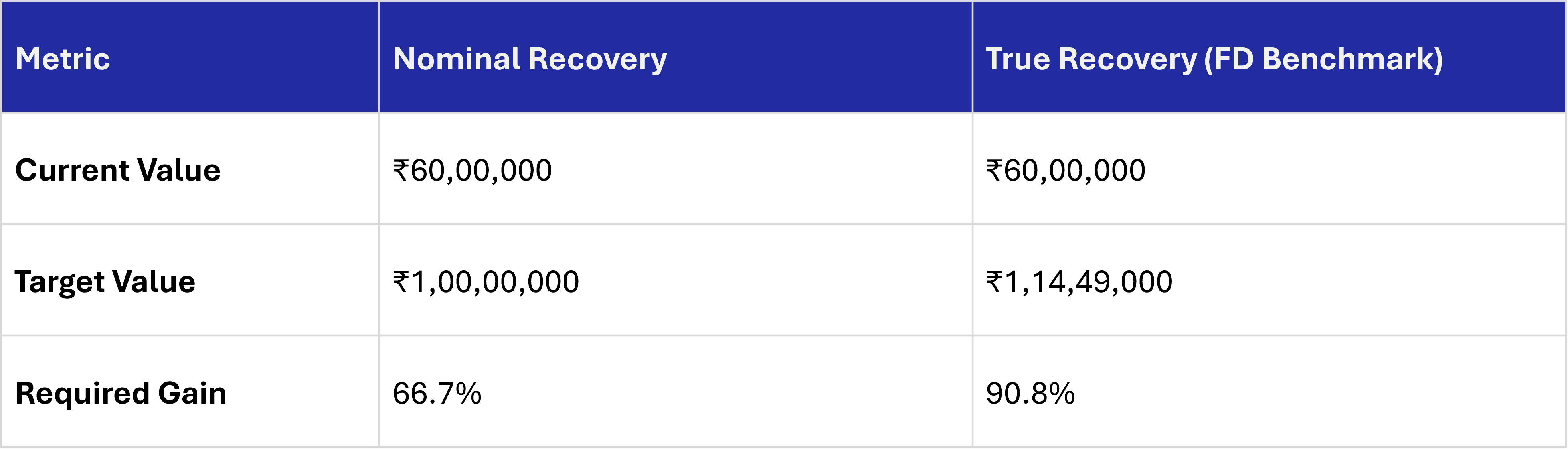
By the time your stock "recovers," you are still nearly 25%[8.1] behind where you could have been. This "recovery trap" is why holding a volatile, concentrated position often destroys compounding momentum, even if the price eventually bounces back.
How Do You Execute a Tax-Efficient Tranche Sale Strategy?
A structured tranche sale strategy involves dividing vested RSUs and ESOPs into blocks to be sold over months or years. This approach balances current liquidity with future potential upside.
For example, if you hold 2,500 shares of a tech stock, you might divide them into 10 tranches of 250 shares each, selling one tranche every quarter.
1. Tax Smoothing: Spreading capital gains over 2.5 years helps avoid hitting higher income tax surcharge brackets in a single financial year.
2. Market Timing: If the stock surges, you still participate as you have not yet sold all the shares.
3. Risk Mitigation: If the stock falls, you have already protected your capital or locked in profits on the earlier tranches at a better price.
Should You Pledge Your Shares for a Loan Instead of Selling?
Investors often use Loan Against Securities (LAS) to unlock liquidity. This can mean that you remain invested in the stock, but at the same time free up your capital without triggering a capital gains tax event. In this structure, you pledge dematerialised shares to a lender such as a bank or NBFC to secure a line of credit.
LTV Ratio: Lenders generally offer a 50% Loan-to-Value (LTV) for equity-based assets. The RBI’s amendment directions on capital market exposure (announced early 2026, effective 1 July 2026) raised the LTV cap on listed shares to 60%, and capped per-individual LAS exposure at ₹1 crore at the banking system level.
Note: Unlisted shares are generally NOT pledgeable under the LAS mechanism as per RBI guidelines.
Tax Efficiency: Since no asset sale occurs, you avoid the 12.5% LTCG tax (for holdings >12 months) or slab-rate STCG tax.
Ownership Benefits: You continue to receive dividends and capital appreciation on the pledged shares.
However, LAS requires discipline due to market risk. If the stock price falls below the lender’s threshold, the lender may exercise a margin call. This means you must either increase the collateral by pledging more shares or repay a portion of the loan. Failure to do so grants the lender the right to liquidate your shares, potentially at a market bottom.
Overall, while LAS does have some benefits of creating short term liquidity without insuring capital gains tax incidence, this may not be the most efficient strategy to reduce the concentration risk in a portfolio over the long term.
Conclusion
In our experience advising clients with concentrated positions, the hardest part is not the math but the emotional shift from builder to investor.
As the mathematical reality of drawdowns demonstrates, even a solid portfolio can quickly transform into a "house of cards" when the asymmetry of recovery returns works against you.
Once you recognise how the Endowment Effect clouds your judgment, you can use tools like tax-efficient tranche sales or to diversify. These allow you to secure your financial independence without remaining tethered to a single stock.
Frequently Asked Questions (FAQs)
Can I gift my concentrated stock position to a family member or a relative to avoid tax?
No. Gifting shifts the tax, it does not remove it. For a non-working spouse, minor child, or daughter-in-law, Section 99 of the Income-tax Act returns the gains to you under the clubbing provisions. For other relatives the recipient will inherit your cost and holding period so they will have to pay tax on the gains whenever they sell.
What is a margin call on a Loan Against Securities?
A margin call occurs when the value of your pledged shares drops below the lender's required threshold, forcing you to either increase collateral, deposit cash or face automatic liquidation.
Should I hold my shares if I believe a buyout is imminent?
Holding for a potential buyout is highly speculative and generally not recommended if it violates your core diversification limits.
Are stock options treated differently than standard shares for concentration risk?
Yes, options carry leverage and expiration dates, making their risks significantly different than fully owned shares in a concentrated portfolio.
Enjoying this article
Share it with the world!
WHAT'S
NEW
Collection of latest reads for you

Semis: 9 turns of de-rating, c.20 points of EPS accretion
Ionic Global Research on 8 Sept 2026
Semiconductor stocks just went through their sharpest valuation reset of the year, the SOXX index's forward P/E fell from roughly 29x in late June to 19.6x now, even as forward earnings e...

Asset X | September 2026: Key Signals Across Asset Classes
Ionic Wealth Macro Desk on 8 Sept 2026
Domestic equities stay resilient on strong earnings and attractive valuations, while global markets remain volatile on rate uncertainty and AI capex concerns. Fixed income holds firm on R...

Gold ETFs vs. EGR vs. Physical Gold: Best Way to Invest in G...
Ionic Wealth Tax Team on 7 Sept 2026
Physical gold's non-refundable GST, elevated customs duty and storage costs quietly erode HNI portfolios — while EGRs offer a SEBI-regulated middle path: exchange-traded liquidity with th...
Ionic Wealth Newsletter
Investment insights
made simple
Sign up for our newsletter about wealth, markets, and more.




AMFI Registered Mutual Fund Distributor
Angel One Wealth Limited (AOWL)
CIN AOWL - U66190MH2023PLC411784
Angel One Investment Services Private Limited (AOISPL)
ARN AOISPL - 306165
CIN AOISPL - U66190MH2024PTC426203
SEBI Registered Research Analyst Number- INH000020305
Mutual fund investments are subject to market risks, read all scheme related documents carefully.
Registered Office: 601, 6th Floor, Ackruti Star, Central Road, MIDC, Chakala, Andheri (East), Mumbai - 400 093
Copyright © 2025, Ionic Wealth | All rights reserved