
Beyond GPUs: The CPU Side of the AI Build-Out
 AI Summary
Beyond GPUs: How CPUs Are Shaping the AI Economy. Everyone talks about GPUs powering AI. But there's another chip that's quietly becoming just as critical, the CPU.
The CPU squeeze hasn't eased — it has settled in. As AI workloads moved from training to inference to agentic systems, server-CPU demand stepped up and stayed elevated. What looked like a temporary shortage has held: lead times have stretched to around six months, prices are up 10–20% since March, and Intel and AMD remain close to sold out for 2026. The constraint now looks structural rather than cyclical.
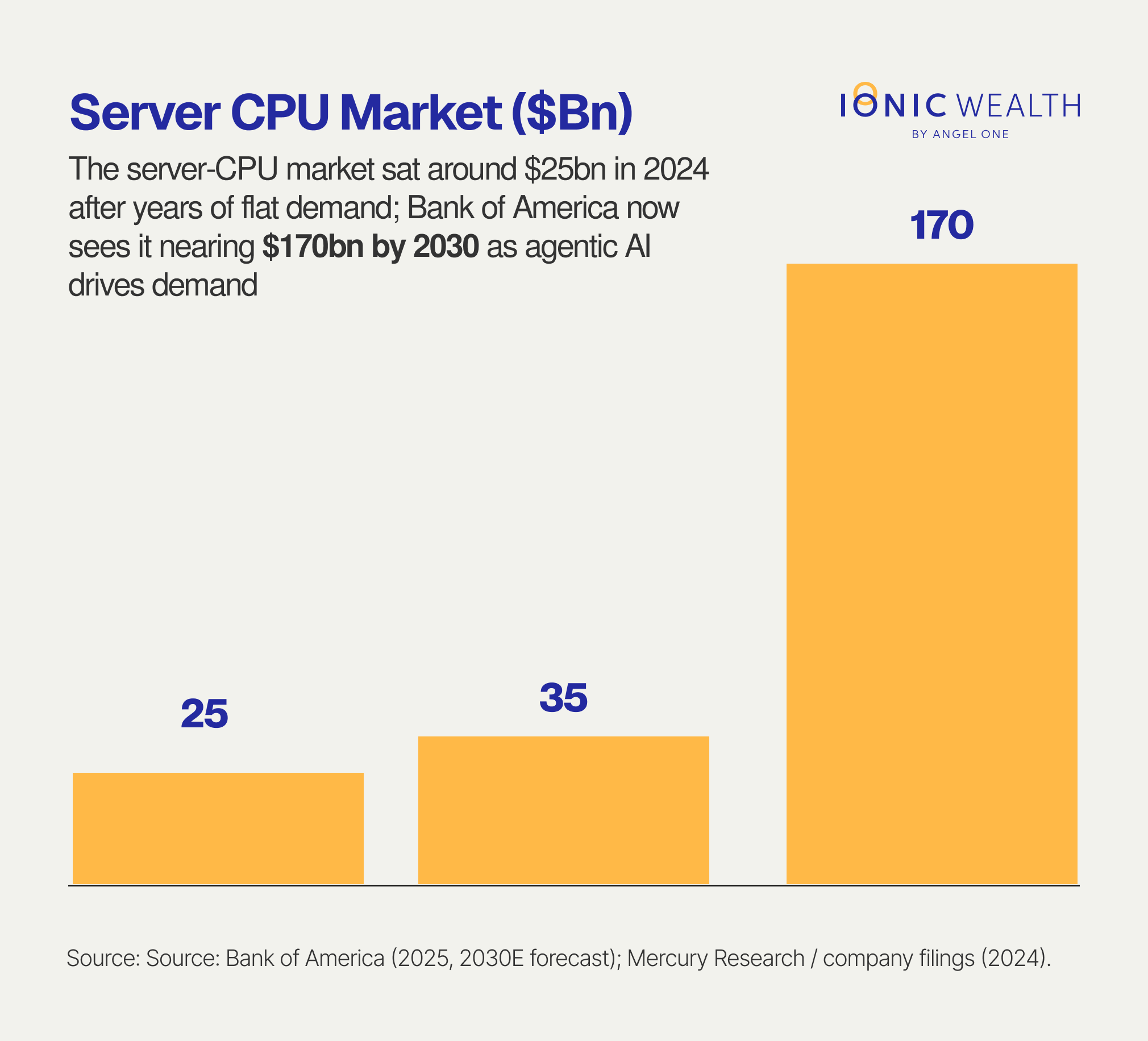
What sustains it is the nature of agentic work. Agents run multi-step workflows — planning, tool calls, database queries, code execution and validation loops — and that orchestration is CPU-bound work that scales with every agent deployed. AMD CEO Lisa Su forecasts the GPU-to-CPU ratio in AI infrastructure will compress from 4–5:1 toward 1:1 as agentic AI and inference workloads increase CPU demand, while Arm estimates an agentic data centre needs roughly four times the CPU cores of a traditional one.
Amazon and Google are widening the field with their own chips. The market is no longer just Intel's Xeon and AMD's EPYC. The hyperscalers now design their own Arm-based server CPUs — AWS's Graviton, Google's Axion and Microsoft's Cobalt — to run general and agentic workloads more efficiently. With Arm's first in-house chip (the AGI CPU, co-developed with Meta) and Nvidia's own Arm-based CPUs (Grace today, Vera next) now sold standalone as well as alongside its GPUs.
The value chain is where the demand lands. Whichever CPU wins, the enablers are paid the same. TSMC fabricates nearly all of them — EPYC, Graviton, Axion and Vera all run on its leading-edge nodes, with Intel's Xeon the main self-made exception — and Cadence and Synopsys supply the design software that every one of these chips is built with.
Ionic View
The CPU side of the AI build-out has held firm through every shift in workload, and the demand is no longer concentrated in one place — it is spreading across a widening set of chip designers as the hyperscalers bring their own silicon to market. As AI moves from answering to acting, the work spreads beyond GPUs to the chips that coordinate everything around them — and, with it, to the networking and memory that move all that data. We see that broadening as the real signal: the AI-hardware opportunity is widening across more kinds of chips and more of the supply chain, rewarding the foundries, tool-makers and component suppliers that enable all of it, not just the headline names.
Enjoying this article
Share it with the world!
WHAT'S
NEW
Collection of latest reads for you

Semis: 9 turns of de-rating, c.20 points of EPS accretion
Ionic Global Research on 8 Sept 2026
Semiconductor stocks just went through their sharpest valuation reset of the year, the SOXX index's forward P/E fell from roughly 29x in late June to 19.6x now, even as forward earnings e...

Asset X | September 2026: Key Signals Across Asset Classes
Ionic Wealth Macro Desk on 8 Sept 2026
Domestic equities stay resilient on strong earnings and attractive valuations, while global markets remain volatile on rate uncertainty and AI capex concerns. Fixed income holds firm on R...

Gold ETFs vs. EGR vs. Physical Gold: Best Way to Invest in G...
Ionic Wealth Tax Team on 7 Sept 2026
Physical gold's non-refundable GST, elevated customs duty and storage costs quietly erode HNI portfolios — while EGRs offer a SEBI-regulated middle path: exchange-traded liquidity with th...
Ionic Wealth Newsletter
Investment insights
made simple
Sign up for our newsletter about wealth, markets, and more.




AMFI Registered Mutual Fund Distributor
Angel One Wealth Limited (AOWL)
CIN AOWL - U66190MH2023PLC411784
Angel One Investment Services Private Limited (AOISPL)
ARN AOISPL - 306165
CIN AOISPL - U66190MH2024PTC426203
SEBI Registered Research Analyst Number- INH000020305
Mutual fund investments are subject to market risks, read all scheme related documents carefully.
Registered Office: 601, 6th Floor, Ackruti Star, Central Road, MIDC, Chakala, Andheri (East), Mumbai - 400 093
Copyright © 2025, Ionic Wealth | All rights reserved