



What is an AIF (Alternative Investment Fund)? Categories, Risks & Returns

Updated 16 Jul 2026•8 min read

Key Takeaways
● SEBI classifies AIFs based on their investment goals and risk profiles. Category I focuses on socially or economically beneficial sectors; Category II is the primary home for private equity and real estate; and Category III uses complex trading strategies, such as those of hedge funds.
● Categories I and II offer pass-through status for income other than business income, meaning the investor pays tax on gains at their applicable rates. Category III funds are generally taxed at the fund level, although recent legal rulings are making these structures more tax-efficient for certain investors.
● Recent regulatory changes have lowered the entry barrier for Large Value Funds to ₹25 crore and introduced Co-Investment Vehicles. These updates allow wealthy investors to participate in specific deals with more flexibility and lower compliance costs than before.
● AIFs are long-term commitments with a standard minimum investment of ₹1 crore and may include lock-in periods of 7 to 10 years. Investors should expect the J-curve effect, where initial fees and setup costs may cause the investment value to dip before significant returns are realised in later years.
An Alternative Investment Fund (AIF) is a private investment pool. It collects money from investors to invest in assets that are not common, such as startups, private companies, real estate, or hedge funds. In India, the Securities and Exchange Board of India (SEBI) oversees these funds. For most categories, you need at least ₹1 crore to start. This makes AIFs a specialised tool for wealthy individuals and large organisations seeking returns that do not always track the ups and downs of the stock market.
The rules for AIFs have changed significantly over the last 18 months. New regulations introduced in late 2025 created formal ways for investors to co-invest and lowered the entry barrier for Large Value Funds. There is also a new category for "Accredited Investors" that has simpler rules. If you are a high-net-worth investor, it is important to know that the rules today are quite different from those in early 2025.
What Are the Three SEBI Categories of Alternative Investment Funds?
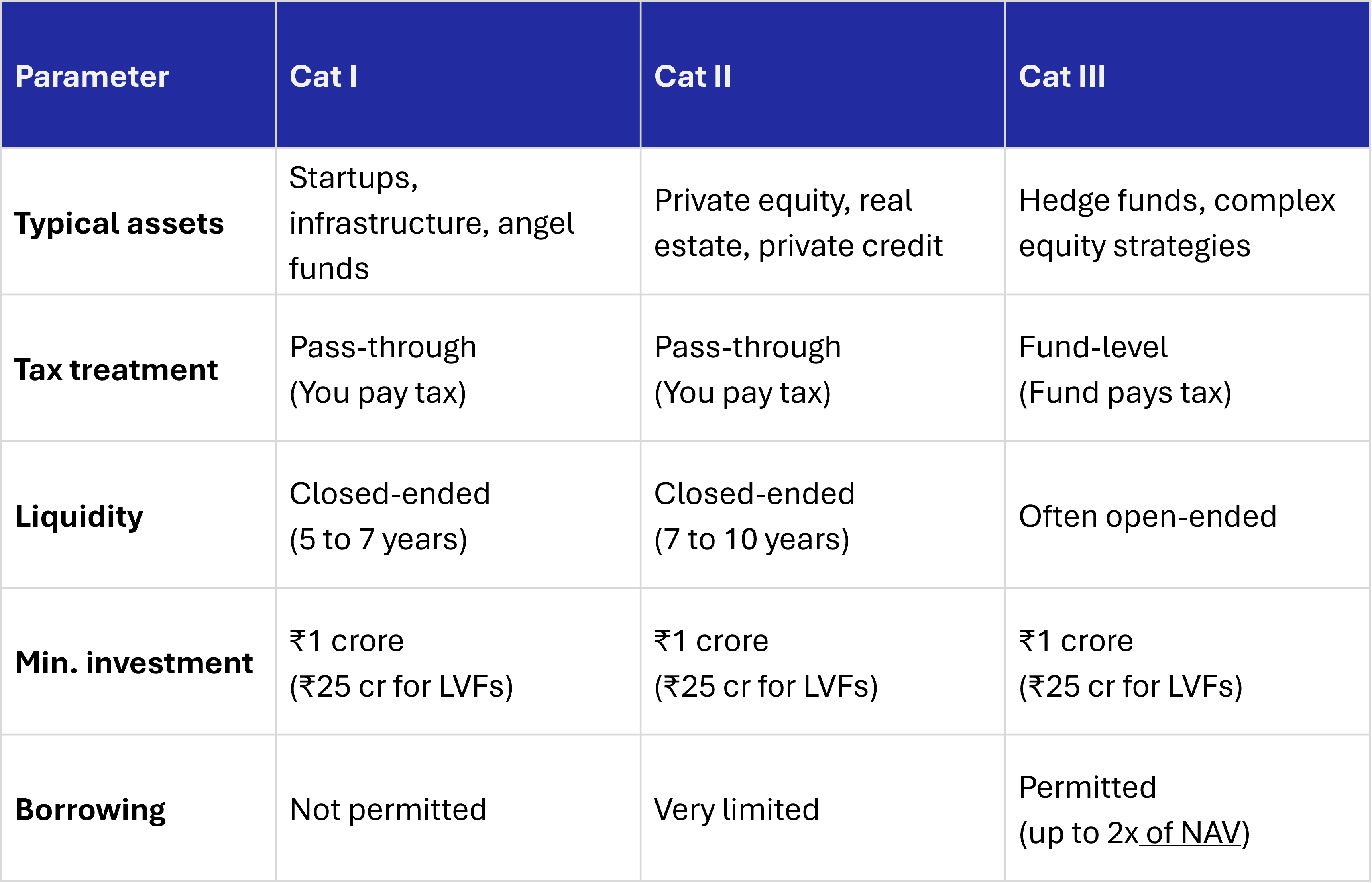
SEBI divides AIFs into three categories based on where they invest, the level of risk they take, and how they are taxed.
● Category I: These funds, called Cat I AIFs, invest in sectors that the government wants to encourage because they help the economy or society. This includes venture capital for startups, infrastructure projects, and social impact funds. As of late 2025, Angel Funds are now a distinct group within this category and are available only to accredited investors.
● Category II: Cat II AIFs are the most common type for wealthy investors. It includes private equity, real estate, and funds that lend money to businesses. These funds are "closed-ended," meaning your money is usually locked in for 7 to 10 years. They cannot borrow money to increase their investment size.
● Category III: These funds are allowed use complex trading methods, such as hedge funds or quantitative trading. Cat III AIFs can either be long-short or long-only. Unlike Category II, these are often "open-ended," meaning you might have more flexibility to enter or exit, and they are allowed to borrow money to boost their returns.
Read More: Category I vs II vs III AIFs
How Does the 2026 Tax Framework Impact My AIF Returns?
Taxation primarily depends on the AIF category, the nature of income earned, and the legal structure of the fund.
The pass-through advantage (Cat I and II)
Cat I and Cat II AIFs enjoy "pass-through" status. This means the fund itself does not pay tax on the income it earns (except for business income). Instead, the income is "passed" to you. You pay tax on it based on your own tax bracket and the type of income it is. For example, if the fund makes a profit from selling shares, you pay capital gains tax. Starting April 2026, new rules provide greater certainty regarding the characterization of the specified investment gains from these funds as capital gains, which is usually better for your taxes.
Cat III's fund-level taxation
Cat III funds usually pay tax at the fund level before the money reaches you. This tax can be high, often around 39% to 42.74%. This means the "gross return" the fund shows you might be much higher than the actual cash you receive. However, a 2025 court ruling suggested that if a fund is structured correctly, it might be able to pass on lower tax rates to investors. This is a developing area that could make Cat III funds more attractive.
The 12.5% LTCG benchmark
Since mid-2024, the tax rate for long-term capital gains (LTCG) is 12.5%. The definition of “long-term” is asset-specific: for listed equity and equity mutual funds, the holding period is more than 12 months. For most other assets, including unlisted shares, real estate, and gold, it is more than 24 months. Short-term gains on listed stocks are taxed at 20%, while other short-term gains are taxed at your regular income tax rate.
What Are the Major Regulatory Shifts in 2026 (CIV and Accredited Investors)?
The 2025 reforms brought two major changes that impact how you can invest in 2026.
Co-Investment Vehicles (CIV)
A CIV allows a Cat I or II fund to create a smaller, a separate vehicle that sits alongside the AIF for a single specific deal.[TD5.1] If you are an accredited investor, you can choose to put extra money into a specific company that the fund is investing in. These vehicles have fewer rules and lower costs than the main fund.
Large Value Funds (LVF) for Accredited Investors
The minimum investment for these specialised funds has been cut from ₹70 crore to ₹25 crore. These funds have much more flexibility. They are permitted to extend their lifespan and allocate more of their money to a single company than regular AIFs. This change makes these flexible tools available to a larger group of wealthy investors.
Real-World Example: Calculating Net Returns for a Cat II PE Fund
To understand how an AIF works in practice, let’s look at Vishal, a successful tech founder who recently sold his company.
Vishal wants to diversify his wealth, so he commits ₹2 crore to a Cat II Private Equity Fund. He doesn't write a cheque for the full amount on day one. Instead, the fund manager "calls" for money over the first three years as they find companies to buy.
At first, Vishal sees the value of his investment drop slightly because the fund is charging management fees but hasn’t sold any companies yet. This is the J-curve at work, and it is entirely normal. By year five, the fund starts selling its companies. Because it is a Cat II fund, Vishal receives the profits directly and pays the 12.5% long-term capital gains tax himself. By the end of year seven, his ₹2 crore has grown to ₹5 crore, which is a gross profit of ₹3 crore. But the real number is what he takes home after costs: a management fee of roughly 2% per year, a performance fee (carry) of 20% of profits above the hurdle rate, and his 12.5% LTCG liability. While the fund might show a 14% annual growth rate, Vishal’s actual net return works out to closer to 10–11%. It is still a significant outcome, and one built on access to private deals he could never have found on the stock market.
Visual Comparison: Cat I vs. II vs. III AIFs (2026 Guide)
What Are the Critical Liquidity and Concentration Risks in AIFs?
There are two major risks unique to these funds.
The J-curve effect
In the first few years, your investment value often declines because the fund spends money on fees and setup while the investments are still young. This is called the J-curve. Investors who get nervous and try to leave early often lose money. You must be patient to see the actual returns.
Liquidity risk and side-pocketing
You cannot easily sell your AIF investment like a stock. You are generally locked in for the full term. Also, if one of the fund's investments gets into trouble, the manager might "side-pocket" it. This means they separate the bad investment from the rest of the fund. While this protects the healthy part of your money, it means that a specific portion of your investment is stuck until the problem is resolved.
Conclusion
Alternative Investment Funds have moved from being complex, niche tools to structured pillars of a modern portfolio. The 2026 regulatory updates offer more flexibility through co-investment and lower entry points for high-value funds. While the ₹1 crore minimum remains a high bar, the improved tax clarity and transparency make these funds a strong choice for those looking beyond the standard stock market. If you have the patience to handle the seven-to-ten-year lock-in period, AIFs can offer a unique path to long-term wealth growth that is less affected by daily market swings.
At Ionic Wealth, AIFs are never positioned as a standalone product. Within the 4A Framework — Assess, Allocate, Access, Advantage — they sit firmly in the Access layer. They are curated opportunities that become meaningful only when sized correctly against the broader portfolio. Before recommending any AIF, we run a full 360° assessment of your wealth, determine the right allocation across liquidity buckets and risk bands, and then identify which fund structure (Cat I, II, or III) fits the gap. The goal is not to chase an IRR in isolation but aim to have a long term view that works in concert with everything else you own.
Frequently Asked Questions (FAQs)
Can I invest less than ₹1 crore in any AIF?
Generally, no. The floor is ₹1 crore. However, a few carve-outs exist. Employees and directors of the fund or its manager may enter at ₹25 lakh, and Accredited Investors are exempt from the ₹1 crore minimum altogether, subject to the scheme.
The deep exception is Social Impact Funds investing only in NPO securities on the Social Stock Exchange, where the individual minimum is ₹1,000. These are structured for social return, not return of capital.
Can I use AIF losses to reduce my other taxes?
For Cat I and Cat II, yes. If the fund loses money on an investment, you can often use that loss to offset gains you made elsewhere in your personal portfolio.
Is my capital called all at once?
No. The terms of capital commitment are defined in the drawdown clause. You typically commit a total amount, and the manager asks for portions of it (drawdowns) over several years as they find new companies to invest in.
How is the performance fee calculated?
Managers usually only take a performance fee if they earn you more than a "hurdle rate" (typically 8 to 10%). Once they beat that mark, they take their share of the profits.