
Why rich investors want accredited status
 AI Summary
Accredited Investor (AI) status in India grants affluent individuals exclusive access to high-value investment opportunities and regulatory flexibilities, driving significant growth in registrations.
Key Takeaways
- AI registrations have surged to over 1,300, nearly a 5x increase from 298 in March 2025, driven by regulatory actions making the license mandatory for certain funds.
- AI status unlocks exclusive access to investments like Large Value Funds (LVFs) under AIFs, PMS investments with 100% unlisted securities, Co-Investment Vehicles, and Angel Funds.
- For qualified investors (e.g., Rs 2 crore annual income or Rs 7.5 crore net worth), AI status enables lower minimum investment thresholds in certain products (e.g., Rs 25 lakh in AIFs), allowing for greater diversification and capital efficiency in sophisticated portfolios.

There are some privileges that are extended only to the affluent class.
An accredited investor (AI) license is one of them.
It gives high-net-worth individuals access to exclusive investment opportunities.
It allows them to put up a lower amount in funds with high minimum ticket size.
And are given regulatory relaxations in certain products or services falling under the purview of SEBI.
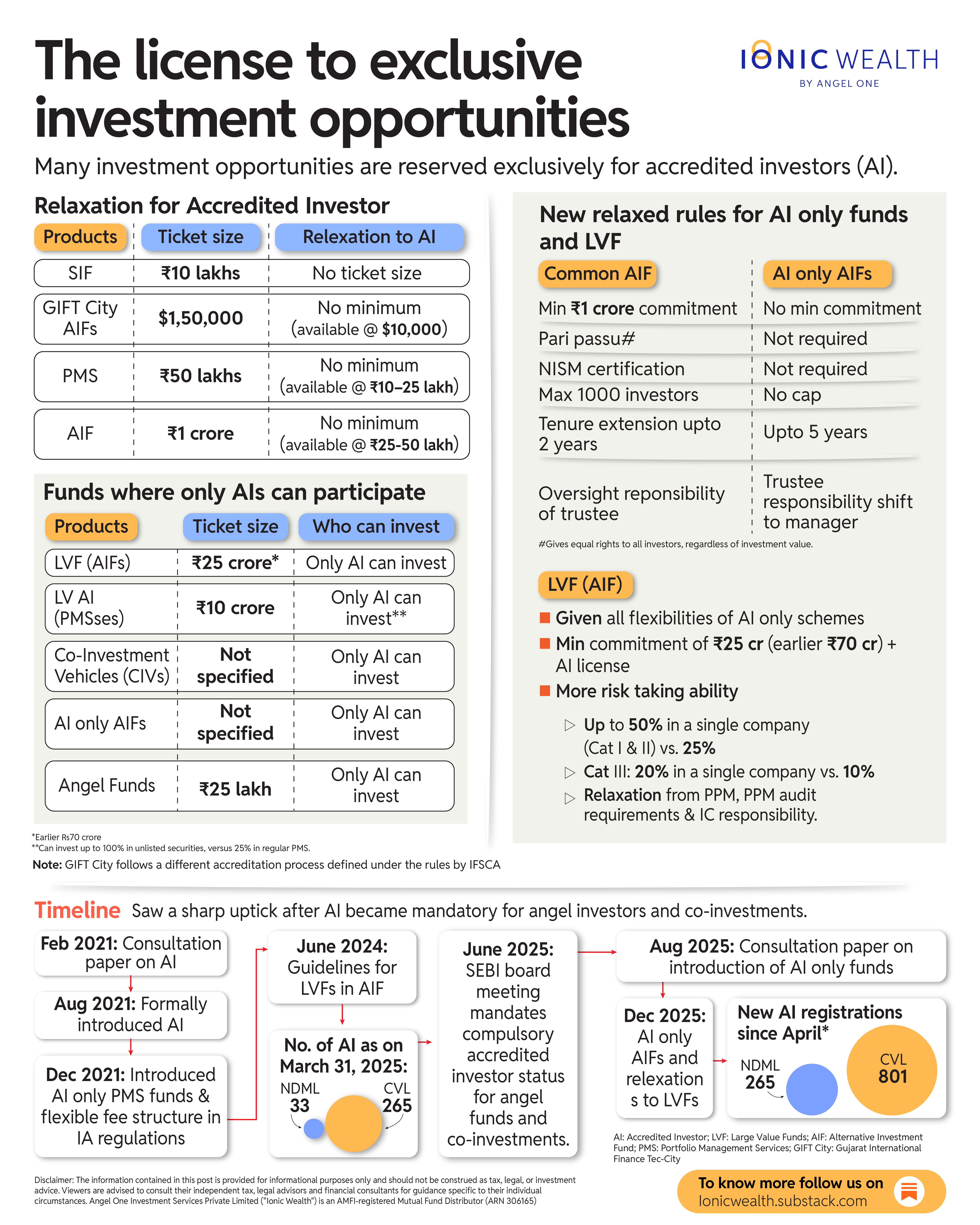
The number of AI registrations has crossed 1,300, up nearly 5x from 298 in March 2025*
Various regulatory actions to boost AI license adoption—such as making the license mandatory for angel funds and co-investments, among other things has driven the rise in registrations. (see infographic)
What’s off-limits without AI
Below are investment opportunities available only to Accredited Investors:
1) Large Value Funds (LVFs) under AIFs: These forms of investments are suited for high-net-worth individuals and ultra-high net individuals with a high-risk appetite. Unlike the regular AIFs, they can take riskier bets.
AIF LVFs have a minimum ticket size of Rs 25 crore, down from Rs 70 crore earlier. They can also take higher risk exposure compared to common AIFs. (See infographic)
2) PMS investments by an Large Value (LV): Similar to this, a large value accredited investor in a PMS can avail discretionary/non-discretionary or advisory services and allocate up to 100% in unlisted securities (vs 25% in common PMSses).
Such clients’ needs to be accredited and enter into an agreement of at least Rs 10 crore.
3) Co-Investment Vehicles (CIVs): Such vehicles allow investors in the Category 1 and category 2 AIFs to put in extra money in some companies the fund invests.
The money is routed through a Collective Investment Vehicle (CIV) scheme that is created for a specific investee company under the same umbrella AIF.
They are open only to existing investors who hold Accredited Investor (AI) status.
4) Angel Funds: Only angel investors can invest in angel funds, which invests in early startup companies. The change was recently made in the circular dated September 10, 2025, which sets out the revised framework for Angel Funds.
5) AI only Funds: The markets regulator announced the rules for a new category of alternative investment funds that will take investments only from accredited investors. Such funds will be subjected to less compliance than a typical AIF.
Reducing ticket size
Quite a few investment products have high minimum investment limit. It’s done to safeguard the interests of small investors from the high risks associated with these sophisticated products.
HNI/UHNI investors with a higher risk appetite can diversify their investments through the lower investment thresholds pursuant to the Accredited Investor certification route.
For instance, an investor having Rs 1 crore investable amount can invest in only one AIF since they have a one crore rupees minimum commitment.
If the investor has an AI license, they can spread the amount across 4 AIFs, putting Rs 25 lakh in each AIF (subject to the AIFs accepting Rs 25 lakh instead of Rs 1 crore for AI license holders).
Should you get accredited?
Accredited investor is a globally accepted concept although its implementation and rules vary across countries.
In developed markets like US, accreditation is mandatory for investing in venture capital, private equity and hedge funds. Sebi also indicated in its consultation paper on AI only AIFs that it wants to slowly move in that direction.
Requirements
Accredited investors are still a nascent concept in India. There are around 1,500 accredited investors in the country. The markets regulator is trying to find ways to improve the number of accredited investors.
To qualify for the AI license, an individual, HUF, Family Trusts or Sole Proprietorships must fulfill one of the three criteria.
On the income criteria, they need to have at least Rs 2 crore annual income.
OR
They need to have a net worth of Rs 7.5 crore with at least 3.75 crore in financial assets.
OR
Have a combined annual income of at least Rs 1 crore and net worth of Rs 5 crore but with at least ₹2.5 Cr in financial assets.
Visit this link to apply for accreditation: Here *Accredited investor registrations data source: NDML | CVL
Enjoying this article
Share it with the world!
WHAT'S
NEW
Collection of latest reads for you

US Delivers Expected Rate Hike, Reaffirms Focus on Price Sta...
Ionic Wealth Macro Desk on 17 Sept 2026
The Fed raised rates 25 bps to 3.75–4.00% in a unanimous vote, with the dot plot pointing to one more hike in 2026. Growth and jobs stay resilient, but inflation above 3% now isn't seen h...

Macro Headwinds Weigh On Market Sentiment, US Fed Decision I...
Ionic Wealth Macro Desk on 16 Sept 2026
Oil above $100/bbl. US 10Y past 5%. DMs down 1.7%, EMs down 3.4%. INR slips despite RBI support. All eyes now on the Fed's 16th September call — Ionic Wealth holds its 70:20:10 allocation...

What goes inside a AI data center?
Ionic Global Research on 15 Sept 2026
AI is transforming data centres from traditional computing facilities into massive, power-intensive infrastructure. This edition explores the rise of AI data centres, their shift from meg...
Ionic Wealth Newsletter
Investment insights
made simple
Sign up for our newsletter about wealth, markets, and more.




AMFI Registered Mutual Fund Distributor
Angel One Wealth Limited (AOWL)
CIN AOWL - U66190MH2023PLC411784
Angel One Investment Services Private Limited (AOISPL)
ARN AOISPL - 306165
CIN AOISPL - U66190MH2024PTC426203
SEBI Registered Research Analyst Number- INH000020305
Mutual fund investments are subject to market risks, read all scheme related documents carefully.
Registered Office: 601, 6th Floor, Ackruti Star, Central Road, MIDC, Chakala, Andheri (East), Mumbai - 400 093
Copyright © 2025, Ionic Wealth | All rights reserved