
When the Model Makers Build Their Own Chips
 AI Summary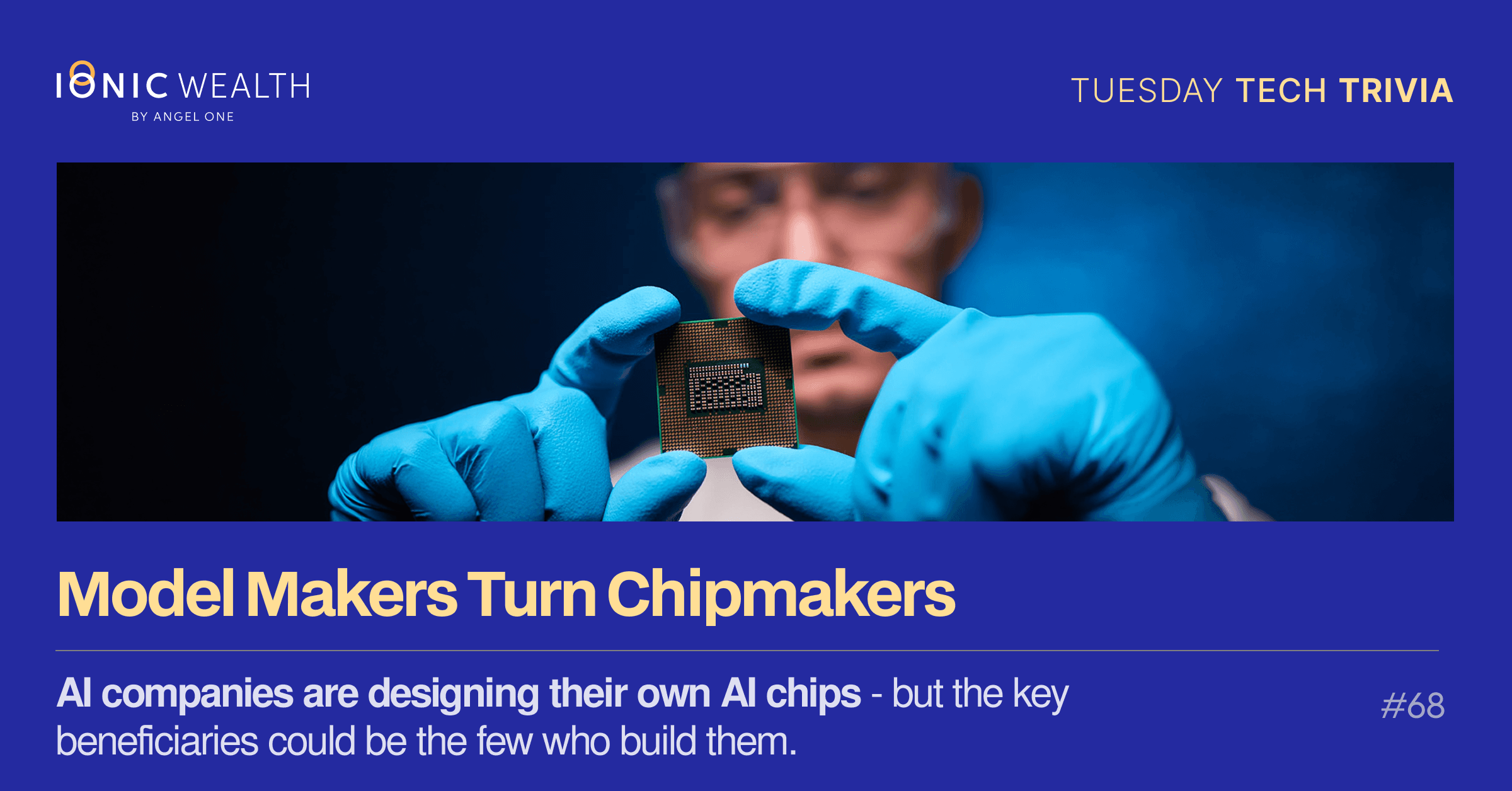
Model Makers Turn Chipmakers: AI companies are designing their own AI chips — but the key beneficiaries could be the few who build them.
The companies that build AI models are now designing their own chips. In the space of three months, three frontier labs have moved into silicon. In April, Anthropic was reported to be exploring its own chip designs. On 24 June, OpenAI and Broadcom unveiled Jalapeño, OpenAI's first custom processor, built specifically to run its models. And on 7 July, Reuters reported that China's DeepSeek is developing an inference chip of its own.
The reason is that the cost of AI has shifted from building models to running them. Training a model is an episodic investment, but inference is a perpetual operating cost — one that now shapes gross margins, response latency and pricing power. Because each company understands its own workloads better than any supplier can, it can design a chip tuned precisely to them, rather than paying for the flexibility of a general-purpose chip.
But designing a chip is not the same as building one, and that is where the value collects. None of these labs manufactures its own silicon. They depend on a small group of specialists: Broadcom and Marvell, which together handle roughly 95% of the custom AI ASIC co-design market (Broadcom sits behind OpenAI's Jalapeño, Google's TPU and Meta's MTIA; Marvell behind Amazon's Trainium and Microsoft's Maia); Taiwan's TSMC, which fabricates and packages nearly all of them and is sold out of advanced packaging through 2026.
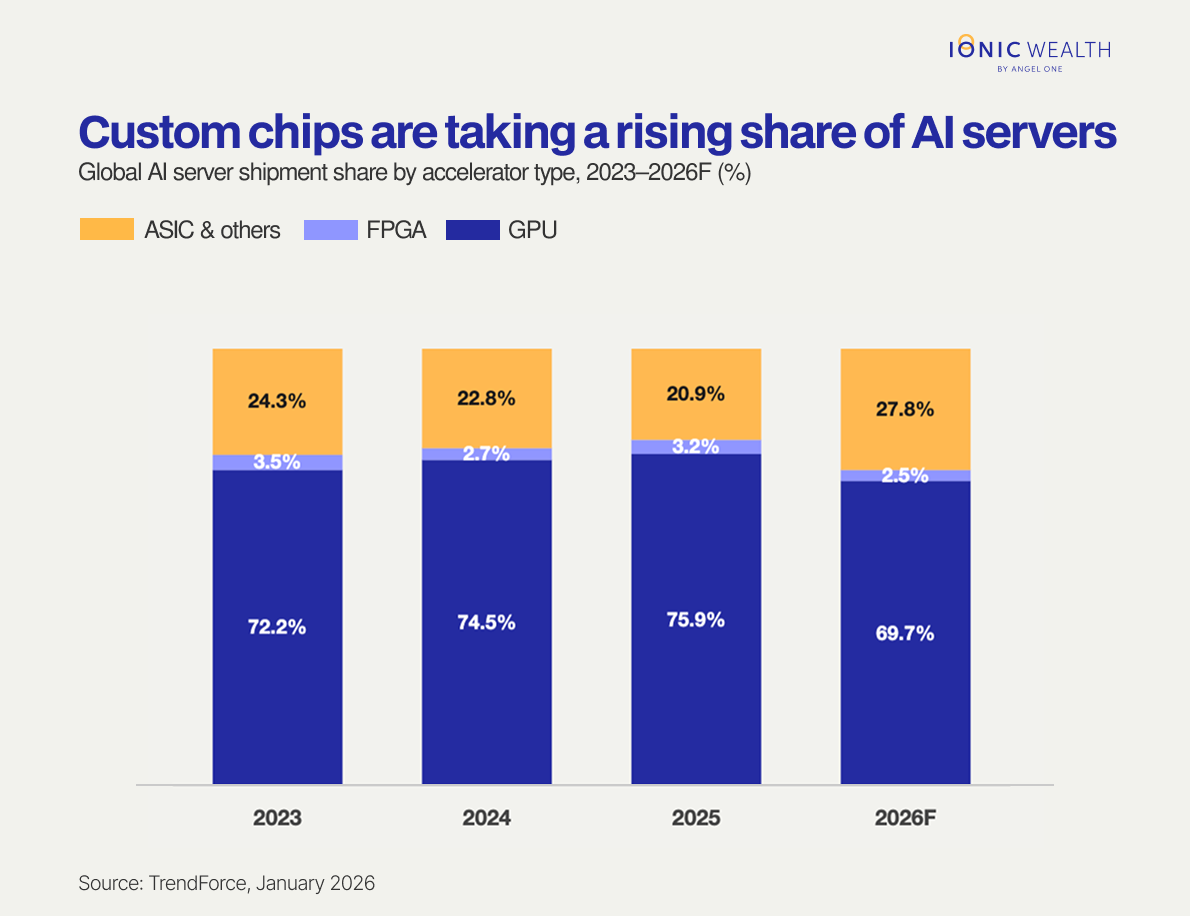
This is not the end of the general-purpose chip, but a widening of the market. Custom silicon is built to supplement, not replace: OpenAI, Meta and the others keep buying merchant GPUs by the million even as their own chips ramp. Custom accelerators are the faster-growing part, with shipments forecast to grow about 45% in 2026 against 16% for GPUs, but both are expanding. The effect is not to crown a single winning chip, but to enlarge the pool of spending that flows to those who design, build and supply them.
Ionic View
The companies at the very top of the AI stack, the model makers themselves, cannot escape their reliance on the layer beneath them: the design houses that turn an idea into a working chip, the single foundry that manufactures almost all of it, and the memory makers that inference cannot run without. As these labs integrate downwards into silicon, they deepen that dependence rather than reduce it. We continue to favor the picks-and-shovels of the AI build-out, because they are paid whichever model, labor chip design ultimately prevails.
Enjoying this article
Share it with the world!
WHAT'S
NEW
Collection of latest reads for you

From Froth to Fundamentals: The market’s shift toward qualit...
Ionic Global Research on 13 Aug 2026
Markets favoured quality and defensives in July as AI capex worries and leveraged unwinds weighed on sentiment, even as inflation stayed sticky across energy, food, tariffs and housing. W...

Private Credit in India: What Filled the Gap Banks Left
Ionic Wealth Tax Team on 10 Aug 2026
Private credit has emerged as a distinct asset class in India, filling the structural lending gap left by banks retreating from mid-market and complex project financing. Delivered mainly ...

Alternative Investments in India: A Guide Beyond Stocks and ...
Ionic Wealth Tax Team on 6 Aug 2026
A comprehensive guide to India's alternatives landscape — AIF Categories I-III, private credit, structured debt, private equity, pre-IPO investing, and REITs/InvITs — mapping regulatory f...
Ionic Wealth Newsletter
Investment insights
made simple
Sign up for our newsletter about wealth, markets, and more.




AMFI Registered Mutual Fund Distributor
Angel One Wealth Limited (AOWL)
CIN AOWL - U66190MH2023PLC411784
Angel One Investment Services Private Limited (AOISPL)
ARN AOISPL - 306165
CIN AOISPL - U66190MH2024PTC426203
SEBI Registered Research Analyst Number- INH000020305
Mutual fund investments are subject to market risks, read all scheme related documents carefully.
Registered Office: 601, 6th Floor, Ackruti Star, Central Road, MIDC, Chakala, Andheri (East), Mumbai - 400 093
Copyright © 2025, Ionic Wealth | All rights reserved