
RSU and ESOP Concentration Risk: Why a Single Stock Bet can Backfire
 AI Summary
.png&w=3840&q=75)
There is a particular confidence that comes from watching your employer's stock appreciate. You hold a meaningful position via Restricted Stock Units (RSUs) or Employee Stock Ownership Plans (ESOPs), it grows into a significant share of your portfolio, and the performance justifies your conviction.
But that’s dangerous. Not the crash, but the confidence that comes during it.
When confidence becomes risk
When you see the company doing well, your belief in the product and the vision strengthens. And you start adding more. Slowly, without you noticing, it becomes 30, 40 or even 50% of your portfolio.
With ESOPs or RSUs as part of your compensation, it's even easier to slip into this position. Because equity grants don't feel like a stock bet. They feel earned. They feel like compensation, not concentration.
For starters, ESOPs give employees the right to buy company shares at a pre-determined price (exercise price) at a later date. If the share price rises above this level, the employee benefits from the upside. RSUs, on the other hand, are granted upon meeting specific milestones or vesting conditions, after which the shares are directly credited to the employee’s demat account—without any upfront payment.
But the data doesn’t care how the stock got into your portfolio and the markets aren’t always pretty.
What History Actually Shows
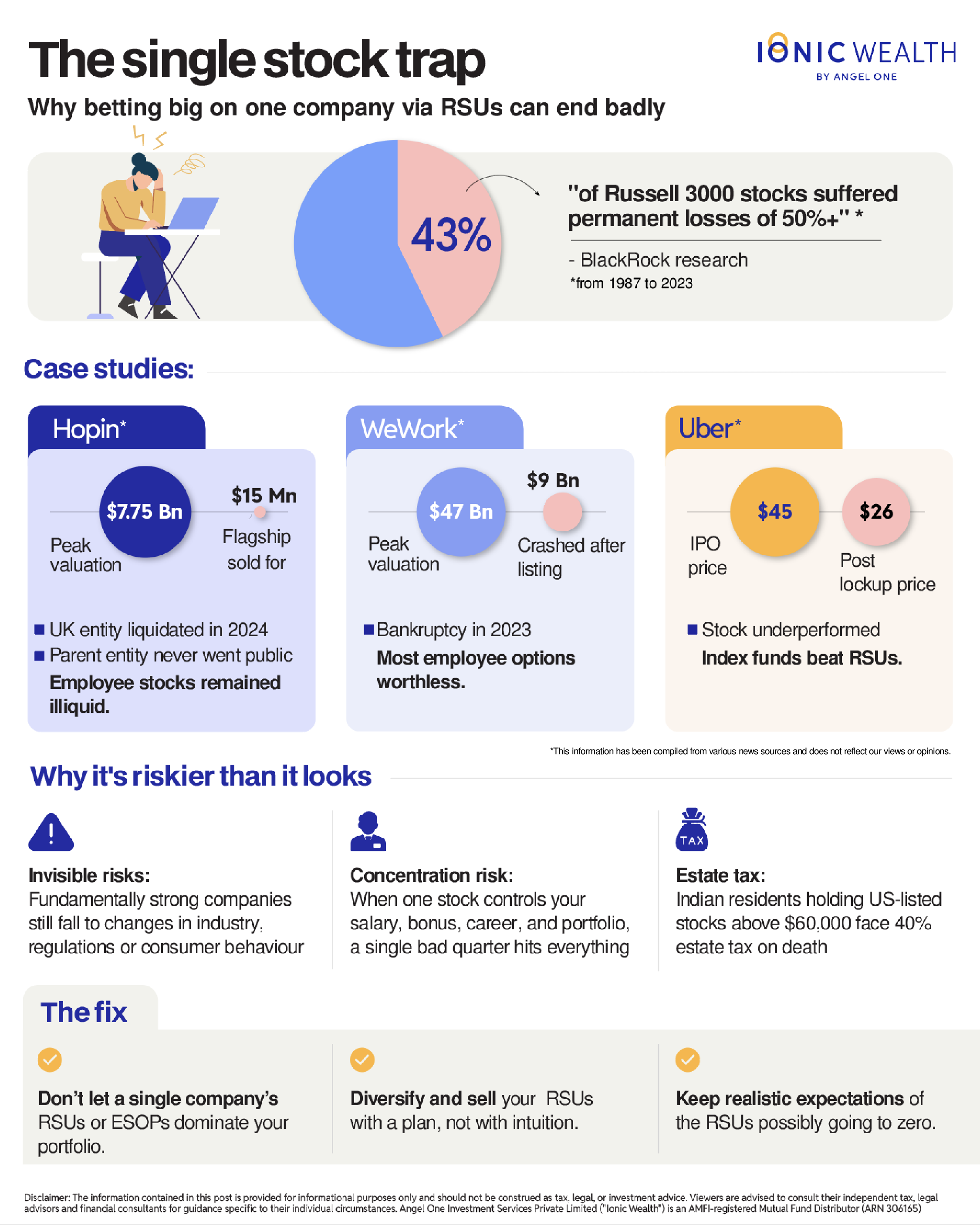
BlackRock's research, published in the Journal of Accountancy, analysed Russell 3000 stocks between 1987 and 2023. Two-thirds of individual stocks underperformed the broader index over their lifetimes. And 43% suffered a “catastrophic loss” — a decline of 50% or more from their peak, with no recovery. Not just a dip, a permanent destruction of value. Which means the lesser stocks you own, the higher is the risk of value destruction in your portfolio.
While there have been success stories of employees becoming millionaires thanks to ESOPs and RSUs, there are a lot of cases that argue against it.
Let’s look at Hopin*, a technology company that launched a virtual events platform in March 2020. At that time, Covid had shut down in-person gatherings, because of which Hopin grew at an astronomical pace. By August 2021, it had raised over $1 billion and hit a $7.75 billion valuation. Then the pandemic ended, and Hopin’s growth slowed. In August 2023, their flagship product was sold for $15 million. By February 2024, the company’s UK entity entered liquidation. The parent company restructured and never went public, so employees’ stocks stayed largely illiquid.
WeWork* - the co-working spaces startup is the more instructive case. WeWork was valued at USD 47 Bn in 2019. There are stories of WeWork employees who bought houses and took out loans to buy the company’s stock, because everyone believed that the IPO would make them rich. Then the S-1 filing went public, analysts tore it apart, and the IPO was shelved. The company eventually did go public via a merger with a Special Purpose Acquisition Company (SPAC) called BowX Acquisition Corp, but the valuation crashed to $9 billion. After a series of restructuring moves, the company filed for bankruptcy in November 2023, with a 98% drop in valuation. So while a tiny fraction of very early employees realized some modest gains, for the vast majority, WeWork equity became worthless.
And then there’s Uber* – the case that technically worked, but with a caveat. Uber went public at $45 per share in May 2019, well below the $120 billion valuation bankers had initially targeted. But by the time the six-month lockup period ended, the stock had dropped to about $26. It wasn’t exactly a wipeout, but employees who had spent years believing in their RSUs found that a simple index fund would have delivered more, with none of the lockups or tax complexity.
Why single stock exposure is riskier than most people think
The pattern across all three cases is consistent: exposure to a single stock - irrespective of the company's growth trajectory - introduces a category of risk that diversification eliminates..
Even fundamentally sound businesses are exposed to forces outside their control - regulatory changes, sectoral repricing, changes in consumer behaviour, or simply a macro environment that turns against their valuation multiple. The BlackRock data makes it clear – 43% of all Russell 3000 stocks suffered permanent catastrophic losses. These weren't all bad companies. Many were profitable, well-managed businesses that just ran into something nobody saw coming. There are things that companies themselves can’t control. Which is why over-exposure to any particular stock can become riskier than we realise.
And when when the stock you’re over-exposed to is also your employer, that risk compounds. Because your salary, your bonuses, your career growth and your investments are all tied to the performance of that one company. So if the stock drops because the company is struggling, there's a real chance that your job is at risk too. The stock, the paycheck, the future — they all move in the same direction, at the same time, for the same reasons. That's not just concentration. That's correlated concentration — and it's worse than any other kind.
Ionic View: What’s to fix
Holding your employer's stock is not the problem. The problem is holding it without a framework. Diversify well, and do it with a plan, not a feeling.
Start with a hard ceiling. Depending on your particular circumstances, identify the maximum exposure you should be taking to employer grants, for instance not more than 30% of your overall investment portfolio. Not as a target, but as a limit. If the stock price rises and your allocation crosses that threshold, that's not necessarily a win. It’s a sign to start reallocating.
Sell your RSUs on a schedule, not on conviction. The moment you start making hold or sell decisions based on how bullish you feel about the company, it stops being an investment and starts being a gamble. Identify fixed interval, quarterly or semi-annual, and liquidate a portion regardless of where the stock is trading. In public markets, this is straightforward. If you're in a private company, map out your exit windows in advance: the next buyback, any secondary sale opportunities, the eventual IPO or acquisition. Don't wait for the IPO to start thinking about this.
The difficult part about managing single-stock risk is that you might need to act against a position that’s working. Every instinct might tell you to hold, but the math will tell you to diversify.
And more often than not, the math is right.
***
A note from the Ionic team
Do you know someone who holds foreign ESOPs or RSUs? We're trying to better understand their experience — how they handle taxes, reporting, and the weight of having a large chunk of their portfolio in a single foreign stock.
If this sounds like someone in your network (or yourself), we'd appreciate you sharing this form with them.
It will take 45 seconds: Click to fill form
***
Have a look at our RSU page: Here
*This information has been compiled from various news sources and does not reflect our views or opinions.
Enjoying this article
Share it with the world!
WHAT'S
NEW
Collection of latest reads for you

Semis: 9 turns of de-rating, c.20 points of EPS accretion
Ionic Global Research on 8 Sept 2026
Semiconductor stocks just went through their sharpest valuation reset of the year, the SOXX index's forward P/E fell from roughly 29x in late June to 19.6x now, even as forward earnings e...

Asset X | September 2026: Key Signals Across Asset Classes
Ionic Wealth Macro Desk on 8 Sept 2026
Domestic equities stay resilient on strong earnings and attractive valuations, while global markets remain volatile on rate uncertainty and AI capex concerns. Fixed income holds firm on R...

Gold ETFs vs. EGR vs. Physical Gold: Best Way to Invest in G...
Ionic Wealth Tax Team on 7 Sept 2026
Physical gold's non-refundable GST, elevated customs duty and storage costs quietly erode HNI portfolios — while EGRs offer a SEBI-regulated middle path: exchange-traded liquidity with th...
Ionic Wealth Newsletter
Investment insights
made simple
Sign up for our newsletter about wealth, markets, and more.




AMFI Registered Mutual Fund Distributor
Angel One Wealth Limited (AOWL)
CIN AOWL - U66190MH2023PLC411784
Angel One Investment Services Private Limited (AOISPL)
ARN AOISPL - 306165
CIN AOISPL - U66190MH2024PTC426203
SEBI Registered Research Analyst Number- INH000020305
Mutual fund investments are subject to market risks, read all scheme related documents carefully.
Registered Office: 601, 6th Floor, Ackruti Star, Central Road, MIDC, Chakala, Andheri (East), Mumbai - 400 093
Copyright © 2025, Ionic Wealth | All rights reserved