
Inflation Risks Rise, RBI Keeps Repo Rate Unchanged For Now
 AI Summary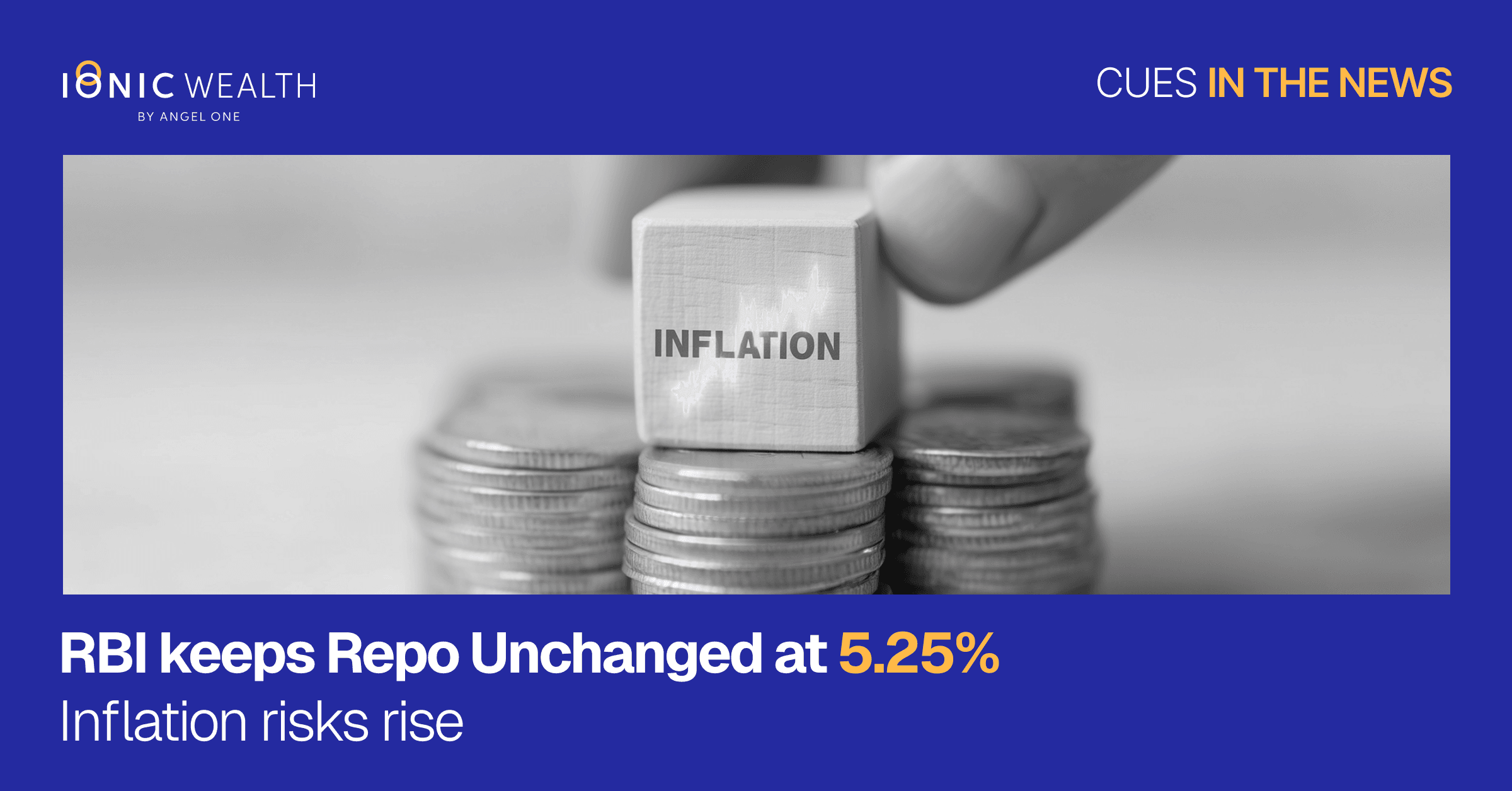
The RBI MPC unanimously voted to keep the policy rate unchanged at 5.25%. The committee also maintained its stance as neutral. The US–Iran conflict has persisted longer than initially anticipated, and each additional week of delayed peace negotiations is exacerbating disruptions to global supply chains, increasing logistical bottlenecks, input costs, and inflationary pressures worldwide. India, a major importer of oil, remains vulnerable at this point, with inflation risks rising sharply over the next few quarters.
Global Macro Risks Cast a Shadow On Domestic Growth Outlook for FY27 as Inflation Risks Amplify
Domestic growth so far has been steady, supported by healthy domestic private consumption and still strong fixed investments. However, the impact of the ongoing war could afect domestic growth adversely especially if the situation continues for a prolonged time. Reflecting these concerns, RBI now expects GDP growth to be around 6.6% in FY27, down from 6.9% estimated in April 2026 policy.
Inflationary pressures globally continue to mount amid elevated oil prices along with weather related risks that could put upward pressure on food inflation. India faces a dual inflation challenge: rising global and domestic prices, compounded by imported inflation from a depreciating currency. Given increased risks to the inflation outlook, RBI has revised CPI inflation projection for FY27 to 5.1%, above RBI’s target of 4.0%- 50 bps higher than the April 2026 estimate.
Measures To Attract Foreign Capital- Positive For INR and G-Secs
The RBI, in coordination with the Central Government, has announced a broad set of measures to attract foreign capital and support the INR. By providing concessional forex swaps for PSUs raising ECBs and fully absorbing hedging costs for AD banks mobilizing 3–5 year FCNR(B) deposits until September 2026, the RBI is encouraging faster USD inflows into the economy.
At the same time, the expansion of the Fully Accessible Route (FAR) to new 15Y, 30Y, and 40Y g-secs, the relaxation of investment limits under the general route, and the removal of taxes on interest income and capital gains for FPIs investing in g-secs significantly improve the attractiveness of Indian debt markets. Together, these measures are expected to boost foreign participation in government bonds, support softer bond yields, and help stabilize the INR amid an uncertain global environment.
Ionic Wealth View
RBI has indicated that -
a) inflation concerns are more driven by global supply-side factors and raising domestic rates are unlikely to curb inflation pressures in the short-term
b) growth slowdown is inevitable, revising down FY27 growth from 6.9% to 6.6%.
However, we believe all eyes will be on US FOMC later this month, if US moves to a tightening bias, EM central banks are unlikely to have much choice especially when other DMs including EU and Japan are also expected to hike rates in the upcoming policy. Food inflation and worries around El Niño and fertiliser costs are also very justified.
The intent to stabilize INR movement and garner foreign capital is evident with array of measures announced in a coordinated efort by the RBI and the Central Government. Both INR and G-Sec yields have reacted positively to the measures. A more stable rupee would also help contain imported inflation, a key driver of rising domestic inflation expectations. Rate hike remains on the card in the H2 of the year but would be highly dependent on timelines of termination of war, domestic crop output and other central bank actions.
(Source: RBI)
Enjoying this article
Share it with the world!
WHAT'S
NEW
Collection of latest reads for you

Resilience Amid Uncertainty: Global Markets Regained Some St...
Ionic Global Research on 11 Sept 2026
Emerging markets led a broad August rebound as resilient earnings offset AI-return jitters and Fed rate-hike risk, with large caps and defensives outperforming small caps. The Pantheon re...

ECB Hikes Rate To 2.50%, War Driven Inflation Takes Priority
Ionic Wealth Macro Desk on 11 Sept 2026
ECB delivers its second 25-bps hike of 2026, pushing the deposit rate to 2.50% as an energy-led inflation spike (3.3% in August) overshadows a modest growth upgrade. Lagarde signals infla...

Semis: 9 turns of de-rating, c.20 points of EPS accretion
Ionic Global Research on 8 Sept 2026
Semiconductor stocks just went through their sharpest valuation reset of the year, the SOXX index's forward P/E fell from roughly 29x in late June to 19.6x now, even as forward earnings e...
Ionic Wealth Newsletter
Investment insights
made simple
Sign up for our newsletter about wealth, markets, and more.




AMFI Registered Mutual Fund Distributor
Angel One Wealth Limited (AOWL)
CIN AOWL - U66190MH2023PLC411784
Angel One Investment Services Private Limited (AOISPL)
ARN AOISPL - 306165
CIN AOISPL - U66190MH2024PTC426203
SEBI Registered Research Analyst Number- INH000020305
Mutual fund investments are subject to market risks, read all scheme related documents carefully.
Registered Office: 601, 6th Floor, Ackruti Star, Central Road, MIDC, Chakala, Andheri (East), Mumbai - 400 093
Copyright © 2025, Ionic Wealth | All rights reserved