
Charged and Ready: China's EV Giants Are Coming for Every Market
 AI Summary
.png&w=3840&q=75)
500k EVs in a single month. Europe just crossed the line: And Chinese OEMs are taking 18% of the global pie.
China's EV industry just survived its most brutal consolidation phase. The winners came out leaner, sharper, and hungry for the world. Europe crossed half a million EV sales in a single month for the first time ever in Mar’26 growing 37% yoy. And it wasn't climate policy that did it. It was the energy shocks. The result is a behavioural shift that energy economists have long predicted: when fuel becomes expensive and uncertain, alternatives suddenly look not just viable, but necessary.
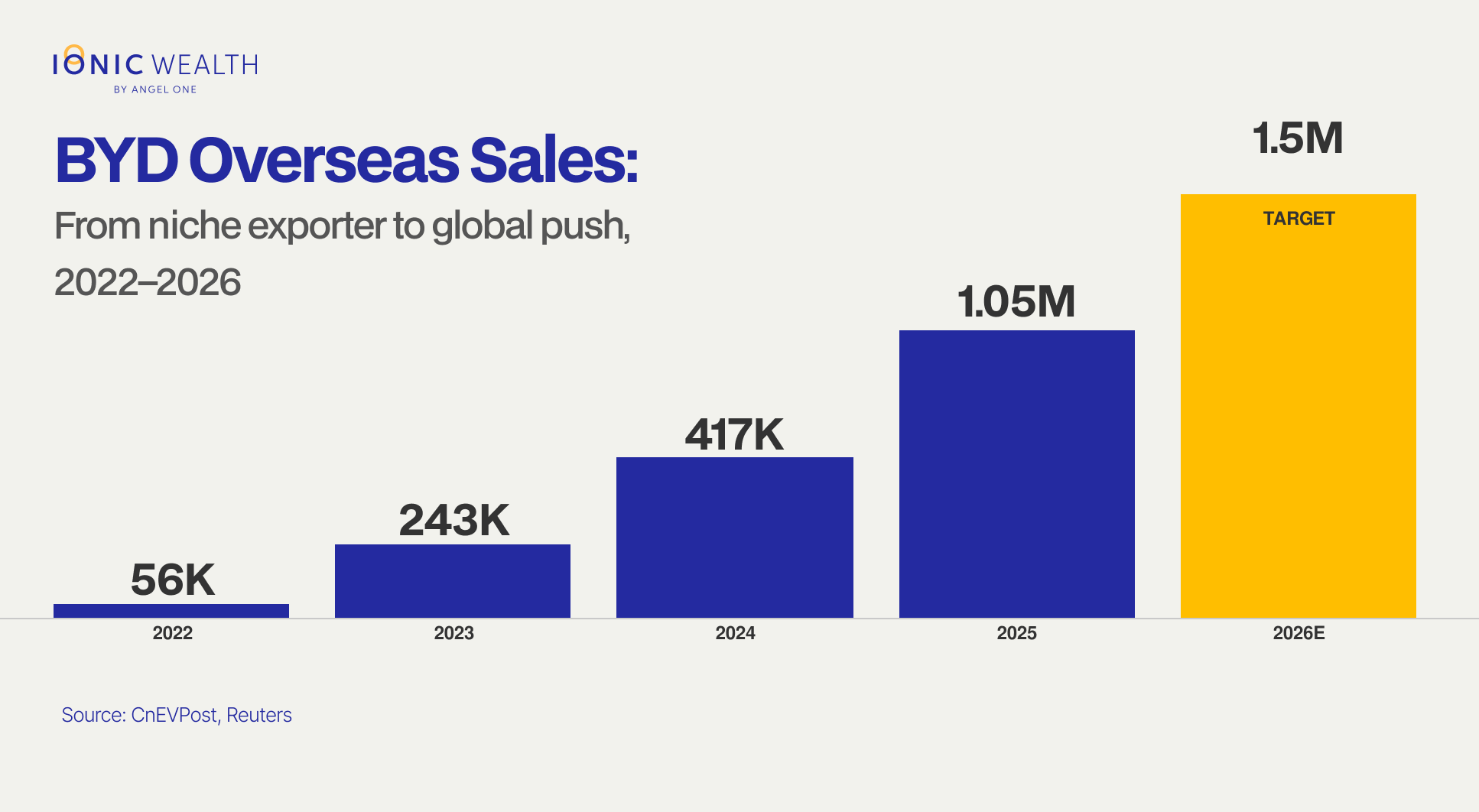
Chinese manufacturers are the ones capitalizing on this trend. Last year, BYD had clocked 4.6 Mn cars total, making it more than BMW and Mercedes combined. In March alone, BYD exported ~120K vehicles, up 65% yoy. Their Hungary factory kicks into full series production this quarter which should roughly 300K units a year, built inside the EU, tariff-free. They're not importing anymore, they're local.
Then there's the battery race. CATL held a Super Tech Day on April 21st and came out swinging. Their new Shenxing LFP charges from 10% to 98% in 6 min 27 s. They also went commercial with their sodium-ion technology recently having signed the world’s largest sodium ion order on 27 Apr’26. With a commitment to deliver 60 GWh over 3 years, this single order exceeds all of their entire 2025 energy storage volume.
Key Takeaways
Europe Inflects: 500K+ EV sales in a single month for the first time. Energy price volatility is now the most powerful adoption catalyst on the planet.
China Leads: Chinese OEMs now hold around 18% of global EV market share.
Tariff Wall Falls: EU-local assembly in Hungary removes the 27% import tariff. Chinese OEMs have stopped being import risks. They're permanent local competitors now.
Battery Arms Race: CATL's 6-minute charge and 60 GWh sodium-ion deal sets a new industry benchmark. BYD and CATL are competing to define the next generation of EV economics.
Ionic View
Today, over 80% of solar panels sold in Europe come from China. The European solar industry has practically disappeared. That took less than 10 years. With EVs, China is running the same playbook.
Geopolitical energy shocks may continue to accelerate adoption. Sodium-ion commercialisation could structurally lower battery costs and help mitigate input cost risks tied to lithium price volatility. CATL's 60 GWh deal this week may be read as a strong signal that this chemistry is approaching commercial scale.
BYD is expanding its global production footprint. CATL is innovating faster. Together, they're not just winning a technology race. CATL and BYD's progress points to China's strong positioning across the EV landscape, including the battery manufacturing cycle."
Enjoying this article
Share it with the world!
WHAT'S
NEW
Collection of latest reads for you

Semis: 9 turns of de-rating, c.20 points of EPS accretion
Ionic Global Research on 8 Sept 2026
Semiconductor stocks just went through their sharpest valuation reset of the year, the SOXX index's forward P/E fell from roughly 29x in late June to 19.6x now, even as forward earnings e...

Asset X | September 2026: Key Signals Across Asset Classes
Ionic Wealth Macro Desk on 8 Sept 2026
Domestic equities stay resilient on strong earnings and attractive valuations, while global markets remain volatile on rate uncertainty and AI capex concerns. Fixed income holds firm on R...

Gold ETFs vs. EGR vs. Physical Gold: Best Way to Invest in G...
Ionic Wealth Tax Team on 7 Sept 2026
Physical gold's non-refundable GST, elevated customs duty and storage costs quietly erode HNI portfolios — while EGRs offer a SEBI-regulated middle path: exchange-traded liquidity with th...
Ionic Wealth Newsletter
Investment insights
made simple
Sign up for our newsletter about wealth, markets, and more.




AMFI Registered Mutual Fund Distributor
Angel One Wealth Limited (AOWL)
CIN AOWL - U66190MH2023PLC411784
Angel One Investment Services Private Limited (AOISPL)
ARN AOISPL - 306165
CIN AOISPL - U66190MH2024PTC426203
SEBI Registered Research Analyst Number- INH000020305
Mutual fund investments are subject to market risks, read all scheme related documents carefully.
Registered Office: 601, 6th Floor, Ackruti Star, Central Road, MIDC, Chakala, Andheri (East), Mumbai - 400 093
Copyright © 2025, Ionic Wealth | All rights reserved