



Asset X | March 2026: Multi-Asset Signals for a World of Heightened Uncertainty

Updated 29 May 2026•4 min read

Markets rarely offer clean setups, and March 2026 is no exception.
Domestic fundamentals are quietly improving; earnings are reviving, macro indicators are turning, and the India-US trade deal provides a meaningful tailwind. But the Middle East crisis is an active headwind that warrants respect, not panic. Our view this month reflects exactly that: conviction on the medium-term thesis, discipline on near-term execution.
Here is how we are reading each asset class, and what factors investors may want to consider.
EQUITIES
The domestic picture is genuinely improving on the margin. Two-wheeler sales clocked 24.9% YoY growth in January 2026, tractor sales hit 40.1% YoY, both pointing to rural recovery. Bank credit growth is running at 14.6% YoY, and systemic liquidity has surged to INR 1,617 Bn in a comfortable surplus. Earnings recovery is visible, not just narrative.
The complication: India imports ~2.6 million barrels of crude per day, roughly 50% of which transits through the Strait of Hormuz. A sustained escalation in the Middle East could directly impact our inflation outlook, CAD, and the room the RBI has to cut rates further. Our scenario analysis suggests that if Brent averages $100/bbl through FY27, CPI could climb to 5.7% and real GDP growth may compress to 6.0%, meaningfully below a base case of 7.0% at $75/bbl. This is not a tail risk; it is the range worth planning for.
Our view: Within equities, a 75:25 split between domestic and global equity may look like a reasonable construct at this point. Within global, a 60:40 tilt towards Developed Markets (including the US) over EMs ex-India could be worth evaluating. Fresh allocations may benefit from a staggered approach; not because the thesis is weak, but because entry discipline matters when geopolitical volatility can swing prices sharply.
On factor positioning: our analysis points towards a positive bias for Value, with a neutral stance on both Momentum and Low Volatility. Momentum has seen a short-term reversal and may need a sustained directional market to rebuild. Low Volatility could be considered purely as a portfolio hedge rather than a return driver.
COMMODITIES: PRECIOUS METALS
Gold is above USD 5,100/oz as of today, with ETF holdings at 4,725 metric tonnes, crossing previous all-time highs. The investment thesis remains supported: safe-haven flows, central bank accumulation, and a structurally weak dollar environment.
Silver's story is more nuanced. The Gold/Silver ratio currently stands at 56.3, below its long-period average of 60.3, meaning silver has outperformed gold on a relative basis. However, silver's industrial demand sensitivity makes it inherently more volatile during risk-off episodes.
Our view: New positions in precious metals may look reasonable with an 85:15 allocation towards Gold over Silver, both on a staggered basis. Given gold's sharp recent move, averaging in over multiple tranches could help manage entry risk more effectively than a lump-sum approach.
CURRENCY: INR
The INR has depreciated 4.3% on a 1-year basis and remains among the weaker-performing EM currencies. The India-US trade deal has provided some support, but Middle East-driven oil price risk and FPI caution continue to create headwinds. Notably, USD and INR are both under pressure simultaneously; this is an unusual co-depreciation dynamic worth monitoring.
Our view: INR may broadly remain in the 88–92 range. Short-term volatility could persist.
ALTERNATES: PRIVATE EQUITY & COMMERCIAL REAL ESTATE
PE markets appear to be entering a more selective, quality-driven phase. Late-stage and VC rounds dominate current flows; IT & ITES leads industry-wise fundraising at $603M in January 2026 alone. Exit activity has moderated, with IPO windows remaining uncertain; near-term realisations may come primarily through sponsor-to-sponsor deals and strategic sales.
Commercial Real Estate continues to look like one of the stronger structural calls in the alternates space. Pan-India office leasing reached 48.9 million sq ft in H1 2025, up 41% YoY. Vacancy levels have declined steadily to 14.7% in H1 2025, and rentals have moved up 5% YoY. Bengaluru and Delhi NCR may look more favourable than other markets; Kolkata, Ahmedabad, and Hyderabad warrant a more cautious view at this point.
FOR LRS INVESTORS: GLOBAL DEPLOYMENT FRAMEWORK
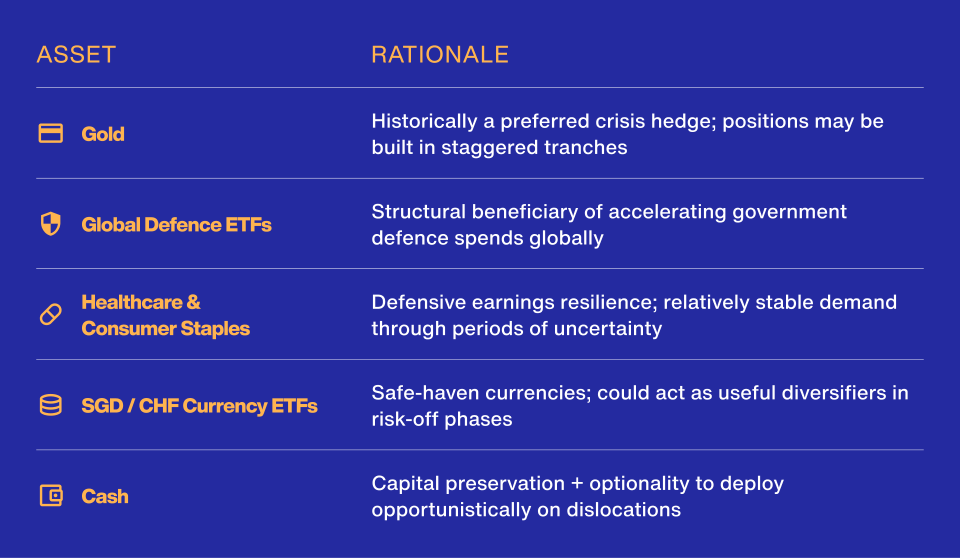
For clients deploying under the Liberalised Remittance Scheme, the current environment may call for a defence-first orientation in global allocation:
IN SUMMARY
The medium-term India story remains on track, with improving macros, reviving earnings, and favourable trade deal resolutions. What may have shifted is the tactical overlay: the Middle East crisis warrants a more staggered, measured approach to fresh allocations across most asset classes. This may not be the environment for aggressive deployment, but it could well be the right time to ensure portfolios are positioned sensibly across assets - domestic and global - for when visibility improves.
Link to the full report: Here
This communication is for informational purposes only and does not constitute investment advice. Please refer to the full disclaimer in the Asset X report dated March 5, 2026.